Claim · model-written summary
Plant inoculation with bacteria did not affect aphid performance.
- Taxon
- Jacobaea vulgaris
 Jacobaea vulgarise2
- Treatment
- Inoculation of the plants with bacteriae0
- Interactor
- Aphis jacobaeae
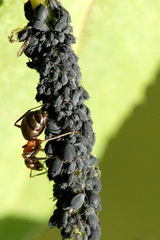 Aphis jacobaeaee1herbivore
- Outcome
- aphid performancee0
- Direction
- did not affecte0
Not reportedMaterialGeneCompoundOrgan / stageSecond interactorSecond interactor roleComparatorSettingValueQualifier
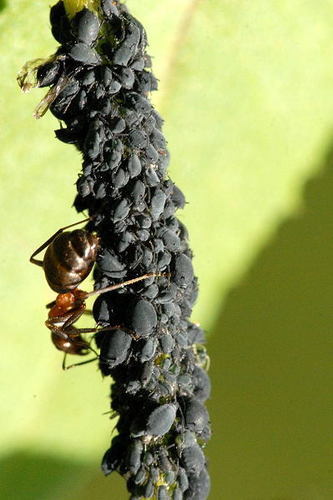
Organisms pictured · Representative pictures of the matched species, not figures from the paper.

Verbatim
e0“Inoculation of the plants with bacteria did not affect aphid performance”
e1“the aphid species Aphis jacobaeae”
e2“Jacobaea vulgaris is an invasive weed”
Title
Exploring the potential of root-associated bacteria to control an outbreak weed
Xiangyu Liu; Klaas Vrieling; Sofia I. F. Gomes; et al. Plant and Soil 2024. doi:10.1007/s11104-024-06726-3
Other claims from this paper (10)
- Intervention effect Pseudomonas brassicacearum significantly reduced J. vulgaris seedling root growth.
- Intervention effect Serratia plymuthica significantly reduced J. vulgaris seedling root growth.
- Intervention effect Bacterial treatment left seed germination unaffected.
- Observation The negative bacterial effects also occurred across other forb species.
- Intervention effect Bacillus injection led to the highest Tyria jacobaeae caterpillar mortality.
- Intervention effect Ingestion of Bacillus had no effect on T. jacobaeae caterpillars.
- Intervention effect Bacterial inoculation significantly affected T. jacobaeae preference.
- Intervention effect P. syringae increased T. jacobaeae preference significantly.
- Intervention effect A Bacillus strain increased T. jacobaeae preference significantly.
- Recommendation Lack of host specificity restricts the two root bacteria for biocontrol.