Claim · model-written summary
Bacterial masses oozed from crosscut stems of diseased plants.
- Taxon
- Cucurbita maxima
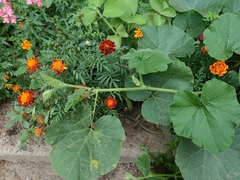 Cucurbita maximat0
- Organ / stage
- stemse0
- Outcome
- Creamy-whitish bacterial masses were observed to oozee0
Not reportedMaterialGeneCompoundInteractorInteractor roleSecond interactorSecond interactor roleTreatmentComparatorSettingDirectionValueQualifier
Organisms pictured · Representative pictures of the matched species, not figures from the paper.

Verbatim
e0“Creamy-whitish bacterial masses were observed to ooze from crosscut stems of these diseased plants”
t0“Cucurbita maxima”
Title
Xiaoman She; Lin Yu; Guobing Lan; et al. Frontiers in Plant Science 2017. doi:10.3389/fpls.2017.01794
Other claims from this paper (12)
- Observation Bacterial wilt was observed on Cucurbita maxima in Guangdong.
- Observation Diseased plants developed wilting, dark brown vasculature and death.
- Observation Ralstonia solanacearum caused Cucurbita maxima bacterial wilt.
- Observation The 24 isolates were phylotype I, race 1.
- Observation Eight isolates were biovar 3.
- Observation Sixteen isolates were biovar 4.
- Observation The isolates clustered in sequevars 17, 45 and 56.
- Observation Sequevar 56 was newly described.
- Observation Xiangyu1 was resistant to RS378.
- Observation Xiangmi was moderately resistant to RS378.
- Observation Nineteen other pumpkin cultivars were susceptible to RS378.
- Observation This was the first reported C. maxima wilt caused by R. solanacearum race 1 worldwide.