Claim · model-written summary
Butachlor (400 ppm) gave high inhibition (97.1%) of the test pathogen compared with oxadiargyl.
- Taxon
- rice
 Oryza sativat0
- Treatment
- Butachlor (400 ppm)e1
- Interactor
- S. oryzae
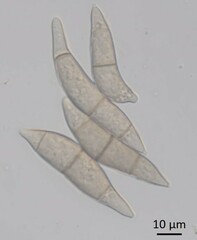 Nakataea oryzaee2pathogen
- Outcome
- inhibition of test pathogene1
- Direction
- highe1
- Value
- 97.1%e1
- Qualifier
- 28.0%e1
- Comparator
- Oxadiargyl (150 ppm)e1
Not reportedMaterialGeneCompoundOrgan / stageSecond interactorSecond interactor roleSetting
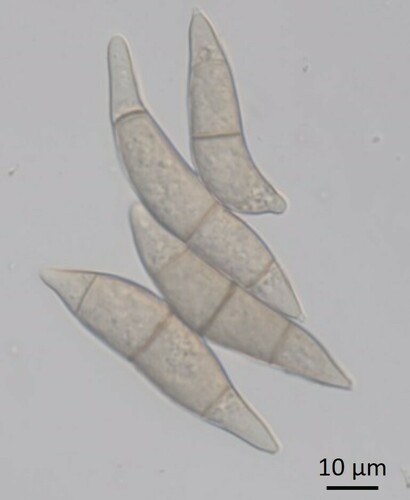
Organisms pictured · Representative pictures of the matched species, not figures from the paper.

Verbatim
t0“stem rot of rice (Sclerotium oryzae)”
e1“Out of two herbicides tested, the inhibition of test pathogen was high (97.1%) in Butachlor (400 ppm) and least (28.0%) in Oxadiargyl (150 ppm)”
e2“were found to be antagonistic to test pathogen S. oryzae”
Title
K. GOPIKA; R. JAGADEESHWAR AGRICULTURE UPDATE 2017. doi:10.15740/has/au/12.techsear(7)2017/2077-2087
Other claims from this paper (17)
- Observation Stem rot incidence in rice varied from 0 to 15% between surveyed fields in Telangana.
- Intervention effect Stem rot incidence was highest in late-transplanted rice compared with early-transplanted rice.
- Association Maximum stem rot incidence (14.8%) occurred in rice-rice cropping compared with rice-groundnut.
- Association Stem rot incidence was lower in rice-groundnut cropping than in rice-rice cropping.
- Association Stem rot incidence was lower in rice-maize cropping than in rice-rice cropping.
- Association Stem rot incidence was highest in clay loam soils compared with clay soils.
- Association Stem rot incidence was lowest in sandy soils.
- Association Stem rot incidence was highest (11.1%) with 151-180 kg N per ha.
- Association Stem rot incidence was highest in fields treated with pretilachlor compared with butachlor.
- Observation Mycoflora and bacteria were isolated from rhizosphere soil of diseased rice plants.
- Intervention effect Trichoderma viride (T1) showed maximum inhibition (75.3%) of the test pathogen S. oryzae in dual culture.
- Intervention effect Pseudomonas fluorescens (BI-1) was highly effective in inhibiting the test pathogen S. oryzae (77.2%) in dual culture.
- Observation P. fluorescens inhibited T. viride growth by 5.0% in compatibility tests.
- Observation No inhibition of P. fluorescens growth by T. viride was observed in compatibility tests.
- Intervention effect Hexaconazole at 200 ppm completely inhibited S. oryzae in poisoned medium.
- Intervention effect Propiconazole at 100 ppm completely inhibited S. oryzae in poisoned medium.
- Intervention effect Trichoderma viride was incompatible with propiconazole (100 ppm) and hexaconazole (200 ppm).