Claim · model-written summary
The abstract reports decreased acidity in C. maxima, primarily driven by malic acid, while also reporting an increase for the same species.
- Taxon
- C. maxima
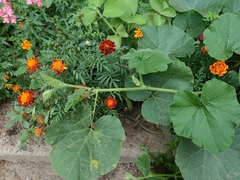 Cucurbita maximae0
- Compound
- malic acide0
- Outcome
- aciditye0
- Direction
- decreasede0
- Qualifier
- but increased in C. maximae0
Not reportedMaterialGeneOrgan / stageInteractorInteractor roleSecond interactorSecond interactor roleTreatmentComparatorSettingValue
Organisms pictured · Representative pictures of the matched species, not figures from the paper.

Schema note from the model: The species attribution contradicts itself.
Verbatim
e0“Additionally, acidity, primarily driven by malic acid, decreased in C. maxima but increased in C. maxima.”
Title
Yingchao Xu; Manman Wang; Hafiz Muhammad Khalid Abbas; et al. Food Chemistry X 2024. doi:10.1016/j.fochx.2024.101383
Other claims from this paper (10)
- Observation Sucrose and carotenoid contents increased in C. moschata during storage.
- Observation Sucrose and carotenoid contents initially increased and then decreased in C. maxima.
- Observation The same acidity sentence also reports increased acidity in C. maxima.
- Observation C. moschata starch content peaked at 30 days postharvest.
- Observation C. maxima starch content peaked at 20 days postharvest.
- Association DPPH scavenging activity correlated with carotenoid content in C. moschata.
- Association DPPH scavenging activity correlated with carotenoid content in C. maxima.
- Observation C. moschata showed improved nutrition and quality at 20–30 days postharvest.
- Observation C. maxima showed higher commercial suitability at 10–20 days postharvest.
- Recommendation The authors conclude that pumpkin storage is crucial for quality improvement.