Abstract
Treating styroblock containers in hot water (68°C) with a very dilute bleach and detergent solution effectively reduced populations of Fusarium and Cylindrocarpon spp., two potential root pathogens of containerized conifer seedlings. However, the treatment did not significantly reduce levels of Phoma (another potential pathogen) nor saprophytic Penicillium and Alternaria spp. The treatment also eliminated Fusarium and Cylindrocarpon spp. from pieces of seedling roots which had penetrated walls of container cells. This cleaning technique will be used in the future at the Champion Timberlands Nursery, Plains, Montana.
Abstract from the paper’s OpenAlex record, shown for indexing and research. Copyright remains with the authors or the publisher. Read at the source ↗
The text the model read, with the source record’s inline markup (italics, sub- and superscripts) rendered and its character entities decoded; quote offsets refer to the raw text.
Claims 8
Claim · model-written summary
Hot water, bleach and detergent reduced Fusarium populations in styroblock containers.
- Taxon
- conifer seedlingse0
- Treatment
- hot water (68°C) with a very dilute bleach and detergent solutione0
- Outcome
- populations of Fusariume0
- Direction
- reducede0
 Fusarium
Not reportedComparator
Organisms pictured · Representative pictures of the matched species, not figures from the paper.

Verbatim
e0“Treating styroblock containers in hot water (68°C) with a very dilute bleach and detergent solution effectively reduced populations of Fusarium and Cylindrocarpon spp., two potential root pathogens of containerized conifer seedlings.”
Claim · model-written summary
The treatment reduced Cylindrocarpon populations in containers.
- Taxon
- conifer seedlingse0
- Treatment
- hot water (68°C) with a very dilute bleach and detergent solutione0
- Interactor
- Cylindrocarpon spp.Cylindrocarpone0pathogen
- Outcome
- populations of Fusarium and Cylindrocarpon spp.e0
- Direction
- reducede0
Not reportedComparator
Verbatim
e0“Treating styroblock containers in hot water (68°C) with a very dilute bleach and detergent solution effectively reduced populations of Fusarium and Cylindrocarpon spp., two potential root pathogens of containerized conifer seedlings.”
Claim · model-written summary
The treatment did not significantly reduce Phoma levels.
- Taxon
- conifer seedlingse1
- Treatment
- the treatmente0
- Outcome
- levels of Phomae0
- Direction
- did not significantly reducee0
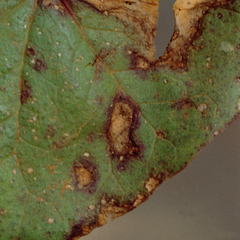 Phoma
Not reportedComparator
Organisms pictured · Representative pictures of the matched species, not figures from the paper.
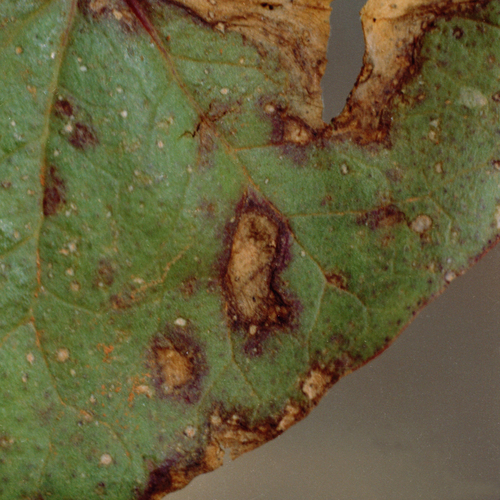
Verbatim
e0“the treatment did not significantly reduce levels of Phoma (another potential pathogen)”
e1“containerized conifer seedlings”
Claim · model-written summary
The treatment did not significantly reduce Penicillium levels.
- Taxon
- conifer seedlingse1
- Treatment
- the treatmente0
- Interactor
- Penicillium
 Penicilliume0other
- Outcome
- saprophytic Penicilliume0
- Direction
- did not significantly reducee0
Not reportedComparator
Organisms pictured · Representative pictures of the matched species, not figures from the paper.

Verbatim
e0“the treatment did not significantly reduce levels of Phoma (another potential pathogen) nor saprophytic Penicillium and Alternaria spp.”
e1“containerized conifer seedlings”
Claim · model-written summary
The treatment did not significantly reduce Alternaria levels.
- Taxon
- conifer seedlingse1
- Treatment
- the treatmente0
- Interactor
- Alternaria spp.
 Alternariae0other
- Outcome
- Alternaria spp.e0
- Direction
- did not significantly reducee0
Not reportedComparator
Organisms pictured · Representative pictures of the matched species, not figures from the paper.

Verbatim
e0“the treatment did not significantly reduce levels of Phoma (another potential pathogen) nor saprophytic Penicillium and Alternaria spp.”
e1“containerized conifer seedlings”
Claim · model-written summary
The treatment eliminated Fusarium from roots that penetrated container walls.
- Taxon
- conifer seedlingse1
- Organ / stage
- seedling rootse0
- Treatment
- The treatmente0
- Outcome
- Fusariume0
- Direction
- eliminatede0
Not reportedComparator
Organisms pictured · Representative pictures of the matched species, not figures from the paper.
Verbatim
e0“The treatment also eliminated Fusarium and Cylindrocarpon spp. from pieces of seedling roots which had penetrated walls of container cells.”
e1“containerized conifer seedlings”
Claim · model-written summary
The treatment eliminated Cylindrocarpon from roots that penetrated container walls.
- Taxon
- conifer seedlingse1
- Organ / stage
- seedling rootse0
- Treatment
- The treatmente0
- Interactor
- Cylindrocarpon spp.Cylindrocarpone0pathogen
- Outcome
- Cylindrocarpon spp.e0
- Direction
- eliminatede0
Not reportedComparator
Verbatim
e0“The treatment also eliminated Fusarium and Cylindrocarpon spp. from pieces of seedling roots which had penetrated walls of container cells.”
e1“containerized conifer seedlings”
Claim · model-written summary
The nursery will use this cleaning technique in future.
Verbatim
e0“This cleaning technique will be used in the future at the Champion Timberlands Nursery, Plains, Montana.”
e1“containerized conifer seedlings”