Abstract
Sheath rot of rice occurs in most rice-growing regions of the world. It usually causes yield losses from 20 to 85%. Sheath rot was reported from Iran in 1993. Year after year, the number of diseased plants increased in the Northern Iran. In summer of 2001, these symptoms were observed in most fields: lesions occur on the upper leaf sheaths, especially the flag leaf sheath. As the disease progresses, lesions enlarge and coalesce and may cover most of the leaf sheath. Panicle may fail to completely or at all. Brown or partially brown not filled or partially filled grain is also associated with infection of the panicle. A whitish powdery growth may be found inside affected sheaths. Infected plants were collected and trasferred to laboratory. Small pieces of diseased tissues were washed under tap water for one hour. Then tissues were placed on WA and incubated at 25 degrees C. These isolates were purified and identified as: Sarocladium oryzae, Fusarium udum, F. semitectum, F. avenaceum, F. flocciferum, F. graminearum, Bipolaris oryzae, Alternaria padwickii, Rhizoctonia solani, Paecilomyces sp., Nigrospora sp. and Trichoderma sp. This is the first report of F. udum in Iran. Also this is the first report that rice is the host for F. semitectum, F. avenaceum and F. flocciferum in Iran. Pathogenicity tests were conducted in glass house. Following species were found to be associated with sheath rot of rice: S. oryzae, F. graminearum, F. udum, F. avenaceum, B. oryzae, A. padwickii. This is the first report in the world that F. udum and A. padwickii are the causal agents of the sheath rot on rice plants.
Abstract from the paper’s OpenAlex record, shown for indexing and research. Copyright remains with the authors or the publisher. Read at the source ↗
The text the model read, with the source record’s inline markup (italics, sub- and superscripts) rendered and its character entities decoded; quote offsets refer to the raw text.
Claims 20
Claim · model-written summary
The number of rice plants affected by sheath rot increased year after year in Northern Iran.
- Taxon
- rice
 Oryza sativat0
- Outcome
- number of diseased plantse0
- Direction
- increasede0
- Setting
- Northern Irane0
Organisms pictured · Representative pictures of the matched species, not figures from the paper.

Verbatim
t0“rice”
e0“Year after year, the number of diseased plants increased in the Northern Iran.”
Claim · model-written summary
Rice sheath lesions occurred on upper leaf sheaths, especially flag leaf sheaths, in most fields.
- Taxon
- riceOryza sativat0
- Outcome
- lesions occur on the upper leaf sheathse0
- Setting
- most fieldse0
Not reportedDirection
Organisms pictured · Representative pictures of the matched species, not figures from the paper.
Verbatim
t0“rice”
e0“In summer of 2001, these symptoms were observed in most fields: lesions occur on the upper leaf sheaths, especially the flag leaf sheath.”
Claim · model-written summary
Rice sheath lesions enlarged and coalesced as disease progressed.
- Taxon
- riceOryza sativat0
- Outcome
- lesions enlarge and coalescee0
Not reportedDirection
Organisms pictured · Representative pictures of the matched species, not figures from the paper.
Verbatim
t0“rice”
e0“As the disease progresses, lesions enlarge and coalesce and may cover most of the leaf sheath.”
Claim · model-written summary
Rice panicles may fail to develop completely.
- Taxon
- riceOryza sativat0
- Outcome
- Panicle may fail to completely or at alle0
Not reportedDirection
Organisms pictured · Representative pictures of the matched species, not figures from the paper.
Verbatim
t0“rice”
e0“Panicle may fail to completely or at all.”
Claim · model-written summary
Brown and incompletely filled rice grain was associated with panicle infection.
- Taxon
- riceOryza sativat0
- Outcome
- Brown or partially brown not filled or partially filled graine0
Not reportedDirection
Organisms pictured · Representative pictures of the matched species, not figures from the paper.
Verbatim
t0“rice”
e0“Brown or partially brown not filled or partially filled grain is also associated with infection of the panicle.”
Claim · model-written summary
Whitish powdery growth occurred inside affected rice sheaths.
- Taxon
- riceOryza sativat0
- Outcome
- whitish powdery growthe0
Not reportedDirection
Organisms pictured · Representative pictures of the matched species, not figures from the paper.
Verbatim
t0“rice”
e0“A whitish powdery growth may be found inside affected sheaths.”
Claim · model-written summary
Sarocladium oryzae was identified among isolates from diseased rice tissues.
- Taxon
- riceOryza sativat0
- Interactor
- Sarocladium oryzae
 Sarocladium oryzaee0pathogen
- Outcome
- isolates were purified and identifiede0
Organisms pictured · Representative pictures of the matched species, not figures from the paper.

Verbatim
t0“rice”
e0“These isolates were purified and identified as: Sarocladium oryzae, Fusarium udum, F. semitectum, F. avenaceum, F. flocciferum, F. graminearum, Bipolaris oryzae, Alternaria padwickii, Rhizoctonia solani, Paecilomyces sp., Nigrospora sp. and Trichoderma sp.”
Claim · model-written summary
Fusarium udum was identified among isolates from diseased rice tissues.
- Taxon
- riceOryza sativat0
- Interactor
- Fusarium udumFusarium udume0pathogen
- Outcome
- isolates were purified and identifiede0
Organisms pictured · Representative pictures of the matched species, not figures from the paper.
Verbatim
t0“rice”
e0“These isolates were purified and identified as: Sarocladium oryzae, Fusarium udum, F. semitectum, F. avenaceum, F. flocciferum, F. graminearum, Bipolaris oryzae, Alternaria padwickii, Rhizoctonia solani, Paecilomyces sp., Nigrospora sp. and Trichoderma sp.”
Claim · model-written summary
F. semitectum was identified among isolates from diseased rice tissues.
- Taxon
- riceOryza sativat0
- Interactor
- F. semitectumFusarium incarnatume0pathogen
- Outcome
- isolates were purified and identifiede0
Organisms pictured · Representative pictures of the matched species, not figures from the paper.
Verbatim
t0“rice”
e0“These isolates were purified and identified as: Sarocladium oryzae, Fusarium udum, F. semitectum, F. avenaceum, F. flocciferum, F. graminearum, Bipolaris oryzae, Alternaria padwickii, Rhizoctonia solani, Paecilomyces sp., Nigrospora sp. and Trichoderma sp.”
Claim · model-written summary
F. avenaceum was identified among isolates from diseased rice tissues.
- Taxon
- riceOryza sativat0
- Interactor
- F. avenaceum
 Fusarium avenaceume0pathogen
- Outcome
- isolates were purified and identifiede0
Organisms pictured · Representative pictures of the matched species, not figures from the paper.

Verbatim
t0“rice”
e0“These isolates were purified and identified as: Sarocladium oryzae, Fusarium udum, F. semitectum, F. avenaceum, F. flocciferum, F. graminearum, Bipolaris oryzae, Alternaria padwickii, Rhizoctonia solani, Paecilomyces sp., Nigrospora sp. and Trichoderma sp.”
Claim · model-written summary
F. flocciferum was identified among isolates from diseased rice tissues.
- Taxon
- riceOryza sativat0
- Interactor
- F. flocciferumFusarium flocciferume0pathogen
- Outcome
- isolates were purified and identifiede0
Organisms pictured · Representative pictures of the matched species, not figures from the paper.
Verbatim
t0“rice”
e0“These isolates were purified and identified as: Sarocladium oryzae, Fusarium udum, F. semitectum, F. avenaceum, F. flocciferum, F. graminearum, Bipolaris oryzae, Alternaria padwickii, Rhizoctonia solani, Paecilomyces sp., Nigrospora sp. and Trichoderma sp.”
Claim · model-written summary
F. graminearum was identified among isolates from diseased rice tissues.
- Taxon
- riceOryza sativat0
- Interactor
- F. graminearum
 Fusarium graminearume0pathogen
- Outcome
- isolates were purified and identifiede0
Organisms pictured · Representative pictures of the matched species, not figures from the paper.

Verbatim
t0“rice”
e0“These isolates were purified and identified as: Sarocladium oryzae, Fusarium udum, F. semitectum, F. avenaceum, F. flocciferum, F. graminearum, Bipolaris oryzae, Alternaria padwickii, Rhizoctonia solani, Paecilomyces sp., Nigrospora sp. and Trichoderma sp.”
Claim · model-written summary
Bipolaris oryzae was identified among isolates from diseased rice tissues.
- Taxon
- riceOryza sativat0
- Interactor
- Bipolaris oryzae
 Bipolaris oryzaee0pathogen
- Outcome
- isolates were purified and identifiede0
Organisms pictured · Representative pictures of the matched species, not figures from the paper.
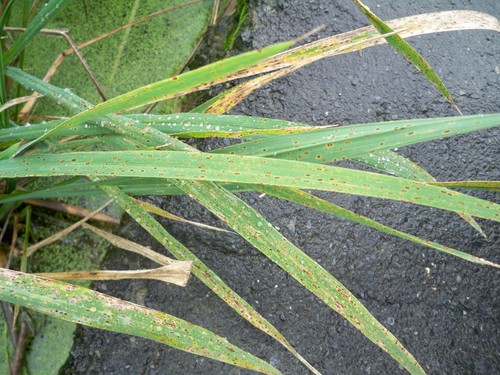
Verbatim
t0“rice”
e0“These isolates were purified and identified as: Sarocladium oryzae, Fusarium udum, F. semitectum, F. avenaceum, F. flocciferum, F. graminearum, Bipolaris oryzae, Alternaria padwickii, Rhizoctonia solani, Paecilomyces sp., Nigrospora sp. and Trichoderma sp.”
Claim · model-written summary
Rice was reported as a host of F. semitectum in Iran.
- Taxon
- riceOryza sativae0
- Interactor
- F. semitectumFusarium incarnatume0pathogen
- Outcome
- rice is the hoste0
- Setting
- Irane0
Organisms pictured · Representative pictures of the matched species, not figures from the paper.
Verbatim
e0“Also this is the first report that rice is the host for F. semitectum, F. avenaceum and F. flocciferum in Iran.”
Claim · model-written summary
Rice was reported as a host of F. avenaceum in Iran.
- Taxon
- riceOryza sativae0
- Interactor
- F. avenaceumFusarium avenaceume0pathogen
- Outcome
- rice is the hoste0
- Setting
- Irane0
Organisms pictured · Representative pictures of the matched species, not figures from the paper.
Verbatim
e0“Also this is the first report that rice is the host for F. semitectum, F. avenaceum and F. flocciferum in Iran.”
Claim · model-written summary
Rice was reported as a host of F. flocciferum in Iran.
- Taxon
- riceOryza sativae0
- Interactor
- F. flocciferumFusarium flocciferume0pathogen
- Outcome
- rice is the hoste0
- Setting
- Irane0
Organisms pictured · Representative pictures of the matched species, not figures from the paper.
Verbatim
e0“Also this is the first report that rice is the host for F. semitectum, F. avenaceum and F. flocciferum in Iran.”
Claim · model-written summary
S. oryzae was associated with rice sheath rot.
- Taxon
- riceOryza sativae0
- Interactor
- S. oryzaeSarocladium oryzaee0pathogen
- Outcome
- sheath rot of ricee0
Not reportedDirection
Organisms pictured · Representative pictures of the matched species, not figures from the paper.
Verbatim
e0“Following species were found to be associated with sheath rot of rice: S. oryzae, F. graminearum, F. udum, F. avenaceum, B. oryzae, A. padwickii.”
Claim · model-written summary
F. graminearum was associated with rice sheath rot.
- Taxon
- riceOryza sativae0
- Interactor
- F. graminearumFusarium graminearume0pathogen
- Outcome
- sheath rot of ricee0
Not reportedDirection
Organisms pictured · Representative pictures of the matched species, not figures from the paper.
Verbatim
e0“Following species were found to be associated with sheath rot of rice: S. oryzae, F. graminearum, F. udum, F. avenaceum, B. oryzae, A. padwickii.”
Claim · model-written summary
B. oryzae was associated with rice sheath rot.
- Taxon
- riceOryza sativae0
- Interactor
- B. oryzaeBipolaris oryzaee0pathogen
- Outcome
- sheath rot of ricee0
Not reportedDirection
Organisms pictured · Representative pictures of the matched species, not figures from the paper.
Verbatim
e0“Following species were found to be associated with sheath rot of rice: S. oryzae, F. graminearum, F. udum, F. avenaceum, B. oryzae, A. padwickii.”
Claim · model-written summary
A. padwickii was associated with rice sheath rot.
- Taxon
- riceOryza sativae0
- Interactor
- A. padwickii
 Alternaria padwickiie0pathogen
- Outcome
- sheath rot of ricee0
Not reportedDirection
Organisms pictured · Representative pictures of the matched species, not figures from the paper.

Verbatim
e0“Following species were found to be associated with sheath rot of rice: S. oryzae, F. graminearum, F. udum, F. avenaceum, B. oryzae, A. padwickii.”