Abstract
The bamboo aphid, Pseudoregma bambucicola, is an important insect pest of bamboo that affects normal bamboo growth and induces sooty molds. The control of P. bambucicola involves the application of chemicals, such as imidacloprid, to which many species are resistant. In this study, we isolate a novel botanical pesticide (9-oxo-10,11-dehydro-ageraphorone) from an Eupatorium adenophorum(Asteraceae: Compositae) petroleum ether extract and test the aphicidal activity of this compound against P. bambucicola in laboratory bioassay and field-based experiments. This ageraphorone compound at a concentration of 2 mg/ml caused 73.33% mortality (corrected mortality [Subtracted the mortality of the negative control]: 70%) of P. bambucicola by laboratory bioassay within 6 h. Even at lower concentrations, this compound caused greater 33% mortality (corrected mortality: 30%) of aphids. Field experiments with naturally infested bamboo plants showed that two applications of 2 mg/ml ageraphorone to infested plants completely cleared infestations within 30 d. These effects were similar to those of the positive control (imidacloprid). These results reveal that 9-oxo-10,11-dehydro-ageraphorone exhibits significant aphicidal activity against bamboo aphids. We suggest that future research be directed at developing this ageraphorone compound from E. adenophorum as an aphicidal agent for biocontrol.
Abstract from the paper’s OpenAlex record; open copy licensed cc-by-nc. Read at the source ↗
The text the model read, with the source record’s inline markup (italics, sub- and superscripts) rendered and its character entities decoded; quote offsets refer to the raw text.
Claims 7
Claim · model-written summary
9-oxo-10,11-dehydro-ageraphorone was isolated from Eupatorium adenophorum petroleum ether extract.
Verbatim
e0“we isolate a novel botanical pesticide (9-oxo-10,11-dehydro-ageraphorone) from an Eupatorium adenophorum(Asteraceae: Compositae) petroleum ether extract”
Claim · model-written summary
At 2 mg/ml, ageraphorone caused 73.33% aphid mortality within 6 h in laboratory bioassays, corrected to 70%.
- Taxon
- P. bambucicola
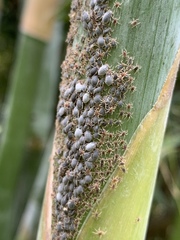 Pseudoregma bambucicolae0
- Treatment
- ageraphorone compound at a concentration of 2 mg/mle0
- Outcome
- mortalitye0
- Direction
- causede0
- Value
- 73.33%e0
- Qualifier
- corrected mortality [Subtracted the mortality of the negative control]: 70%e0
- Comparator
- negative controle0
- Setting
- laboratorye0
Organisms pictured · Representative pictures of the matched species, not figures from the paper.
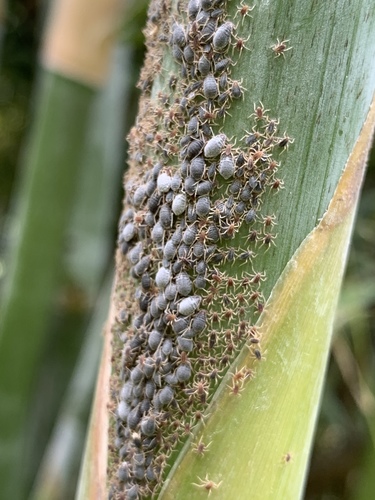
Verbatim
e0“This ageraphorone compound at a concentration of 2 mg/ml caused 73.33% mortality (corrected mortality [Subtracted the mortality of the negative control]: 70%) of P. bambucicola by laboratory bioassay within 6 h”
Claim · model-written summary
Lower ageraphorone concentrations caused greater 33% aphid mortality, corrected to 30%.
- Taxon
- P. bambucicolaPseudoregma bambucicolae1
- Treatment
- lower concentrationse0
- Outcome
- mortalitye0
- Direction
- causede0
- Value
- 33%e0
- Qualifier
- corrected mortality: 30%e0
Not reportedComparator
Organisms pictured · Representative pictures of the matched species, not figures from the paper.
Verbatim
e0“Even at lower concentrations, this compound caused greater 33% mortality (corrected mortality: 30%) of aphids”
e1“This ageraphorone compound at a concentration of 2 mg/ml caused 73.33% mortality (corrected mortality [Subtracted the mortality of the negative control]: 70%) of P. bambucicola by laboratory bioassay within 6 h”
Claim · model-written summary
Two 2 mg/ml ageraphorone applications cleared bamboo infestations within 30 d.
- Treatment
- two applications of 2 mg/ml ageraphoronee0
- Interactor
- Pseudoregma bambucicolaPseudoregma bambucicolae1pest
- Outcome
- infestationse0
- Direction
- completely clearede0
- Value
- 30 de0
- Setting
- Fielde0
Not reportedComparator
Organisms pictured · Representative pictures of the matched species, not figures from the paper.
Verbatim
e0“Field experiments with naturally infested bamboo plants showed that two applications of 2 mg/ml ageraphorone to infested plants completely cleared infestations within 30 d”
e1“The bamboo aphid, Pseudoregma bambucicola, is an important insect pest of bamboo”
Claim · model-written summary
Ageraphorone effects were similar to imidacloprid positive controls.
Verbatim
e0“These effects were similar to those of the positive control (imidacloprid)”
e1“ageraphorone exhibits significant aphicidal activity against bamboo aphids”
Claim · model-written summary
9-oxo-10,11-dehydro-ageraphorone exhibited significant aphicidal activity.
Not reportedComparatorDirection
Verbatim
e0“9-oxo-10,11-dehydro-ageraphorone exhibits significant aphicidal activity against bamboo aphids”
Claim · model-written summary
The authors recommend developing ageraphorone as an aphicidal biocontrol agent.
Verbatim
e0“We suggest that future research be directed at developing this ageraphorone compound from E. adenophorum as an aphicidal agent for biocontrol”
e1“bamboo aphids”