Abstract
Salicylic acid and its analogues are considered the most important compounds which can be activated a systemic acquired resistance (SAR) in plants. The disadvantages and limits related to the usual methods in particular fungicide spray to the control of black leaf streak disease (BLSD) require research of approaches more respectful of the environment for this disease management such as the use of SAR inducers. The effects of Salicylic acid (SA) and Acibenzolar-S-methyl (ASM) on the interaction of two susceptible cultivars of banana (Orishele and Corne 1) with the hemibiotrophic fungal Mycosphaerella fijiensis and his toxin (juglone) were investigated. The results showed that SA and ASM at low concentrations (25 and 50 µg/ml) did not affect M. fijiensis development but have the capacity to induce protection into sensitive banana against juglone toxic effect. These SAR inducers reduced the intensity of the necrosis due to the juglone and lengthened the incubation period of M. fijiensis after inoculation of banana leaves. The expression of the resistance induced was related to the variety of banana. More significant effectiveness of protection was obtained with ASM in particular on Corne 1. A total protection against the induction of necrosis was kept up to 100 µg/ml of juglone 2 to 3 weeks after application of ASM on the soil and on the leaves of banana. ASM constitutes a viable and noncontaminant option in the fight against to BLSD because of his non-inhibiting action on M. fijiensis and excellent protection into banana when roots and leaves were treated.
Abstract from the paper’s OpenAlex record; open copy licensed cc-by. Read at the source ↗
The text the model read, with the source record’s inline markup (italics, sub- and superscripts) rendered and its character entities decoded; quote offsets refer to the raw text.
Claims 8
Claim · model-written summary
SA and ASM at low concentrations did not affect Mycosphaerella fijiensis development.
- Taxon
- bananae1
- Treatment
- SA and ASM at low concentrationse2
- Interactor
- M. fijiensis
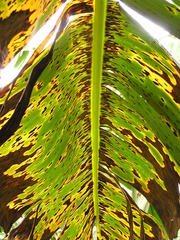 Pseudocercospora fijiensise2pathogen
- Outcome
- M. fijiensis developmente2
- Direction
- did not affecte2
Not reportedComparator
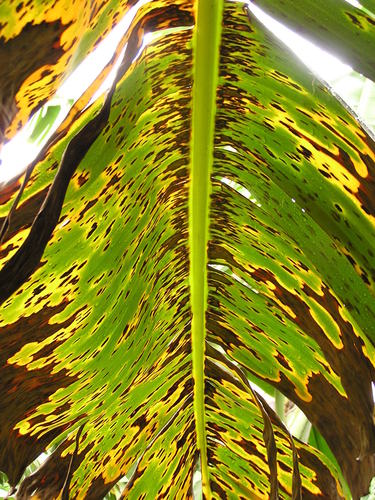
Organisms pictured · Representative pictures of the matched species, not figures from the paper.
Verbatim
e1“two susceptible cultivars of banana (Orishele and Corne 1)”
e2“SA and ASM at low concentrations (25 and 50 µg/ml) did not affect M. fijiensis development”
Claim · model-written summary
SA and ASM induced protection of sensitive banana against the toxic effect of juglone.
Not reportedComparator
Verbatim
e1“two susceptible cultivars of banana (Orishele and Corne 1)”
e2“SA and ASM at low concentrations (25 and 50 µg/ml) did not affect M. fijiensis development”
e3“have the capacity to induce protection into sensitive banana against juglone toxic effect”
Claim · model-written summary
SAR inducers reduced the intensity of juglone-induced necrosis on banana.
- Taxon
- bananae1
- Treatment
- SAR inducerse4
- Compound
- juglonee4
- Outcome
- intensity of the necrosise4
- Direction
- reducede4
Not reportedComparator
Verbatim
e1“two susceptible cultivars of banana (Orishele and Corne 1)”
e4“These SAR inducers reduced the intensity of the necrosis due to the juglone”
Claim · model-written summary
SAR inducers lengthened the incubation period of M. fijiensis on inoculated banana leaves.
- Taxon
- bananae1
- Treatment
- SAR inducerse4
- Interactor
- M. fijiensisPseudocercospora fijiensise5pathogen
- Outcome
- incubation period of M. fijiensise5
- Direction
- lengthenede5
Not reportedComparator
Organisms pictured · Representative pictures of the matched species, not figures from the paper.
Verbatim
e1“two susceptible cultivars of banana (Orishele and Corne 1)”
e4“These SAR inducers reduced the intensity of the necrosis due to the juglone”
e5“lengthened the incubation period of M. fijiensis after inoculation of banana leaves”
Claim · model-written summary
The expression of SA and ASM induced resistance in banana is related to the variety.
Not reportedDirection
Verbatim
e6“The expression of the resistance induced was related to the variety of banana”
Claim · model-written summary
ASM gave more significant protection than SA on Corne 1 banana.
- Taxon
- bananae1
- Material
- Corne 1e1
- Treatment
- ASMe7
- Outcome
- effectiveness of protectione7
- Direction
- More significante7
Not reportedComparator
Verbatim
e1“two susceptible cultivars of banana (Orishele and Corne 1)”
e7“More significant effectiveness of protection was obtained with ASM in particular on Corne 1”
Claim · model-written summary
ASM gave total protection against juglone-induced necrosis up to 100 µg/ml juglone for 2 to 3 weeks after application.
- Taxon
- bananae7
- Treatment
- ASM on the soil and on the leavese7
- Compound
- juglonee7
- Outcome
- protection against the induction of necrosise7
- Direction
- total protectione7
- Qualifier
- 2 to 3 weeks after applicatione7
Not reportedComparator
Verbatim
e7“A total protection against the induction of necrosis was kept up to 100 µg/ml of juglone 2 to 3 weeks after application of ASM on the soil and on the leaves of banana”
Claim · model-written summary
ASM is a viable and noncontaminant option for controlling black leaf streak disease in banana.
Verbatim
e0“ASM constitutes a viable and noncontaminant option in the fight against to BLSD because of his non-inhibiting action on M. fijiensis and excellent protection into banana when roots and leaves were treated”
The same questions in other papers
salicylic acid · control · MusaResults agree
1 paper in the same direction as this paper
- positive
acibenzolar-S-methyl · control · MusaResults agree
1 paper in the same direction as this paper
- positive
acibenzolar-S-methyl · molecular: expression · MusaResults agree
3 papers in the same direction as this paper
- positive
- positive
- positive
resistance inducer · disease · MusaResults agree
1 paper in the same direction as this paper
- positive
Claims are grouped by organism, treatment and what was measured or targeted. A paper counts as positive when any of its claims in the group is positive.