Abstract
‘CDC Mindon’ (Reg. No. CV‐337, PI 651860; CN107350; Canadian Food Inspection Agency [CFIA] Reg. No. 6224, Canadian PBR Appl. No. 07‐5903) is a two‐row spring feed barley ( Hordeum vulgare L.) developed at the Crop Development Centre (CDC), University of Saskatchewan, Saskatoon, SK, Canada, with collaboration by Agriculture and Agri‐Food Canada at the Brandon Research Centre, Brandon, MB, Canada, and the Eastern Cereal and Oilseed Research Centre, Ottawa, ON, Canada. CDC Mindon was tested in CDC yield trials as SB00106 in 2000–2003 and in the Western Canadian Cooperative Two‐Row Barley Registration trial as TR04378 during 2004 and 2005. CDC Mindon was registered for production in western Canada as it has demonstrated good agronomic performance combined with good kernel quality and, of greater significance, enhanced resistance to Fusarium head blight (incited by Fusarium graminearum Schwabe) with lower deoxynivalenol accumulation in combination with tolerance to spot blotch [incited by Cochliobolus sativus (Ito & Kuribayashi) Drechs. Ex Dastur]. CDC Mindon is also resistant to the barley smuts (incited by Ustilago spp.).
Abstract from the paper’s OpenAlex record, shown for indexing and research. Copyright remains with the authors or the publisher. Read at the source ↗
The text the model read, with the source record’s inline markup (italics, sub- and superscripts) rendered and its character entities decoded; quote offsets refer to the raw text.
Claims 6
Claim · model-written summary
CDC Mindon has good agronomic performance in western Canada.
- Taxon
- barley
 Hordeum vulgaret0
- Material
- CDC Mindone1
- Outcome
- agronomic performancee1
- Setting
- western Canadae1
Organisms pictured · Representative pictures of the matched species, not figures from the paper.

Verbatim
t0“Barley”
e1“CDC Mindon was registered for production in western Canada as it has demonstrated good agronomic performance combined with good kernel quality”
Claim · model-written summary
CDC Mindon has enhanced resistance to Fusarium head blight caused by Fusarium graminearum.
- Taxon
- barleyHordeum vulgaret0
- Interactor
- Fusarium graminearum Schwabe
 Fusarium graminearume2pathogen
- Outcome
- resistance to Fusarium head blighte2
Organisms pictured · Representative pictures of the matched species, not figures from the paper.

Verbatim
t0“Barley”
e2“enhanced resistance to Fusarium head blight (incited by Fusarium graminearum Schwabe)”
Claim · model-written summary
CDC Mindon has lower deoxynivalenol accumulation in its grain.
- Taxon
- barleyHordeum vulgaret0
- Outcome
- deoxynivalenol accumulatione3
- Direction
- lowere3
Organisms pictured · Representative pictures of the matched species, not figures from the paper.
Verbatim
t0“Barley”
e3“with lower deoxynivalenol accumulation”
Claim · model-written summary
CDC Mindon has tolerance to spot blotch caused by Cochliobolus sativus.
- Taxon
- barleyHordeum vulgaret0
- Interactor
- Cochliobolus sativus (Ito & Kuribayashi) Drechs. Ex Dastur
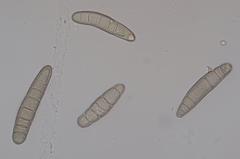 Bipolaris sorokinianae4pathogen
- Outcome
- tolerance to spot blotche4
Organisms pictured · Representative pictures of the matched species, not figures from the paper.
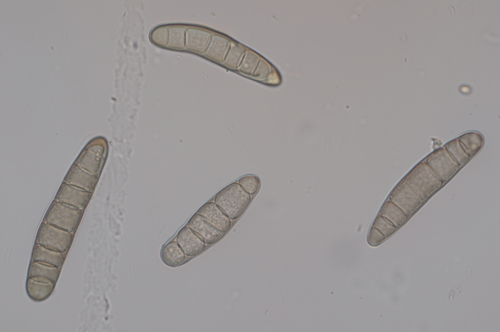
Verbatim
t0“Barley”
e4“tolerance to spot blotch [incited by Cochliobolus sativus (Ito & Kuribayashi) Drechs. Ex Dastur]”
Claim · model-written summary
CDC Mindon is resistant to the barley smuts caused by Ustilago spp.
- Taxon
- barleyHordeum vulgaret0
- Material
- CDC Mindone5
- Outcome
- resistant to the barley smutse5
 Ustilago
Organisms pictured · Representative pictures of the matched species, not figures from the paper.

Verbatim
t0“Barley”
e5“CDC Mindon is also resistant to the barley smuts (incited by Ustilago spp.)”
Claim · model-written summary
CDC Mindon has good kernel quality.
- Taxon
- barleyHordeum vulgaret0
- Material
- CDC Mindone1
- Outcome
- kernel qualitye1
Organisms pictured · Representative pictures of the matched species, not figures from the paper.
Verbatim
t0“Barley”
e1“CDC Mindon was registered for production in western Canada as it has demonstrated good agronomic performance combined with good kernel quality”