Abstract
We report results of transplant experiments that examined direct interactions between red mangrove (Rhizophora mangle) roots and two common root—fouling sponges (Tedania ignis and Haliclona implexiformis) on carbonate—based, oligotrophic mangrove cays in Belize, Central America. On these cays, subtidal prop roots of mangroves at water's edge often extend 1—2 m below lowest low water before anchoring in the substrate and host a community of algal and invertebrate epibionts dominated by massive sponges. Live sponges transplanted onto otherwise bare roots increased root growth rate two— to fourfold relative to controls. Roots fouled naturally by these and other massive sponges produce adventitious fine rootlets that ramify throughout sponge tissue; these rootlets structurally resemble underground rootlets that function in nutrient uptake. Sponges transplanted onto bare mangrove roots induced rootlet proliferation within 4 wk. Only live sponges elicited this response, indicating that adventitious rootlet production is not simply a by—product of anoxia or darkness. Sponges transplanted onto bare roots grew 1.4—10 times faster than did sponges grown on polyvinyl chloride (PVC) tubes at identical depths and locations. Relative abundances of $ { 15}$N (expressed as $\delta { 15}$N per mil) and $ { 13}$C ($\delta { 13}$C per mil) in Tedania, Haliclona, an additional sponge, Ulosa ruetzleri, and rootlets, roots, stems, twigs, and leaves of mangrove hosts suggest that mangrove roots obtain dissolved inorganic nitrogen from sponges, and that sponges obtain carbon from mangrove roots. No transfer of N or C was observed in similar analyses of roots fouled by the red alga Acanthophora spicifera. We conclude that where they co—occur, massive sponges and mangroves are facultative mutualists. In mangrove forests, as in other marginal habitats, facilitations may enable increased growth and production of component species.
Abstract from the paper’s OpenAlex record, shown for indexing and research. Copyright remains with the authors or the publisher. Read at the source ↗
The text the model read, with the source record’s inline markup (italics, sub- and superscripts) rendered and its character entities decoded; quote offsets refer to the raw text.
Claims 9
Claim · model-written summary
Live sponges on bare mangrove roots raised root growth rate two- to fourfold.
- Taxon
- Rhizophora mangle
 Rhizophora manglee1
- Treatment
- Live sponges transplanted onto otherwise bare rootse0
- Outcome
- root growth ratee0
- Direction
- increasede0
- Value
- two— to fourfolde0
- Comparator
- controlse0
Organisms pictured · Representative pictures of the matched species, not figures from the paper.
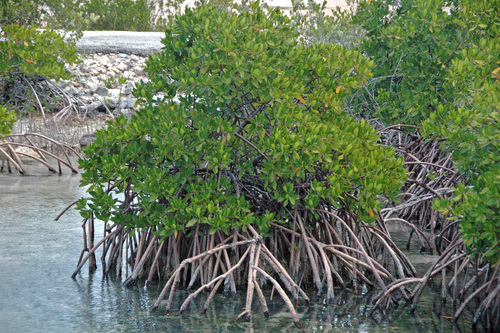
Verbatim
e0“Live sponges transplanted onto otherwise bare roots increased root growth rate two— to fourfold relative to controls.”
e1“red mangrove (Rhizophora mangle)”
Claim · model-written summary
Naturally sponge-fouled mangrove roots produced fine adventitious rootlets through sponge tissue.
- Taxon
- Rhizophora mangleRhizophora manglee1
- Outcome
- adventitious fine rootlets that ramify throughout sponge tissuee0
Organisms pictured · Representative pictures of the matched species, not figures from the paper.
Verbatim
e0“Roots fouled naturally by these and other massive sponges produce adventitious fine rootlets that ramify throughout sponge tissue”
e1“red mangrove (Rhizophora mangle)”
Claim · model-written summary
Transplanted sponges induced mangrove rootlet proliferation within 4 weeks.
- Taxon
- Rhizophora mangleRhizophora manglee1
- Treatment
- Sponges transplanted onto bare mangrove rootse0
- Outcome
- rootlet proliferatione0
- Direction
- inducede0
- Value
- 4 wke0
Not reportedComparator
Organisms pictured · Representative pictures of the matched species, not figures from the paper.
Verbatim
e0“Sponges transplanted onto bare mangrove roots induced rootlet proliferation within 4 wk.”
e1“red mangrove (Rhizophora mangle)”
Claim · model-written summary
Only live sponges elicited adventitious rootlet production.
- Taxon
- Rhizophora mangleRhizophora manglee2
- Treatment
- live spongese0
- Outcome
- adventitious rootlet productione1
- Direction
- elicitede0
Not reportedComparator
Organisms pictured · Representative pictures of the matched species, not figures from the paper.
Verbatim
e0“Only live sponges elicited this response”
e1“adventitious rootlet production”
e2“red mangrove (Rhizophora mangle)”
Claim · model-written summary
Sponges grew 1.4–10 times faster on mangrove roots than on PVC tubes.
- Taxon
- Rhizophora mangleRhizophora manglee1
- Treatment
- Sponges transplanted onto bare rootse0
- Outcome
- Sponges transplanted onto bare roots grewe0
- Direction
- fastere0
- Value
- 1.4—10 timese0
- Comparator
- sponges grown on polyvinyl chloride (PVC) tubese0
Organisms pictured · Representative pictures of the matched species, not figures from the paper.
Verbatim
e0“Sponges transplanted onto bare roots grew 1.4—10 times faster than did sponges grown on polyvinyl chloride (PVC) tubes at identical depths and locations.”
e1“red mangrove (Rhizophora mangle)”
Claim · model-written summary
Isotope abundances suggest mangrove roots obtain dissolved inorganic nitrogen from sponges.
- Taxon
- Rhizophora mangleRhizophora manglee1
- Outcome
- dissolved inorganic nitrogene0
Not reportedDirection
Organisms pictured · Representative pictures of the matched species, not figures from the paper.
Verbatim
e0“mangrove roots obtain dissolved inorganic nitrogen from sponges”
e1“red mangrove (Rhizophora mangle)”
Claim · model-written summary
Isotope abundances suggest sponges obtain carbon from mangrove roots.
- Taxon
- Rhizophora mangleRhizophora manglee1
- Outcome
- sponges obtain carbone0
Not reportedDirection
Organisms pictured · Representative pictures of the matched species, not figures from the paper.
Verbatim
e0“sponges obtain carbon from mangrove roots”
e1“red mangrove (Rhizophora mangle)”
Claim · model-written summary
No nitrogen or carbon transfer was observed in roots fouled by Acanthophora spicifera.
- Taxon
- Rhizophora mangleRhizophora manglee1
- Interactor
- Acanthophora spicifera
 Acanthophora spiciferae0other
- Outcome
- transfer of N or Ce0
- Direction
- No transfere0
Organisms pictured · Representative pictures of the matched species, not figures from the paper.

Verbatim
e0“No transfer of N or C was observed in similar analyses of roots fouled by the red alga Acanthophora spicifera.”
e1“red mangrove (Rhizophora mangle)”
Claim · model-written summary
The authors conclude that co-occurring massive sponges and mangroves are facultative mutualists.
- Taxon
- Rhizophora mangleRhizophora manglee1
- Interactor
- massive spongese0symbiont
- Outcome
- facultative mutualistse0
Organisms pictured · Representative pictures of the matched species, not figures from the paper.
Verbatim
e0“where they co—occur, massive sponges and mangroves are facultative mutualists.”
e1“red mangrove (Rhizophora mangle)”