Abstract
Abstract Plant sensor nucleotide-binding leucine-rich repeat (NLR) receptors detect pathogen effectors through their integrated domains (IDs). The RGA5 sensor NLR recognizes its corresponding effectors AVR-Pia and AVR1-CO39 from the blast fungus Magnaporthe oryzae through direct binding to its heavy metal-associated (HMA) ID to trigger the RGA4 helper NLR-dependent resistance in rice. Here we report a mutant of RGA5 named RGA5HMA5 that confers complete resistance in transgenic rice plants to the M. oryzae strains expressing the noncorresponding effector AVR-PikD. RGA5HMA5 carries three engineered interfaces, two of which lie in the HMA ID and the other in the C-terminal Lys-rich stretch tailing the ID. However, the RGA5 variants having one or two of the three interfaces, including replacing all the Lys residues with Glu residues in the Lys-rich stretch, failed to activate RGA4-dependent cell death of rice protoplasts. Altogether, this work demonstrates that sensor NLRs require a concerted action of multiple surfaces within and outside the IDs to both recognize noncorresponding effectors and activate helper NLR-mediated resistance, and has implications in structure-guided designing of sensor NLRs.
Abstract from the paper’s OpenAlex record, shown for indexing and research. Copyright remains with the authors or the publisher. Read at the source ↗
The text the model read, with the source record’s inline markup (italics, sub- and superscripts) rendered and its character entities decoded; quote offsets refer to the raw text.
Claims 4
Claim · model-written summary
RGA5HMA5 conferred complete resistance in transgenic rice to M. oryzae strains expressing AVR-PikD.
- Taxon
- rice
 Oryza sativae0
- Treatment
- a mutant of RGA5 named RGA5HMA5e0
- Interactor
- M. oryzae
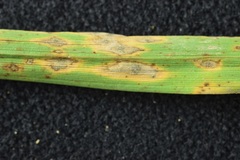 Pyricularia oryzaee0pathogen
- Gene
- RGA5HMA5e0
- Outcome
- complete resistancee0
Not reportedComparatorDirection
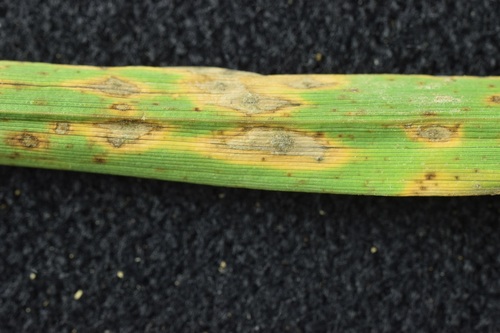
Organisms pictured · Representative pictures of the matched species, not figures from the paper.

Verbatim
e0“a mutant of RGA5 named RGA5HMA5 that confers complete resistance in transgenic rice plants to the M. oryzae strains expressing the noncorresponding effector AVR-PikD”
Claim · model-written summary
RGA5HMA5 carries three engineered interfaces.
- Taxon
- riceOryza sativae1
- Gene
- RGA5HMA5e0
- Outcome
- three engineered interfacese0
Organisms pictured · Representative pictures of the matched species, not figures from the paper.
Verbatim
e0“RGA5HMA5 carries three engineered interfaces, two of which lie in the HMA ID and the other in the C-terminal Lys-rich stretch tailing the ID”
e1“transgenic rice plants”
Claim · model-written summary
RGA5 variants with one or two interfaces failed to activate RGA4-dependent rice protoplast cell death.
- Taxon
- riceOryza sativae0
- Treatment
- replacing all the Lys residues with Glu residuese0
- Gene
- RGA5e0
- Outcome
- RGA4-dependent cell deathe0
Not reportedComparatorDirection
Organisms pictured · Representative pictures of the matched species, not figures from the paper.
Verbatim
e0“the RGA5 variants having one or two of the three interfaces, including replacing all the Lys residues with Glu residues in the Lys-rich stretch, failed to activate RGA4-dependent cell death of rice protoplasts”
Claim · model-written summary
Multiple surfaces within and outside integrated domains are required for effector recognition and resistance activation.
- Taxon
- riceOryza sativae1
- Gene
- sensor NLRse0
- Outcome
- recognize noncorresponding effectors and activate helper NLR-mediated resistancee0
- Qualifier
- concerted action of multiple surfaces within and outside the IDse0
Organisms pictured · Representative pictures of the matched species, not figures from the paper.
Verbatim
e0“sensor NLRs require a concerted action of multiple surfaces within and outside the IDs to both recognize noncorresponding effectors and activate helper NLR-mediated resistance”
e1“transgenic rice plants”