Claim · model-written summary
Baicao series strains had larger genomes (41.04 to 41.16 Mb) than rice strains GDYJ7 and ZJX18 (38.69 and 39.05 Mb).
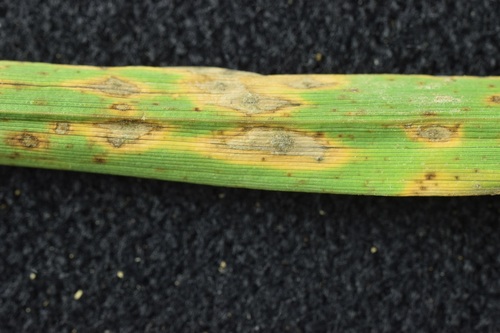
 Pyricularia oryzae
Verbatim
t0“Pyricularia oryzae Strains Isolated from Rice and Barnyard Grass”
e1“Baicao series strains possessed larger genomes (41.04 Mb to 41.16 Mb) with a higher content of repetitive sequences (6.68% to 7.09%) compared to rice strains GDYJ7 and ZJX18 (38.69 Mb and 39.05 Mb; 3.66% and 3.71% repeats)”
Title
Wenda Sun; Xiaohan Zhang; Zhuan Zhang; et al. Journal of Fungi 2026. doi:10.3390/jof12020109
Other claims from this paper (8)
- Observation Baicao series strains caused typical lesion symptoms on barnyard grass.
- Observation Baicao series strains did not cause lesions on rice leaves.
- Observation Rice strains GDYJ7 and ZJX18 caused lesions mainly on rice.
- Observation Baicao series strains had a higher content of repetitive sequences (6.68% to 7.09%) than rice strains GDYJ7 and ZJX18 (3.66% and 3.71%).
- Observation Phylogenetic analysis grouped Baicao series strains with grass-isolated P. oryzae strains, a grass-infecting pathotype, and GDYJ7 and ZJX18 with rice-isolated strains.
- Observation Baicao series, GDYJ7 and ZJX18 are all relatively distant from P. grisea.
- Observation PCR showed Baicao series strains harbored significantly fewer avirulence genes (Avr-Pib, Avr-Pizt, PWL3) than GDYJ7 and ZJX18 (Avr-Pib, Avr-Pizt, Avr-Pi9, Avr-Pik, PWL2).
- Observation Baicao9 retained only Avr-Pib.