Abstract
Rhizobial surface polysaccharides are required for nodule formation on the roots of at least some legumes but the mechanisms by which they act are yet to be determined. As a first step to investigate the function of exopolysaccharide (EPS) in the formation of determinate nodules, we isolated Mesorhizobium loti mutants affected in various steps of EPS biosynthesis and characterized their symbiotic phenotypes on two Lotus spp. The wild-type M. loti R7A produced both high molecular weight EPS and lower molecular weight (LMW) polysaccharide fractions whereas most mutant strains produced only LMW fractions. Mutants affected in predicted early biosynthetic steps (e.g., exoB) formed nitrogen-fixing nodules on Lotus corniculatus and L. japonicus 'Gifu', whereas mutants affected in mid or late biosynthetic steps (e.g., exoU) induced uninfected nodule primordia and, occasionally, a few infected nodules following a lengthy delay. These mutants were disrupted at the stage of infection thread (IT) development. Symbiotically defective EPS and Nod factor mutants functionally complemented each other in co-inoculation experiments. The majority of full-length IT observed harbored only the EPS mutant strain and did not show bacterial release, whereas the nitrogen-fixing nodules contained both mutants. Examination of the symbiotic proficiency of the exoU mutant on various L. japonicus ecotypes revealed that both host and environmental factors were linked to the requirement for EPS. These results reveal a complex function for M. loti EPS in determinate nodule formation and suggest that EPS plays a signaling role at the stages of both IT initiation and bacterial release.
Abstract from the paper’s OpenAlex record; open copy licensed cc-by-sa. Read at the source ↗
The text the model read, with the source record’s inline markup (italics, sub- and superscripts) rendered and its character entities decoded; quote offsets refer to the raw text.
Claims 9
Claim · model-written summary
Wild-type M. loti R7A produced high and low molecular weight polysaccharide fractions, while most mutants produced only low molecular weight fractions.
- Taxon
- M. loti R7A
 Mesorhizobium lotie0
- Outcome
- high molecular weight EPS and lower molecular weight (LMW) polysaccharide fractionse0
- Comparator
- most mutant strainse0
Organisms pictured · Representative pictures of the matched species, not figures from the paper.

Verbatim
e0“The wild-type M. loti R7A produced both high molecular weight EPS and lower molecular weight (LMW) polysaccharide fractions whereas most mutant strains produced only LMW fractions”
Claim · model-written summary
Early biosynthetic mutants formed nitrogen-fixing nodules on both Lotus hosts.
- Taxon
- Lotus corniculatus and L. japonicus 'Gifu'
 Lotus japonicus
 Lotus corniculatuse0
- Material
- Mutants affected in predicted early biosynthetic stepse0
- Interactor
- Mutantse0symbiont
- Gene
- exoBe0
- Outcome
- nitrogen-fixing nodulese0
Organisms pictured · Representative pictures of the matched species, not figures from the paper.
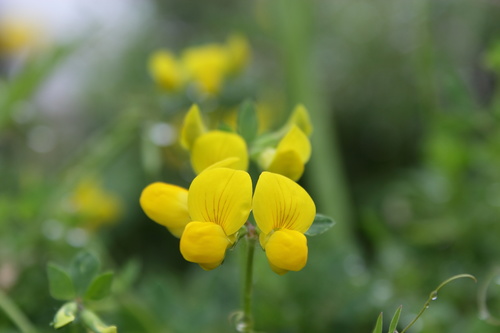

Verbatim
e0“Mutants affected in predicted early biosynthetic steps (e.g., exoB) formed nitrogen-fixing nodules on Lotus corniculatus and L. japonicus 'Gifu'”
Claim · model-written summary
Mid or late biosynthetic mutants induced uninfected nodule primordia and occasional delayed infected nodules.
- Gene
- exoUe0
- Outcome
- uninfected nodule primordia and, occasionally, a few infected nodulese0
- Qualifier
- following a lengthy delaye0
 Lotus
Organisms pictured · Representative pictures of the matched species, not figures from the paper.

Verbatim
e0“mutants affected in mid or late biosynthetic steps (e.g., exoU) induced uninfected nodule primordia and, occasionally, a few infected nodules following a lengthy delay”
t0“Lotus”
Claim · model-written summary
Those mutants were blocked during infection thread development.
- Outcome
- infection thread (IT) developmente0
Organisms pictured · Representative pictures of the matched species, not figures from the paper.
Verbatim
e0“These mutants were disrupted at the stage of infection thread (IT) development”
t0“Lotus”
Claim · model-written summary
Defective EPS and Nod factor mutants complemented one another in co-inoculation.
Organisms pictured · Representative pictures of the matched species, not figures from the paper.
Verbatim
e0“Symbiotically defective EPS and Nod factor mutants functionally complemented each other in co-inoculation experiments”
t0“Lotus”
Claim · model-written summary
Most full-length infection threads contained only the EPS mutant and lacked bacterial release.
Organisms pictured · Representative pictures of the matched species, not figures from the paper.
Verbatim
e0“The majority of full-length IT observed harbored only the EPS mutant strain and did not show bacterial release”
t0“Lotus”
Claim · model-written summary
Nitrogen-fixing nodules contained both mutants.
- Outcome
- nitrogen-fixing nodules contained both mutantse0
Organisms pictured · Representative pictures of the matched species, not figures from the paper.
Verbatim
e0“the nitrogen-fixing nodules contained both mutants”
t0“Lotus”
Claim · model-written summary
Host and environmental factors were linked to EPS requirement across L. japonicus ecotypes.
- Taxon
- L. japonicusLotus japonicuse0
- Material
- various L. japonicus ecotypese0
- Outcome
- requirement for EPSe0
- Qualifier
- both host and environmental factorse0
Not reportedDirection
Organisms pictured · Representative pictures of the matched species, not figures from the paper.
Verbatim
e0“the exoU mutant on various L. japonicus ecotypes revealed that both host and environmental factors were linked to the requirement for EPS”
Claim · model-written summary
The authors suggest EPS signals at infection thread initiation and bacterial release.
Organisms pictured · Representative pictures of the matched species, not figures from the paper.
Verbatim
e0“suggest that EPS plays a signaling role at the stages of both IT initiation and bacterial release”
t0“Lotus”