Abstract
The effects of the phytotoxin prehelminthosporol from the fungal pathogen Bipolaris sorokiniana on the activities of the plasma membrane H + ‐ATPase, Ca 2+ ‐ ATPase, and 1, 3‐β‐glucan synthase in barley roots were investigated in vitro. Plasma membranes were isolated by aqueous polymer two‐phase partitioning. Proton pumping by the H + ‐ATPase was drastically reduced in a dose‐dependent manner, with complete inhibition at 500 μM prehelminthosporol, while inhibition of ATP hydrolysis was less drastic, with a 35% inhibition at 500 μM toxin. Ca 2+ uptake was also reduced, although to a lesser extent than proton pumping, with a maximal inhibition of 60% at 500 μM toxin. The 1, 3‐β‐glucan synthase activity was weakly stimulated at toxin concentrations below 100 μM, with higher concentrations being inhibitory. Taken together, our results indicate that prehelminthosporol exerts its effect in at least two ways. First, it appears to disrupt the membrane barrier and thus seriously interfere with establishment of the proton gradient that drives ion and nutrient uptake and affect the efflux of Ca 2+ to maintain the low cytoplasmic concentration of Ca 2+ essential for the function of Ca 2+ as a messenger in signal transduction. Secondly, it appears to inhibit the enzyme activities. The 1, 3‐β‐glucan synthase is activated by Ca 2+ and can operate in the presence of low concentrations of prehelminthosporol (which may induce Ca 2+ leakage into the cytoplasm and hence activate the enzyme), to produce callose to seal leaky membranes.
Abstract from the paper’s OpenAlex record, shown for indexing and research. Copyright remains with the authors or the publisher. Read at the source ↗
The text the model read, with the source record’s inline markup (italics, sub- and superscripts) rendered and its character entities decoded; quote offsets refer to the raw text.
Claims 7
Claim · model-written summary
Prehelminthosporol dose-dependently reduced proton pumping, with complete inhibition at 500 μM.
- Taxon
- barley
 Hordeum vulgaret0
- Treatment
- prehelminthosporole0
- Interactor
- Bipolaris sorokiniana
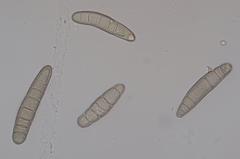 Bipolaris sorokinianat1pathogen
- Outcome
- Proton pumping by the H + ‐ATPasee0
- Direction
- reducede0
- Value
- 500 μMe0
Not reportedComparator
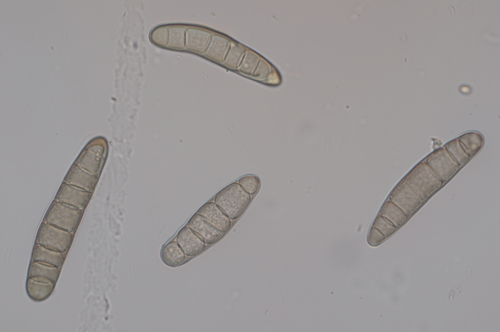
Organisms pictured · Representative pictures of the matched species, not figures from the paper.

Verbatim
e0“Proton pumping by the H + ‐ATPase was drastically reduced in a dose‐dependent manner, with complete inhibition at 500 μM prehelminthosporol”
t0“barley”
t1“Bipolaris sorokiniana”
Claim · model-written summary
Toxin inhibited ATP hydrolysis by 35% at 500 μM.
- Taxon
- barleyHordeum vulgaret0
- Treatment
- 500 μM toxine0
- Interactor
- Bipolaris sorokinianaBipolaris sorokinianat1pathogen
- Outcome
- ATP hydrolysise0
- Direction
- inhibitione0
- Value
- 35%e0
Not reportedComparator
Organisms pictured · Representative pictures of the matched species, not figures from the paper.
Verbatim
e0“inhibition of ATP hydrolysis was less drastic, with a 35% inhibition at 500 μM toxin”
t0“barley”
t1“Bipolaris sorokiniana”
Claim · model-written summary
Toxin reduced calcium uptake, reaching 60% maximal inhibition at 500 μM.
- Taxon
- barleyHordeum vulgaret0
- Treatment
- 500 μM toxine0
- Interactor
- Bipolaris sorokinianaBipolaris sorokinianat1pathogen
- Outcome
- Ca 2+ uptakee0
- Direction
- reducede0
- Value
- 60%e0
Not reportedComparator
Organisms pictured · Representative pictures of the matched species, not figures from the paper.
Verbatim
e0“Ca 2+ uptake was also reduced, although to a lesser extent than proton pumping, with a maximal inhibition of 60% at 500 μM toxin”
t0“barley”
t1“Bipolaris sorokiniana”
Claim · model-written summary
Low toxin concentrations weakly stimulated 1,3-beta-glucan synthase activity.
- Taxon
- barleyHordeum vulgaret0
- Treatment
- toxin concentrations below 100 μMe0
- Interactor
- Bipolaris sorokinianaBipolaris sorokinianat1pathogen
- Outcome
- 1, 3‐β‐glucan synthase activitye0
- Direction
- stimulatede0
Not reportedComparator
Organisms pictured · Representative pictures of the matched species, not figures from the paper.
Verbatim
e0“The 1, 3‐β‐glucan synthase activity was weakly stimulated at toxin concentrations below 100 μM”
t0“barley”
t1“Bipolaris sorokiniana”
Claim · model-written summary
Higher toxin concentrations inhibited 1,3-beta-glucan synthase activity.
- Taxon
- barleyHordeum vulgaret0
- Treatment
- higher concentrationse0
- Interactor
- Bipolaris sorokinianaBipolaris sorokinianat1pathogen
- Outcome
- 1, 3‐β‐glucan synthase activitye1
- Direction
- inhibitorye0
Not reportedComparator
Organisms pictured · Representative pictures of the matched species, not figures from the paper.
Verbatim
e0“with higher concentrations being inhibitory”
e1“The 1, 3‐β‐glucan synthase activity was weakly stimulated”
t0“barley”
t1“Bipolaris sorokiniana”
Claim · model-written summary
The authors inferred that toxin disrupts the membrane barrier and proton gradient.
- Taxon
- barleyHordeum vulgaret0
- Outcome
- proton gradiente0
- Qualifier
- disrupt the membrane barriere0
Organisms pictured · Representative pictures of the matched species, not figures from the paper.
Verbatim
e0“it appears to disrupt the membrane barrier and thus seriously interfere with establishment of the proton gradient”
t0“barley”
Claim · model-written summary
The authors inferred that toxin inhibits enzyme activities.
- Taxon
- barleyHordeum vulgaret0
- Outcome
- enzyme activitiese0
- Qualifier
- inhibite0
Organisms pictured · Representative pictures of the matched species, not figures from the paper.
Verbatim
e0“it appears to inhibit the enzyme activities”
t0“barley”
The same questions in other papers
pathogen product · Bipolaris sorokiniana · Hordeum vulgare (barley)Results agree
1 paper in the same direction as this paper
- negative
Claims are grouped by organism, treatment and what was measured or targeted. A paper counts as positive when any of its claims in the group is positive.