Abstract
In this study, we report new insights into the function of a wheat (Triticum aestivum) MYB gene TaPIMP1 through overexpression and underexpression, and its underlying mechanism in wheat. Electrophoretic mobility shift and yeast-one-hybrid assays indicated that TaPIMP1 can bind to five MYB-binding sites including ACI, and activate the expression of the genes with the cis-element, confirming that TaPIMP1 is an MYB transcription activator. TaPIMP1-overexpressing transgenic wheat exhibited significantly enhanced resistance to the fungal pathogen Bipolaris sorokiniana and drought stresses, whereas TaPIMP1-underexpressing transgenic wheat showed more susceptibility to the stresses compared with untransformed wheat, revealing that TaPIMP1 positively modulates host-defense responses to B. sorokiniana and drought stresses. Microarray analysis showed that a subset of defense- and stress-related genes were up-regulated by TaPIMP1. These genes, including TaPIMP1, RD22, TLP4 and PR1a, were regulated by ABA and salicylic acid (SA). TaPIMP1-underexpressing transgenic wheat showed compromised induction of these stress-responsive genes following ABA and SA treatments. In summary, TaPIMP1, as a positive molecular linker, mediates resistance to B. sorokiniana and drought stresses by regulation of stress-related genes in ABA- and SA-signaling pathways in wheat. Furthermore, TaPIMP1 may provide a transgenic tool for engineering multiple-resistance wheat in breeding programs.
Abstract from the paper’s OpenAlex record, shown for indexing and research. Copyright remains with the authors or the publisher. Read at the source ↗
The text the model read, with the source record’s inline markup (italics, sub- and superscripts) rendered and its character entities decoded; quote offsets refer to the raw text.
Claims 7
Claim · model-written summary
Overexpression of TaPIMP1 significantly enhanced wheat resistance to the fungal pathogen Bipolaris sorokiniana.
- Taxon
- wheat
 Triticum aestivume1
- Material
- TaPIMP1-overexpressing transgenic wheate1
- Treatment
- overexpressinge1
- Interactor
- Bipolaris sorokiniana
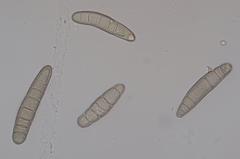 Bipolaris sorokinianae1pathogen
- Gene
- TaPIMP1e1
- Outcome
- resistancee1
- Direction
- enhancede1
Not reportedComparator
Organisms pictured · Representative pictures of the matched species, not figures from the paper.

Verbatim
e1“TaPIMP1-overexpressing transgenic wheat exhibited significantly enhanced resistance to the fungal pathogen Bipolaris sorokiniana and drought stresses”
Claim · model-written summary
Overexpression of TaPIMP1 significantly enhanced wheat resistance to drought stresses.
- Taxon
- wheatTriticum aestivume1
- Material
- TaPIMP1-overexpressing transgenic wheate1
- Treatment
- drought stressese1
- Gene
- TaPIMP1e1
- Outcome
- resistancee1
- Direction
- enhancede1
Not reportedComparator
Organisms pictured · Representative pictures of the matched species, not figures from the paper.
Verbatim
e1“TaPIMP1-overexpressing transgenic wheat exhibited significantly enhanced resistance to the fungal pathogen Bipolaris sorokiniana and drought stresses”
Claim · model-written summary
Underexpression of TaPIMP1 made wheat more susceptible to the stresses (B. sorokiniana and drought) than untransformed wheat.
- Taxon
- wheatTriticum aestivume2
- Material
- TaPIMP1-underexpressing transgenic wheate2
- Treatment
- stressese2
- Gene
- TaPIMP1e2
- Outcome
- susceptibilitye2
- Direction
- moree2
- Comparator
- untransformed wheate2
Organisms pictured · Representative pictures of the matched species, not figures from the paper.
Verbatim
e2“TaPIMP1-underexpressing transgenic wheat showed more susceptibility to the stresses compared with untransformed wheat”
Claim · model-written summary
Underexpression of TaPIMP1 compromised the induction of stress-responsive genes after ABA and SA treatments in wheat.
- Taxon
- wheatTriticum aestivume3
- Material
- TaPIMP1-underexpressing transgenic wheate3
- Treatment
- ABA and SA treatmentse3
- Gene
- TaPIMP1e3
- Outcome
- induction of these stress-responsive genese3
- Direction
- compromisede3
Not reportedComparator
Organisms pictured · Representative pictures of the matched species, not figures from the paper.
Verbatim
e3“TaPIMP1-underexpressing transgenic wheat showed compromised induction of these stress-responsive genes following ABA and SA treatments”
Claim · model-written summary
Microarray analysis showed that TaPIMP1 up-regulated a subset of defense- and stress-related genes in wheat.
- Taxon
- wheatTriticum aestivume5
- Treatment
- TaPIMP1e4
- Gene
- TaPIMP1e5
- Outcome
- defense- and stress-related genese4
- Direction
- up-regulatede4
Not reportedComparator
Organisms pictured · Representative pictures of the matched species, not figures from the paper.
Verbatim
e4“Microarray analysis showed that a subset of defense- and stress-related genes were up-regulated by TaPIMP1”
e5“a wheat (Triticum aestivum) MYB gene TaPIMP1”
Claim · model-written summary
TaPIMP1 binds to five MYB-binding sites including ACI in wheat.
- Taxon
- wheatTriticum aestivume5
- Gene
- TaPIMP1e6
- Outcome
- bind to five MYB-binding sitese6
Organisms pictured · Representative pictures of the matched species, not figures from the paper.
Verbatim
e5“a wheat (Triticum aestivum) MYB gene TaPIMP1”
e6“TaPIMP1 can bind to five MYB-binding sites including ACI”
Claim · model-written summary
TaPIMP1 activates expression of genes carrying the cis-element in wheat.
- Taxon
- wheatTriticum aestivume5
- Gene
- TaPIMP1e5
- Outcome
- expression of the genes with the cis-elemente7
- Direction
- activatee7
Organisms pictured · Representative pictures of the matched species, not figures from the paper.
Verbatim
e5“a wheat (Triticum aestivum) MYB gene TaPIMP1”
e7“activate the expression of the genes with the cis-element”
The same questions in other papers
salicylic acid · molecular: expression · Triticum aestivum (wheat)Positive and negative results
5 papers in the same direction as this paper · 29 in the opposite direction
- positive
- positive
- positive
31 papers more in this group
See all 35 papers →(+)-abscisic acid · molecular: expression · Triticum aestivum (wheat)Positive and negative results
8 papers in the same direction as this paper · 34 in the opposite direction
- positive
- positive
- positive
39 papers more in this group
See all 43 papers →Claims are grouped by organism, treatment and what was measured or targeted. A paper counts as positive when any of its claims in the group is positive.