Abstract
Dark septate endophytes (DSE) are common and abundant root-colonizing fungi in the native tallgrass prairie. To characterize DSE fungi were isolated from roots of mixed tallgrass prairie plant communities. Isolates were grouped according to morphology, and the grouping was refined by ITS-RFLP and/or sequencing of the ITS region. Sporulating species of Periconia, Fusarium, Microdochium and Aspergillus were isolated along with many sterile fungi. Leek resynthesis was used to quickly screen for DSE fungi among the isolates. Periconia macro-spinosa and Microdochium sp. formed typical DSE structures in the roots; Periconia produced melanized intracellular microsclerotia in host root cortex, whereas Microdochium produced abundant melanized inter- and intracellular chlamydospores. To further validate the results of the leek resynthesis growth responses of leek and a dominant prairie grass, Andropogon gerardii, were assessed in a laboratory resynthesis system. Leek growth mainly was unresponsive to the inoculation with Periconia or Microdochium, whereas Andropogon tended to respond positively. Select Periconia and Microdochium isolates were tested further for their enzymatic capabilities and for ability to use organic and inorganic nitrogen sources. These fungi tested positive for amylase, cellulase, polyphenol oxidases and gelatinase. Periconia isolates used both organic and inorganic nitrogen sources. Our study identified distinct endophytes in a tallgrass prairie ecosystem and indicated that these endo-phytes can use a variety of complex nutrient sources, suggesting facultative biotrophic and saprotrophic habits.
Abstract from the paper’s OpenAlex record, shown for indexing and research. Copyright remains with the authors or the publisher. Read at the source ↗
The text the model read, with the source record’s inline markup (italics, sub- and superscripts) rendered and its character entities decoded; quote offsets refer to the raw text.
Claims 11
Claim · model-written summary
Periconia, Fusarium, Microdochium and Aspergillus were isolated from tallgrass prairie roots.
- Taxon
- tallgrass prairie plant communitiese1
- Outcome
- were isolated along with many sterile fungie0
- Qualifier
- Fusarium, Microdochium and Aspergilluse0
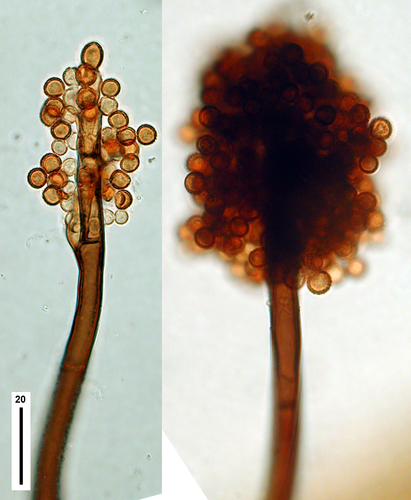
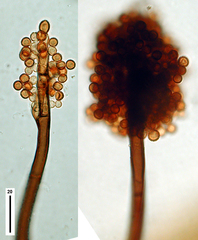 Periconia
Organisms pictured · Representative pictures of the matched species, not figures from the paper.
Verbatim
e0“Sporulating species of Periconia, Fusarium, Microdochium and Aspergillus were isolated along with many sterile fungi.”
e1“roots of mixed tallgrass prairie plant communities”
Claim · model-written summary
Periconia macro-spinosa formed typical dark septate endophyte structures in leek roots.
- Taxon
- Leek
 Allium ampeloprasume1
- Interactor
- Periconia macro-spinosaPericonia macrospinosae0symbiont
- Outcome
- typical DSE structures in the rootse0
Organisms pictured · Representative pictures of the matched species, not figures from the paper.

Verbatim
e0“Periconia macro-spinosa and Microdochium sp. formed typical DSE structures in the roots”
e1“Leek resynthesis was used to quickly screen for DSE fungi among the isolates.”
Claim · model-written summary
Microdochium sp. formed typical dark septate endophyte structures in leek roots.
- Taxon
- LeekAllium ampeloprasume1
- Interactor
- Microdochium sp.
 Microdochiume0symbiont
- Outcome
- typical DSE structures in the rootse0
Organisms pictured · Representative pictures of the matched species, not figures from the paper.

Verbatim
e0“Periconia macro-spinosa and Microdochium sp. formed typical DSE structures in the roots”
e1“Leek resynthesis was used to quickly screen for DSE fungi among the isolates.”
Claim · model-written summary
Periconia formed melanized intracellular microsclerotia in host root cortex.
- Taxon
- LeekAllium ampeloprasume1
- Outcome
- melanized intracellular microsclerotia in host root cortexe0
Organisms pictured · Representative pictures of the matched species, not figures from the paper.
Verbatim
e0“Periconia produced melanized intracellular microsclerotia in host root cortex”
e1“Leek resynthesis was used to quickly screen for DSE fungi among the isolates.”
Claim · model-written summary
Microdochium formed abundant melanized chlamydospores in host roots.
- Taxon
- LeekAllium ampeloprasume1
- Interactor
- MicrodochiumMicrodochiume0symbiont
- Outcome
- abundant melanized inter- and intracellular chlamydosporese0
Organisms pictured · Representative pictures of the matched species, not figures from the paper.
Verbatim
e0“Microdochium produced abundant melanized inter- and intracellular chlamydospores.”
e1“Leek resynthesis was used to quickly screen for DSE fungi among the isolates.”
Claim · model-written summary
Leek growth was mainly unresponsive to Periconia inoculation.
- Taxon
- LeekAllium ampeloprasume0
- Treatment
- inoculation with Periconiae0
- Outcome
- Leek growthe0
- Direction
- unresponsivee0
Not reportedComparator
Organisms pictured · Representative pictures of the matched species, not figures from the paper.
Verbatim
e0“Leek growth mainly was unresponsive to the inoculation with Periconia or Microdochium”
Claim · model-written summary
Leek growth was mainly unresponsive to Microdochium inoculation.
- Taxon
- LeekAllium ampeloprasume0
- Treatment
- inoculation with Periconia or Microdochiume0
- Interactor
- MicrodochiumMicrodochiume0symbiont
- Outcome
- Leek growthe0
- Direction
- unresponsivee0
Not reportedComparator
Organisms pictured · Representative pictures of the matched species, not figures from the paper.
Verbatim
e0“Leek growth mainly was unresponsive to the inoculation with Periconia or Microdochium”
Claim · model-written summary
Andropogon gerardii tended to respond positively to Periconia inoculation.
- Taxon
- Andropogon gerardii
 Andropogon gerardie1
- Treatment
- inoculation with Periconia or Microdochiume2
- Outcome
- respond positivelye0
- Direction
- positivelye0
Not reportedComparator
Organisms pictured · Representative pictures of the matched species, not figures from the paper.

Verbatim
e0“Andropogon tended to respond positively.”
e1“a dominant prairie grass, Andropogon gerardii”
e2“inoculation with Periconia or Microdochium”
Claim · model-written summary
Andropogon gerardii tended to respond positively to Microdochium inoculation.
- Taxon
- Andropogon gerardiiAndropogon gerardie1
- Treatment
- inoculation with Periconia or Microdochiume2
- Interactor
- MicrodochiumMicrodochiume2symbiont
- Outcome
- respond positivelye0
- Direction
- positivelye0
Not reportedComparator
Organisms pictured · Representative pictures of the matched species, not figures from the paper.
Verbatim
e0“Andropogon tended to respond positively.”
e1“a dominant prairie grass, Andropogon gerardii”
e2“inoculation with Periconia or Microdochium”
Claim · model-written summary
The isolated endophytes tested positive for amylase, cellulase, polyphenol oxidases and gelatinase.
Verbatim
e0“These fungi tested positive for amylase, cellulase, polyphenol oxidases and gelatinase.”
e1“roots of mixed tallgrass prairie plant communities”
Claim · model-written summary
Periconia isolates used organic and inorganic nitrogen sources.
Organisms pictured · Representative pictures of the matched species, not figures from the paper.
Verbatim
e0“Periconia isolates used both organic and inorganic nitrogen sources.”
e1“roots of mixed tallgrass prairie plant communities”
The same questions in other papers
inoculation · growth · Allium ampeloprasum (leek)Positive and negative results
2 papers in the same direction as this paper · 7 in the opposite direction
- positive
- positive
- positive
6 papers more in this group
See all 10 papers →Claims are grouped by organism, treatment and what was measured or targeted. A paper counts as positive when any of its claims in the group is positive.