Abstract
Discussion about thrips (Thysanoptera) as main pollinators has been controversial in the past because thrips do not fit the preconception of an effective pollinator. In this study, we present evidence for thrips pollination in the dioecious pioneer tree genus Macaranga (Euphorbiaceae). Macaranga hullettii is pollinated predominantly by one thrips species, Neoheegeria sp. (Phlaeothripidae, Thysanoptera). As a reward for pollinators, the protective floral bracteoles function as breeding sites for thrips and trichomal nectaries on the adaxial surface of the floral bracteoles provide alimentation. Flowering phenology of both staminate and pistillate trees was highly synchronized within 3-4 wk periods. In contrast to pistillate trees, staminate trees start to breed the thrips inside the developing inflorescences ∼2 wk before anthesis. Breeding of Neoheegeria sp. in the laboratory indicates that the thrips development is completed within ∼17 d. Thus, staminate trees offer breeding sites for one thrips generation until the onset of pollen presentation. Intraspecific pollen transfer by thrips was proved by pollen loads of thrips taken from receptive pistillate inflorescences of M. hullettii. Bagging experiments of different mesh sizes showed that seed set reached almost the level of open-pollinated flowers when exclusively tiny insects like thrips were able to enter the net bags, but no apomictic seed set occurred when no insect access was given to the flowers.
Abstract from the paper’s OpenAlex record, shown for indexing and research. Copyright remains with the authors or the publisher. Read at the source ↗
The text the model read, with the source record’s inline markup (italics, sub- and superscripts) rendered and its character entities decoded; quote offsets refer to the raw text.
Claims 9
Claim · model-written summary
Macaranga hullettii is pollinated by thrips
- Taxon
- Macaranga hullettii
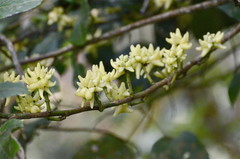 Macaranga hullettiie0
- Interactor
- Neoheegeria sp.Neoheegeriae0pollinator
- Outcome
- pollinatione2
Organisms pictured · Representative pictures of the matched species, not figures from the paper.
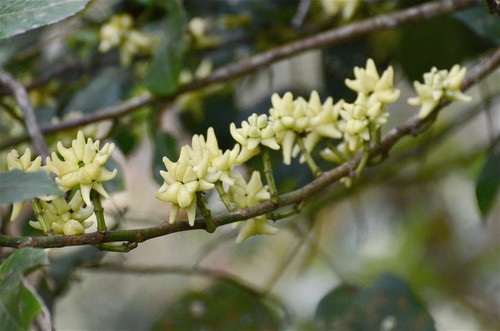
Verbatim
e0“Macaranga hullettii is pollinated predominantly by one thrips species, Neoheegeria sp.”
e2“we present evidence for thrips pollination in the dioecious pioneer tree genus Macaranga”
Claim · model-written summary
Flowering phenology of staminate and pistillate Macaranga hullettii trees was highly synchronized within 3-4 weeks
- Taxon
- Macaranga hullettiiMacaranga hullettiie0
- Outcome
- Flowering phenologye1
- Value
- 3-4 wk periodse1
- Qualifier
- highly synchronizede1
Organisms pictured · Representative pictures of the matched species, not figures from the paper.
Verbatim
e0“Macaranga hullettii is pollinated predominantly by one thrips species, Neoheegeria sp.”
e1“Flowering phenology of both staminate and pistillate trees was highly synchronized within 3-4 wk periods”
Claim · model-written summary
Staminate Macaranga hullettii trees start breeding thrips inside developing inflorescences about 2 weeks before anthesis, unlike pistillate trees
- Taxon
- Macaranga hullettiiMacaranga hullettiie0
- Outcome
- start to breed the thrips inside the developing inflorescencese2
- Value
- ∼2 wk before anthesise2
- Comparator
- pistillate treese2
 Thrips
Organisms pictured · Representative pictures of the matched species, not figures from the paper.

Verbatim
e0“Macaranga hullettii is pollinated predominantly by one thrips species, Neoheegeria sp.”
e2“In contrast to pistillate trees, staminate trees start to breed the thrips inside the developing inflorescences ∼2 wk before anthesis”
Claim · model-written summary
Thrips development on Neoheegeria sp. is completed within about 17 days in the laboratory
- Taxon
- Macaranga hullettiiMacaranga hullettiie0
- Interactor
- Neoheegeria sp.Neoheegeriae3pollinator
- Outcome
- thrips developmente3
- Value
- ∼17 de3
Organisms pictured · Representative pictures of the matched species, not figures from the paper.
Verbatim
e0“Macaranga hullettii is pollinated predominantly by one thrips species, Neoheegeria sp.”
e3“Breeding of Neoheegeria sp. in the laboratory indicates that the thrips development is completed within ∼17 d”
Claim · model-written summary
Staminate Macaranga hullettii trees offer breeding sites for one thrips generation until pollen presentation begins
- Taxon
- Macaranga hullettiiMacaranga hullettiie0
- Material
- staminate treese4
- Outcome
- breeding sites for one thrips generatione4
- Qualifier
- until the onset of pollen presentatione4
Organisms pictured · Representative pictures of the matched species, not figures from the paper.
Verbatim
e0“Macaranga hullettii is pollinated predominantly by one thrips species, Neoheegeria sp.”
e4“Thus, staminate trees offer breeding sites for one thrips generation until the onset of pollen presentation”
Claim · model-written summary
Intraspecific pollen transfer by thrips was demonstrated in Macaranga hullettii
- Taxon
- Macaranga hullettiiMacaranga hullettiie0
- Outcome
- Intraspecific pollen transfer by thripse5
Organisms pictured · Representative pictures of the matched species, not figures from the paper.
Verbatim
e0“Macaranga hullettii is pollinated predominantly by one thrips species, Neoheegeria sp.”
e5“Intraspecific pollen transfer by thrips was proved by pollen loads of thrips taken from receptive pistillate inflorescences of M. hullettii”
Claim · model-written summary
Seed set of Macaranga hullettii bagged with mesh allowing tiny insects reached almost the level of open-pollinated flowers
- Taxon
- Macaranga hullettiiMacaranga hullettiie0
- Treatment
- Bagging experiments of different mesh sizese6
- Outcome
- seed sete6
- Direction
- no_changeinferrede6
- Qualifier
- when exclusively tiny insects like thrips were able to enter the net bagse6
- Comparator
- open-pollinated flowerse6
Organisms pictured · Representative pictures of the matched species, not figures from the paper.
Verbatim
e0“Macaranga hullettii is pollinated predominantly by one thrips species, Neoheegeria sp.”
e6“Bagging experiments of different mesh sizes showed that seed set reached almost the level of open-pollinated flowers when exclusively tiny insects like thrips were able to enter the net bags”
Claim · model-written summary
Macaranga hullettii flowers without insect access produced no apomictic seed set
- Taxon
- Macaranga hullettiiMacaranga hullettiie0
- Treatment
- no insect accesse7
- Outcome
- apomictic seed sete7
Not reportedComparatorDirection
Organisms pictured · Representative pictures of the matched species, not figures from the paper.
Verbatim
e0“Macaranga hullettii is pollinated predominantly by one thrips species, Neoheegeria sp.”
e7“but no apomictic seed set occurred when no insect access was given to the flowers”
Claim · model-written summary
The protective floral bracteoles of Macaranga hullettii function as breeding sites for thrips
- Taxon
- Macaranga hullettiiMacaranga hullettiie0
- Organ / stage
- floral bracteolese1
- Outcome
- the protective floral bracteoles function as breeding sites for thripse1
Organisms pictured · Representative pictures of the matched species, not figures from the paper.
Verbatim
e0“Macaranga hullettii is pollinated predominantly by one thrips species, Neoheegeria sp.”
e1“the protective floral bracteoles function as breeding sites for thrips”