Abstract
Field evaluation of new insecticides for the management of pomegranate aphid, Aphis punicae was carried out at Bijapur-Karnataka for two years during 2010 and 2011. The study revealed that thiamethoxam 25 WG @ 0.2 g/l recorded highest reduction in population followed by imidacloprid 70 WG @ 0.3g/l. During first year, the mean reduction with thiamethoxam was 90.19 and 94.10% after first and second spay, whereas during second year, the reduction was to the extent of 91.19 and 93.42%, respectively. Similarly, during 2010, imidacloprid recorded 87.92 and 90.39% reduction in population after first and second sprays whereas during 2011 it was 89.73 and 93.42%. The trees sprayed with thiamethoxam (9105 kg/ha) and imidacloprid (9038 kg/ha) recorded highest quantity of marketable fruits. Thus thiamethoxam and imidacloprid recorded highest gross returns, net returns and maximum B:C ratio.
Abstract from the paper’s OpenAlex record, shown for indexing and research. Copyright remains with the authors or the publisher. Read at the source ↗
The text the model read, with the source record’s inline markup (italics, sub- and superscripts) rendered and its character entities decoded; quote offsets refer to the raw text.
Claims 9
Claim · model-written summary
Thiamethoxam 25 WG at 0.2 g/l gave the highest reduction in pomegranate aphid population, followed by imidacloprid 70 WG at 0.3 g/l.
- Taxon
- pomegranate
 Punica granatumt0
- Treatment
- thiamethoxam 25 WG @ 0.2 g/le0
- Interactor
- Aphis punicae
 Aphis punicaee1pest
- Outcome
- reduction in populatione0
- Direction
- higheste0
- Comparator
- imidacloprid 70 WG @ 0.3g/le0
Organisms pictured · Representative pictures of the matched species, not figures from the paper.

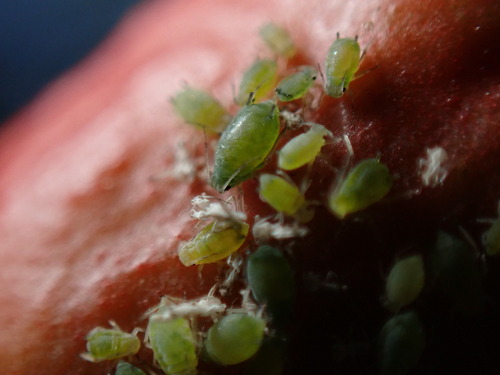
Verbatim
e0“thiamethoxam 25 WG @ 0.2 g/l recorded highest reduction in population followed by imidacloprid 70 WG @ 0.3g/l”
t0“pomegranate”
e1“Aphis punicae”
Claim · model-written summary
In the first year thiamethoxam reduced the aphid population by a mean of 90.19% and 94.10% after the first and second spray.
- Taxon
- pomegranatePunica granatumt0
- Treatment
- thiamethoxame0
- Interactor
- Aphis punicaeAphis punicaee1pest
- Outcome
- mean reductione0
- Direction
- reductione0
- Value
- 90.19 and 94.10%e0
Not reportedComparator
Organisms pictured · Representative pictures of the matched species, not figures from the paper.
Verbatim
e0“During first year, the mean reduction with thiamethoxam was 90.19 and 94.10% after first and second spay”
t0“pomegranate”
e1“Aphis punicae”
Claim · model-written summary
In the second year thiamethoxam reduced the aphid population by 91.19% and 93.42% after the first and second spray.
- Taxon
- pomegranatePunica granatumt0
- Treatment
- thiamethoxame0
- Interactor
- Aphis punicaeAphis punicaee1pest
- Outcome
- reductione0
- Direction
- reductione0
- Value
- 91.19 and 93.42%e0
Not reportedComparator
Organisms pictured · Representative pictures of the matched species, not figures from the paper.
Verbatim
e0“During first year, the mean reduction with thiamethoxam was 90.19 and 94.10% after first and second spay, whereas during second year, the reduction was to the extent of 91.19 and 93.42%”
t0“pomegranate”
e1“Aphis punicae”
Claim · model-written summary
In 2010 imidacloprid reduced the aphid population by 87.92% and 90.39% after the first and second spray.
- Taxon
- pomegranatePunica granatumt0
- Treatment
- imidaclopride0
- Interactor
- Aphis punicaeAphis punicaee1pest
- Outcome
- reduction in populatione0
- Direction
- reductione0
- Value
- 87.92 and 90.39%e0
Not reportedComparator
Organisms pictured · Representative pictures of the matched species, not figures from the paper.
Verbatim
e0“during 2010, imidacloprid recorded 87.92 and 90.39% reduction in population after first and second sprays”
t0“pomegranate”
e1“Aphis punicae”
Claim · model-written summary
In 2011 imidacloprid reduced the aphid population by 89.73% and 93.42%.
- Taxon
- pomegranatePunica granatumt0
- Treatment
- imidaclopride0
- Interactor
- Aphis punicaeAphis punicaee1pest
- Outcome
- reduction in populatione0
- Direction
- reductione0
- Value
- 89.73 and 93.42%e0
Not reportedComparator
Organisms pictured · Representative pictures of the matched species, not figures from the paper.
Verbatim
e0“during 2010, imidacloprid recorded 87.92 and 90.39% reduction in population after first and second sprays whereas during 2011 it was 89.73 and 93.42%”
t0“pomegranate”
e1“Aphis punicae”
Claim · model-written summary
Pomegranate trees sprayed with thiamethoxam gave the highest quantity of marketable fruits, 9105 kg/ha.
- Taxon
- pomegranatePunica granatumt0
- Treatment
- thiamethoxame0
- Outcome
- quantity of marketable fruitse0
- Direction
- higheste0
- Value
- 9105 kg/hae0
Not reportedComparator
Organisms pictured · Representative pictures of the matched species, not figures from the paper.
Verbatim
e0“The trees sprayed with thiamethoxam (9105 kg/ha) and imidacloprid (9038 kg/ha) recorded highest quantity of marketable fruits”
t0“pomegranate”
Claim · model-written summary
Pomegranate trees sprayed with imidacloprid gave the highest quantity of marketable fruits, 9038 kg/ha.
- Taxon
- pomegranatePunica granatumt0
- Treatment
- imidaclopride0
- Outcome
- quantity of marketable fruitse0
- Direction
- higheste0
- Value
- 9038 kg/hae0
Not reportedComparator
Organisms pictured · Representative pictures of the matched species, not figures from the paper.
Verbatim
e0“The trees sprayed with thiamethoxam (9105 kg/ha) and imidacloprid (9038 kg/ha) recorded highest quantity of marketable fruits”
t0“pomegranate”
Claim · model-written summary
Thiamethoxam gave the highest gross returns, net returns and maximum B:C ratio.
- Taxon
- pomegranatePunica granatumt0
- Treatment
- thiamethoxame0
- Outcome
- gross returns, net returns and maximum B:C ratioe0
- Direction
- higheste0
Not reportedComparator
Organisms pictured · Representative pictures of the matched species, not figures from the paper.
Verbatim
e0“thiamethoxam and imidacloprid recorded highest gross returns, net returns and maximum B:C ratio”
t0“pomegranate”
Claim · model-written summary
Imidacloprid gave the highest gross returns, net returns and maximum B:C ratio.
- Taxon
- pomegranatePunica granatumt0
- Treatment
- imidaclopride0
- Outcome
- gross returns, net returns and maximum B:C ratioe0
- Direction
- higheste0
Not reportedComparator
Organisms pictured · Representative pictures of the matched species, not figures from the paper.
Verbatim
e0“thiamethoxam and imidacloprid recorded highest gross returns, net returns and maximum B:C ratio”
t0“pomegranate”
The same questions in other papers
thiamethoxam · quality: postharvest · Punica granatum (pomegranate)Results agree
1 paper in the same direction as this paper
- positive
imidacloprid · quality: postharvest · Punica granatum (pomegranate)Results agree
1 paper in the same direction as this paper
- positive
thiamethoxam · yield · Punica granatum (pomegranate)Results agree
1 paper in the same direction as this paper
- positive
imidacloprid · yield · Punica granatum (pomegranate)Results agree
1 paper in the same direction as this paper
- positive
thiamethoxam · Aphis punicae · Punica granatum (pomegranate)Results agree
4 papers in the same direction as this paper
- positive
- positive
- positive
1 paper more in this group
See all 5 papers →imidacloprid · Aphis punicae · Punica granatum (pomegranate)Results agree
4 papers in the same direction as this paper
- positive
- positive
- positive
1 paper more in this group
See all 5 papers →Claims are grouped by organism, treatment and what was measured or targeted. A paper counts as positive when any of its claims in the group is positive.