Abstract
Considerable evidence of the interrelations existing between bird and insect life has come to light in connection with investigations into the economic status of certain birds carried on under the auspices of the California State Fish and Game Commission and the University of California.Some of the best evidence came from an investigation of a grasshopper outbreak in the vicinity of Los Banos, Merced County, California.A part of the results of this investigation was published in the University of California ' Publications in Zoology,' volume 11, pages 1-20.In the present paper additional matter is combined with a part of that previously presented, the whole being now offered with a special view to the problem of insect destruction by birds in California.Certain sections of California are annually troubled with grasshoppers, and there is seldom a year when they do not cause considerable damage to crops in some part of the state.Reports of damage caused by grasshoppers in 1912 first began to be received in June.The western part of Merced County, and parts of Kings and Kern Counties were most affected.In the vicinity of Los Banos, Merced County, where the investigation was carried on, grasshoppers give some trouble each year but their depredations in 1912 were more extensive than usual.On many of the ranches the entire summer crop of alfalfa was destroyed.The only control measure resorted to was burning over of pasture and alfalfa land.As most of the grasshoppers already had wings when the burning was done, the majority escaped unharmed.Garden truck and small trees in the infested areas were attacked by the pests.Corn, tomatoes, and even onions were stripped of every leaf.In many instances small shade trees, even including eucalyptus, were completely defoliated.The species of grasshopper causing the damage was the diiferential grasshopper, Melanoplus differentialis.The only other species noted at the time were Camnula pellucida, Conozoa behrensi, and Parapomala calamus.
Abstract from the paper’s OpenAlex record; open copy licensed public-domain. Read at the source ↗
The text the model read, with the source record’s inline markup (italics, sub- and superscripts) rendered and its character entities decoded; quote offsets refer to the raw text.
Claims 14
Claim · model-written summary
Grasshopper depredations near Los Banos in 1912 were more extensive than usual.
Verbatim
e0“In the vicinity of Los Banos, Merced County, where the investigation was carried on, grasshoppers give some trouble each year but their depredations in 1912 were more extensive than usual.”
Claim · model-written summary
The entire summer alfalfa crop was destroyed on many ranches.
- Taxon
- alfalfa
 Medicago sativae0
- Interactor
- Melanoplus differentialis
 Melanoplus differentialise1pest
- Outcome
- entire summer crop of alfalfa was destroyede0
- Qualifier
- many of the ranchese0
Not reportedDirection
Organisms pictured · Representative pictures of the matched species, not figures from the paper.


Verbatim
e0“On many of the ranches the entire summer crop of alfalfa was destroyed.”
e1“The species of grasshopper causing the damage was the diiferential grasshopper, Melanoplus differentialis.”
Claim · model-written summary
Most grasshoppers escaped burning unharmed because they already had wings.
- Taxon
- grasshoppersAcridomorphae0
- Treatment
- burning over of pasture and alfalfa lande0
- Outcome
- majority escaped unharmede0
- Qualifier
- already had wingse0
Not reportedComparatorDirection
Verbatim
e0“The only control measure resorted to was burning over of pasture and alfalfa land.As most of the grasshoppers already had wings when the burning was done, the majority escaped unharmed.”
Claim · model-written summary
Garden truck was attacked in infested areas.
- Taxon
- Garden trucke0
- Interactor
- Melanoplus differentialisMelanoplus differentialise1pest
- Outcome
- attacked by the pestse0
- Setting
- infested arease0
Not reportedDirection
Organisms pictured · Representative pictures of the matched species, not figures from the paper.
Verbatim
e0“Garden truck and small trees in the infested areas were attacked by the pests.”
e1“The species of grasshopper causing the damage was the diiferential grasshopper, Melanoplus differentialis.”
Claim · model-written summary
Small trees were attacked in infested areas.
- Taxon
- small treese0
- Interactor
- Melanoplus differentialisMelanoplus differentialise1pest
- Outcome
- attacked by the pestse0
- Setting
- infested arease0
Not reportedDirection
Organisms pictured · Representative pictures of the matched species, not figures from the paper.
Verbatim
e0“Garden truck and small trees in the infested areas were attacked by the pests.”
e1“The species of grasshopper causing the damage was the diiferential grasshopper, Melanoplus differentialis.”
Claim · model-written summary
Corn was stripped of every leaf.
- Taxon
- Corn
 Zea mays subsp. mayse0
- Interactor
- Melanoplus differentialisMelanoplus differentialise1pest
- Outcome
- stripped of every leafe0
Not reportedDirection
Organisms pictured · Representative pictures of the matched species, not figures from the paper.

Verbatim
e0“Corn, tomatoes, and even onions were stripped of every leaf.”
e1“The species of grasshopper causing the damage was the diiferential grasshopper, Melanoplus differentialis.”
Claim · model-written summary
Tomatoes were stripped of every leaf.
- Taxon
- tomatoes
 Solanum lycopersicume0
- Interactor
- Melanoplus differentialisMelanoplus differentialise1pest
- Outcome
- stripped of every leafe0
Not reportedDirection
Organisms pictured · Representative pictures of the matched species, not figures from the paper.

Verbatim
e0“Corn, tomatoes, and even onions were stripped of every leaf.”
e1“The species of grasshopper causing the damage was the diiferential grasshopper, Melanoplus differentialis.”
Claim · model-written summary
Onions were stripped of every leaf.
- Taxon
- onions
 Allium cepae0
- Interactor
- Melanoplus differentialisMelanoplus differentialise1pest
- Outcome
- stripped of every leafe0
Not reportedDirection
Organisms pictured · Representative pictures of the matched species, not figures from the paper.

Verbatim
e0“Corn, tomatoes, and even onions were stripped of every leaf.”
e1“The species of grasshopper causing the damage was the diiferential grasshopper, Melanoplus differentialis.”
Claim · model-written summary
Small shade trees were completely defoliated in many instances.
- Taxon
- small shade treese0
- Interactor
- Melanoplus differentialisMelanoplus differentialise1pest
- Outcome
- completely defoliatede0
Not reportedDirection
Organisms pictured · Representative pictures of the matched species, not figures from the paper.
Verbatim
e0“In many instances small shade trees, even including eucalyptus, were completely defoliated.”
e1“The species of grasshopper causing the damage was the diiferential grasshopper, Melanoplus differentialis.”
Claim · model-written summary
Eucalyptus trees were completely defoliated.
- Taxon
- eucalyptus
 Eucalyptuse0
- Interactor
- Melanoplus differentialisMelanoplus differentialise1pest
- Outcome
- completely defoliatede0
Not reportedDirection
Organisms pictured · Representative pictures of the matched species, not figures from the paper.

Verbatim
e0“In many instances small shade trees, even including eucalyptus, were completely defoliated.”
e1“The species of grasshopper causing the damage was the diiferential grasshopper, Melanoplus differentialis.”
Claim · model-written summary
The damage-causing grasshopper was identified as Melanoplus differentialis.
- Taxon
- Melanoplus differentialisMelanoplus differentialise0
- Outcome
- species of grasshopper causing the damagee0
Not reportedDirection
Organisms pictured · Representative pictures of the matched species, not figures from the paper.
Verbatim
e0“The species of grasshopper causing the damage was the diiferential grasshopper, Melanoplus differentialis.”
Claim · model-written summary
Camnula pellucida was also observed during the investigation.
- Taxon
- Camnula pellucida
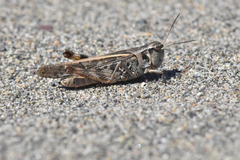 Camnula pellucidae0
- Outcome
- species noted at the timee0
Not reportedDirection
Organisms pictured · Representative pictures of the matched species, not figures from the paper.
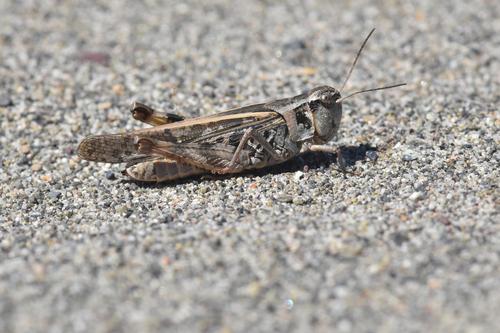
Verbatim
e0“The only other species noted at the time were Camnula pellucida, Conozoa behrensi, and Parapomala calamus.”
Claim · model-written summary
Conozoa behrensi was also observed during the investigation.
Not reportedDirection
Verbatim
e0“The only other species noted at the time were Camnula pellucida, Conozoa behrensi, and Parapomala calamus.”
Claim · model-written summary
Parapomala calamus was also observed during the investigation.
Not reportedDirection
Verbatim
e0“The only other species noted at the time were Camnula pellucida, Conozoa behrensi, and Parapomala calamus.”