Abstract
Campomanesia aurea (O. Berg) is a species native to southern Brazil, naturally occurring from the state of São Paulo to Rio Grande do Sul, and presenting a great ornamental potential. The objective was to verify the rooting of semihardwood cuttings of Campomanesia aurea using indolebutyric acid (IBA) doses. The cuttings were collected in the municipality of Barão do Triunfo, Rio Grande do Sul State, in December 2014. The cutting base was immersed in concentrations of zero (control), 2,000, 4,000, 6,000 and 8,000 mg L-1 of IBA, subsequently established in a carbonized rice husk substrate and placed in a protected environment with an intermittent misting system. At 111 days after installation, dead and rooted cuttings, leaf retention, callus formation, root volume, root and shoot dry matter were evaluated. The experimental design was completely randomized with four replications with 20 cuttings. Data were submitted to analysis of variance and regression. No statistical differences were found for any of the evaluations. An average rooting was observed in 28% of cuttings and callus formation was observed in 48% of cuttings. Root average volume per cutting was 0.15 mL, root dry mass was 0.01 g, and shoot dry mass was 0.28 g. There was a negative correlation between leaf retention and mortality of cuttings. It is concluded that the production of C. aurea by cutting is viable, and that there was no positive response to the application of IBA with the conditions under which the experiment was developed.
Abstract from the paper’s OpenAlex record; open copy licensed cc-by. Read at the source ↗
The text the model read, with the source record’s inline markup (italics, sub- and superscripts) rendered and its character entities decoded; quote offsets refer to the raw text.
Claims 8
Claim · model-written summary
An average rooting of 28% was observed in cuttings of Campomanesia aurea.
- Taxon
- Campomanesia aurea
 Campomanesia aureae0
- Organ / stage
- cuttingse1
- Outcome
- rootinge1
- Value
- 28%e1
Organisms pictured · Representative pictures of the matched species, not figures from the paper.
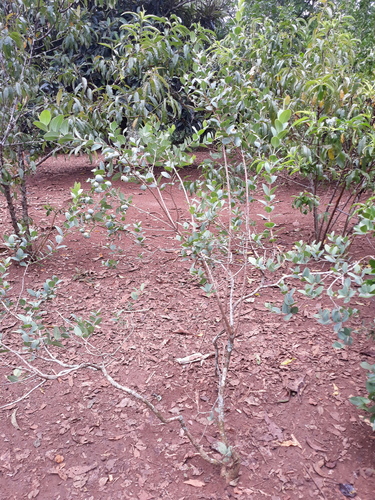
Verbatim
e0“Campomanesia aurea (O. Berg) is a species native to southern Brazil”
e1“An average rooting was observed in 28% of cuttings”
Claim · model-written summary
Callus formation was observed in 48% of Campomanesia aurea cuttings.
- Taxon
- Campomanesia aureaCampomanesia aureae0
- Organ / stage
- cuttingse2
- Outcome
- callus formatione2
- Value
- 48%e2
Organisms pictured · Representative pictures of the matched species, not figures from the paper.
Verbatim
e0“Campomanesia aurea (O. Berg) is a species native to southern Brazil”
e2“callus formation was observed in 48% of cuttings”
Claim · model-written summary
Root average volume per cutting of Campomanesia aurea was 0.15 mL.
- Taxon
- Campomanesia aureaCampomanesia aureae0
- Organ / stage
- Roote4
- Outcome
- root average volume per cuttinge4
- Value
- 0.15 mLe4
Organisms pictured · Representative pictures of the matched species, not figures from the paper.
Verbatim
e0“Campomanesia aurea (O. Berg) is a species native to southern Brazil”
e4“Root average volume per cutting was 0.15 mL”
Claim · model-written summary
Root dry mass of Campomanesia aurea cuttings was 0.01 g.
- Taxon
- Campomanesia aureaCampomanesia aureae0
- Organ / stage
- roote5
- Outcome
- root dry masse5
- Value
- 0.01 ge5
Organisms pictured · Representative pictures of the matched species, not figures from the paper.
Verbatim
e0“Campomanesia aurea (O. Berg) is a species native to southern Brazil”
e5“root dry mass was 0.01 g”
Claim · model-written summary
Shoot dry mass of Campomanesia aurea cuttings was 0.28 g.
- Taxon
- Campomanesia aureaCampomanesia aureae0
- Organ / stage
- shoote6
- Outcome
- shoot dry masse6
- Value
- 0.28 ge6
Organisms pictured · Representative pictures of the matched species, not figures from the paper.
Verbatim
e0“Campomanesia aurea (O. Berg) is a species native to southern Brazil”
e6“shoot dry mass was 0.28 g”
Claim · model-written summary
Leaf retention was negatively correlated with mortality of Campomanesia aurea cuttings.
- Taxon
- Campomanesia aureaCampomanesia aureae0
- Organ / stage
- leafe7
- Outcome
- mortality of cuttingse7
- Direction
- negativee7
Organisms pictured · Representative pictures of the matched species, not figures from the paper.
Verbatim
e0“Campomanesia aurea (O. Berg) is a species native to southern Brazil”
e7“There was a negative correlation between leaf retention and mortality of cuttings”
Claim · model-written summary
Cutting propagation of Campomanesia aurea is viable.
- Taxon
- C. aureaCampomanesia aureae4
- Outcome
- production of C. aurea by cuttinge4
Organisms pictured · Representative pictures of the matched species, not figures from the paper.
Verbatim
e4“It is concluded that the production of C. aurea by cutting is viable”
Claim · model-written summary
IBA doses of 2,000 to 8,000 mg L-1 gave no significant difference in any cutting evaluation or positive response compared with the zero control.
- Taxon
- Campomanesia aureaCampomanesia aureae0
- Treatment
- IBAe4
- Outcome
- any of the evaluationse5
- Direction
- no_changeinferrede5
- Comparator
- zero (control)e4
Organisms pictured · Representative pictures of the matched species, not figures from the paper.
Verbatim
e0“Campomanesia aurea (O. Berg) is a species native to southern Brazil”
e4“The cutting base was immersed in concentrations of zero (control), 2,000, 4,000, 6,000 and 8,000 mg L-1 of IBA”
e5“No statistical differences were found for any of the evaluations”
e6“there was no positive response to the application of IBA”