Claim · model-written summary
The April essential oil yield of Campomanesia aurea leaves was 4.44%.
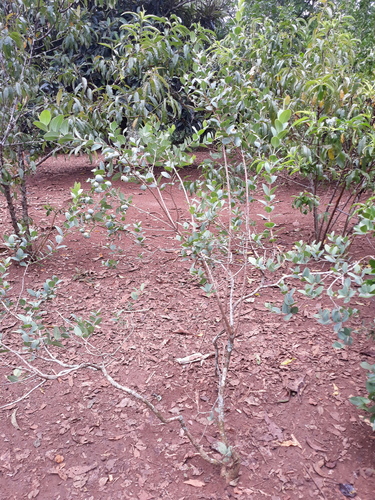
 Campomanesia aurea
Verbatim
e0“The essential oil (EO) composition of leaves of Campomanesia aurea was analyzed by GC-MS”
e1“The plant was collected in April (EOA) and October (EOO) in São Francisco de Assis/RS”
e2“The yields were 4.44% in April, and 6.15%, in October”
Title
L. A. Pacheco; E. M. Ethur; T. Sheibel; et al. Brazilian Journal of Biology 2020. doi:10.1590/1519-6984.219889
Other claims from this paper (13)
- Observation The October essential oil yield of Campomanesia aurea leaves was 6.15%.
- Observation Thirty-one compounds were identified in the April essential oil.
- Observation Twenty-eight compounds were identified in the October essential oil.
- Observation The identified compounds in the April essential oil accounted for 96.87% of the total.
- Observation The identified compounds in the October essential oil accounted for 99.46% of the total.
- Observation p-Cymene was the major identified monoterpene in the April essential oil, at 8.33%.
- Observation α-Cadinol was the major identified sesquiterpene in the April essential oil, at 10.72%.
- Observation Terpinolene was the major identified monoterpene in the October essential oil, at 3.43%.
- Observation α-Cadinol was the major identified sesquiterpene in the October essential oil, at 12.79%.
- Observation The essential oil had a minimum inhibitory concentration of 10 mg/mL against Listeria monocytogenes strains ATCC 7644 and 19114.
- Observation The essential oil had a bacteriostatic effect at 20 mg/mL against Listeria monocytogenes.
- Observation The essential oil had a minimum inhibitory concentration of 20 mg/mL against Listeria monocytogenes ATCC 13932.
- Intervention effect The October essential oil (EOO) inhibited sessile growth by 90% at 4.0 mg/mL, the best antibiofilm result reported.