Abstract
Band canker of almond caused by Botryosphaeriaceae species has been a sporadic disease on 6- to 8-year-old almond trees in California many years after its discovery in the mid-1970s. However, during the mid- to late-2000s, the disease appeared frequently in much younger orchards, 2-4-year-old trees, and especially on trees grafted to vigorous rootstocks (i.e., ‘Hansen’) and in the majority of almond-growing regions. In California, for example, orchards with band canker were recorded in Kern, Fresno, Madera, Merced, Stanislaus, San Joaquin, Sacramento, Yolo, Solano, Colusa, Yuba and Sutter, Butte, Glenn, and Tehama Counties. The aim of this study, financed by the Almond Board of California, was to determine the causal agents of the disease, the period of infection of young almond trees, the spread of the disease among orchards, and develop disease management practices. Seven species were isolated and identified causing cankers on almond trees as follows: Botryosphaeria dothidea, Neofusicoccum parvum, N. mediterraneum, N. nonquaesitum, Diplodia seriata, and Macrophomina phaseolina causing cankers on the trunk of the trees; and B. dothidea, N. mediterraneum, N. parvum, and Dothiorella sarmentorum causing canopy cankers. Inoculations of potted plants of the cultivar ‘Nonpareil’ with B. dothidea periodically for 2 years indicated that the inoculation conducted from March through May caused the largest cankers. The spread of the disease from inoculum sources into the almond orchards was studied in two orchards, one in Fresno Co. with the principal source of inoculum from riparian vegetation along an irrigation canal, and the second in Butte County with the main inoculum source being an old walnut orchard next to the almonds bearing pycnidia and pseudothecia of the pathogens. In both orchards, the spatial pattern showed that the severity and incidence of symptoms declined with distance from the external inoculum sources. However, we have recently detected spatial patterns of band canker severity in very young orchards (2-3 years old) that suggest other inoculum sources, such as early putative infection at nurseries, although this contention needs to be studied in the near future. To manage the disease various methods were attempted. None of the tried methods had significant effect on reducing band canker, except the installation of splitters in the sprinklers in a ‘Nonpareil’/‘Padre’ orchard. Specifically, the size of the band cankers was significantly reduced about 4 months after the alteration of the sprinklers. Also, during the next season, this control practice caused a decrease in both the size and the incidence of the band cankers by 50%. Future research plans on possible endophytic inoculum sources of Botryosphaeriaceae as they transition to become pathogens and new disease management strategies in newly planted orchards will be discussed.
Abstract from the paper’s OpenAlex record, shown for indexing and research. Copyright remains with the authors or the publisher. Read at the source ↗
The text the model read, with the source record’s inline markup (italics, sub- and superscripts) rendered and its character entities decoded; quote offsets refer to the raw text.
Claims 8
Claim · model-written summary
Six named fungi caused trunk cankers on almond trees.
- Taxon
- almond
 Prunus dulcist0
- Interactor
- Botryosphaeria dothidea
 Botryosphaeria dothideae0pathogen
- Outcome
- cankers on the trunk of the treese0
Organisms pictured · Representative pictures of the matched species, not figures from the paper.


Verbatim
e0“Botryosphaeria dothidea, Neofusicoccum parvum, N. mediterraneum, N. nonquaesitum, Diplodia seriata, and Macrophomina phaseolina causing cankers on the trunk of the trees”
t0“almond”
Claim · model-written summary
Four named fungi caused canopy cankers on almond trees.
- Taxon
- almondPrunus dulcist0
- Interactor
- Dothiorella sarmentorum
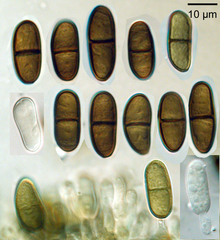 Dothiorella sarmentorume0pathogen
- Outcome
- canopy cankerse0
Organisms pictured · Representative pictures of the matched species, not figures from the paper.
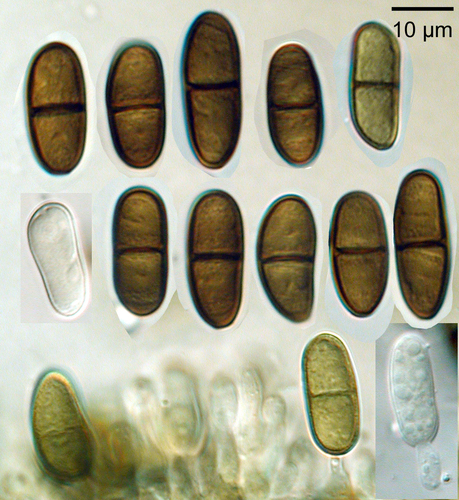
Verbatim
e0“B. dothidea, N. mediterraneum, N. parvum, and Dothiorella sarmentorum causing canopy cankers”
t0“almond”
Claim · model-written summary
March through May inoculation with B. dothidea produced the largest cankers on potted Nonpareil almond plants.
- Taxon
- almondPrunus dulcist0
- Material
- ‘Nonpareil’e0
- Treatment
- inoculation conducted from March through Maye0
- Interactor
- B. dothideaBotryosphaeria dothideae0pathogen
- Outcome
- cankerse0
- Direction
- largeste0
Not reportedComparator
Organisms pictured · Representative pictures of the matched species, not figures from the paper.
Verbatim
e0“Inoculations of potted plants of the cultivar ‘Nonpareil’ with B. dothidea periodically for 2 years indicated that the inoculation conducted from March through May caused the largest cankers.”
t0“almond”
Claim · model-written summary
Canker severity and incidence declined with distance from external inoculum sources in both almond orchards.
- Taxon
- almondPrunus dulcist0
- Outcome
- severity and incidence of symptomse0
- Direction
- declinede0
- Setting
- orchardse0
Organisms pictured · Representative pictures of the matched species, not figures from the paper.
Verbatim
e0“In both orchards, the spatial pattern showed that the severity and incidence of symptoms declined with distance from the external inoculum sources.”
t0“almond”
Claim · model-written summary
Spatial patterns in young almond orchards suggest additional inoculum sources, possibly nursery infection.
- Taxon
- almondPrunus dulcist0
- Outcome
- spatial patterns of band canker severitye0
- Qualifier
- although this contention needs to be studied in the near futuree0
Organisms pictured · Representative pictures of the matched species, not figures from the paper.
Verbatim
e0“spatial patterns of band canker severity in very young orchards (2-3 years old) that suggest other inoculum sources, such as early putative infection at nurseries, although this contention needs to be studied in the near future”
t0“almond”
Claim · model-written summary
Most attempted management methods had no significant effect on band canker reduction.
- Taxon
- almondPrunus dulcist0
- Treatment
- tried methodse0
- Outcome
- band cankere0
- Qualifier
- except the installation of splitters in the sprinklerse0
Not reportedComparatorDirection
Organisms pictured · Representative pictures of the matched species, not figures from the paper.
Verbatim
e0“None of the tried methods had significant effect on reducing band canker, except the installation of splitters in the sprinklers in a ‘Nonpareil’/‘Padre’ orchard.”
t0“almond”
Claim · model-written summary
Sprinkler splitters significantly reduced almond band canker size after about four months.
- Taxon
- almondPrunus dulcist0
- Material
- ‘Nonpareil’/‘Padre’e1
- Treatment
- installation of splitters in the sprinklerse1
- Outcome
- size of the band cankerse0
- Direction
- reducede0
- Qualifier
- about 4 monthse0
Not reportedComparator
Organisms pictured · Representative pictures of the matched species, not figures from the paper.
Verbatim
e0“the size of the band cankers was significantly reduced about 4 months after the alteration of the sprinklers”
e1“installation of splitters in the sprinklers in a ‘Nonpareil’/‘Padre’ orchard”
t0“almond”
Claim · model-written summary
Sprinkler modification decreased almond band canker size by 50% the following season.
- Taxon
- almondPrunus dulcist0
- Treatment
- installation of splitters in the sprinklerse1
- Outcome
- size and the incidence of the band cankerse0
- Direction
- decreasee0
- Value
- 50%e0
- Qualifier
- during the next seasone0
Not reportedComparator
Organisms pictured · Representative pictures of the matched species, not figures from the paper.
Verbatim
e0“during the next season, this control practice caused a decrease in both the size and the incidence of the band cankers by 50%”
e1“installation of splitters in the sprinklers in a ‘Nonpareil’/‘Padre’ orchard”
t0“almond”
The same questions in other papers
irrigation · growth · Prunus dulcis (almond)Positive and negative results
4 papers in the same direction as this paper · 3 in the opposite direction · 1 reporting no difference from an alternative
- no effect
- negative
- negative
5 papers more in this group
See all 9 papers →inoculation · Botryosphaeria dothidea · Prunus dulcis (almond)Results agree
1 paper in the same direction as this paper
- negative
irrigation · disease · Prunus dulcis (almond)Results agree
1 paper in the same direction as this paper
- positive
Claims are grouped by organism, treatment and what was measured or targeted. A paper counts as positive when any of its claims in the group is positive.