Abstract
Abstract: Several fungi species are associated with rice seeds, mainly Bipolaris oryzae, since it can kill seedlings and reduce production. Thus, the objective of this research was to study the potential of pre-selected combinations of rhizobacteria [DFs-C4 (DFs185/DFs416/DFs418) and DFs-C5 (DFs306/DFs416/DFs418)], when compared to their use individually (DFs185, DFs306, DFs416, DFs418), besides DFs223, evaluating the effect on the incidence and transmission of B. oryzae, incidence of phytopathogenic fungi and in the initial growth after rice seeds microbiolization. Seeds of cultivars BRS Pelota and BRS Querência (four lots each) were immersed in suspension of these bacteria or in saline solution (control) under agitation (for 30 minutes at 10 ºC). The fungi incidence was evaluated on blotter test. The pathogen transmission was assayed in sterilized vermiculite and humid chamber at 25 ± 2 ºC. After 15 days, the severity of the symptoms and the plant growth were evaluated. For both cultivars, the best treatments were DFs185 and DFs306, reducing the fungi incidence, including B. oryzae, as well as its transmission to seedlings, resulting in seedling length increase. The combination of biocontrol bacteria, individually efficient, did not result in a lower fungi incidence, or a reduction in the transmission of B. oryzae to the seedlings or an initial increase in seedling growth. Therefore, these rhizobacteria are more efficient when used individually.
Abstract from the paper’s OpenAlex record; open copy licensed cc-by. Read at the source ↗
The text the model read, with the source record’s inline markup (italics, sub- and superscripts) rendered and its character entities decoded; quote offsets refer to the raw text.
Claims 7
Claim · model-written summary
DFs185 reduced fungal incidence in rice seeds.
- Taxon
- rice
 Oryza sativat0
- Treatment
- DFs185e0
- Interactor
- B. oryzae
 Bipolaris oryzaee0pathogen
- Outcome
- fungi incidencee0
- Direction
- reducinge0
Not reportedComparator
Organisms pictured · Representative pictures of the matched species, not figures from the paper.

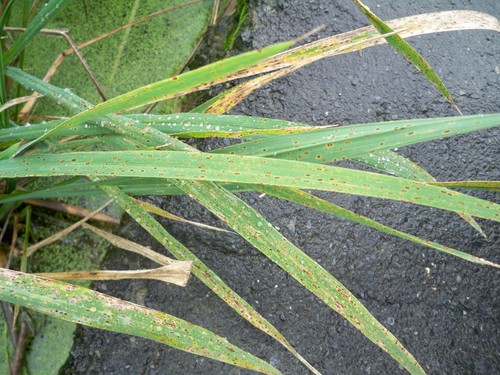
Verbatim
e0“the best treatments were DFs185 and DFs306, reducing the fungi incidence, including B. oryzae”
t0“rice”
Claim · model-written summary
DFs306 reduced fungal incidence in rice seeds.
- Taxon
- riceOryza sativat0
- Treatment
- DFs306e0
- Interactor
- B. oryzaeBipolaris oryzaee0pathogen
- Outcome
- fungi incidencee0
- Direction
- reducinge0
Not reportedComparator
Organisms pictured · Representative pictures of the matched species, not figures from the paper.
Verbatim
e0“the best treatments were DFs185 and DFs306, reducing the fungi incidence, including B. oryzae”
t0“rice”
Claim · model-written summary
DFs185 reduced B. oryzae transmission to rice seedlings.
- Taxon
- riceOryza sativat0
- Treatment
- DFs185e0
- Interactor
- B. oryzaeBipolaris oryzaee0pathogen
- Outcome
- transmission to seedlingse0
- Direction
- reducinge0
Not reportedComparator
Organisms pictured · Representative pictures of the matched species, not figures from the paper.
Verbatim
e0“the best treatments were DFs185 and DFs306, reducing the fungi incidence, including B. oryzae, as well as its transmission to seedlings”
t0“rice”
Claim · model-written summary
DFs306 reduced B. oryzae transmission to rice seedlings.
- Taxon
- riceOryza sativat0
- Treatment
- DFs306e0
- Interactor
- B. oryzaeBipolaris oryzaee0pathogen
- Outcome
- transmission to seedlingse0
- Direction
- reducinge0
Not reportedComparator
Organisms pictured · Representative pictures of the matched species, not figures from the paper.
Verbatim
e0“the best treatments were DFs185 and DFs306, reducing the fungi incidence, including B. oryzae, as well as its transmission to seedlings”
t0“rice”
Claim · model-written summary
DFs185 increased rice seedling length.
- Taxon
- riceOryza sativat0
- Treatment
- DFs185e0
- Outcome
- seedling lengthe0
- Direction
- increasee0
Not reportedComparator
Organisms pictured · Representative pictures of the matched species, not figures from the paper.
Verbatim
e0“the best treatments were DFs185 and DFs306, reducing the fungi incidence, including B. oryzae, as well as its transmission to seedlings, resulting in seedling length increase”
t0“rice”
Claim · model-written summary
DFs306 increased rice seedling length.
- Taxon
- riceOryza sativat0
- Treatment
- DFs306e0
- Outcome
- seedling lengthe0
- Direction
- increasee0
Not reportedComparator
Organisms pictured · Representative pictures of the matched species, not figures from the paper.
Verbatim
e0“the best treatments were DFs185 and DFs306, reducing the fungi incidence, including B. oryzae, as well as its transmission to seedlings, resulting in seedling length increase”
t0“rice”
Claim · model-written summary
Combined bacteria did not further lower fungal incidence or transmission or increase early rice seedling growth.
- Taxon
- riceOryza sativat0
- Treatment
- combination of biocontrol bacteriae0
- Interactor
- B. oryzaeBipolaris oryzaee0pathogen
- Outcome
- lower fungi incidencee0
- Direction
- did not result in a lowere0
Not reportedComparator
Organisms pictured · Representative pictures of the matched species, not figures from the paper.
Verbatim
e0“The combination of biocontrol bacteria, individually efficient, did not result in a lower fungi incidence, or a reduction in the transmission of B. oryzae to the seedlings or an initial increase in seedling growth”
t0“rice”
The same questions in other papers
biocontrol · Bipolaris oryzae · Oryza sativa (rice)Positive and negative results
3 in the opposite direction
- positive
- positive
- positive
inoculation · Bipolaris oryzae · Oryza sativa (rice)Positive and negative results
2 papers in the same direction as this paper · 3 in the opposite direction
- positive
- positive
- positive
2 papers more in this group
See all 6 papers →Claims are grouped by organism, treatment and what was measured or targeted. A paper counts as positive when any of its claims in the group is positive.