Abstract
The main objective of this study was to assess the effectiveness of various fungicides in managing rice brown spot, a common fungal disease in India that can reduce crop yield and seed quality. During 2020-21 crop seasons, a research project was conducted in the experimental plot of the Department of Plant Pathology at the College of Agriculture in Rewa, Madhya Pradesh, India. Different treatments involving fungicide application at various rice growth stages were implemented. The results showed that all treatments involving fungicides significantly reduced the incidence of rice brown spot in-vitro condition and increased crop yield when compared to the control group. Among the fungicides, Difenoconazole 25% EC at a concentration of 200ppm proved to be highly effective in controlling the growth of the fungal mycelium. In in-vivo condition, the treatment involving T4, which includes seed treatment with the bio-control agent Trichoderma viride (10g/kg seeds), the application of Trichoderma viride (10g/l) at 15-20 days after transplanting, and the application of propiconazole (1g/l) at the booting exhibited the highest level of reduction in the incidence of brown spot disease, amounting to 13.6 per cent. The integrated management approach are very effective to control the brown spot disease in rice.
Abstract from the paper’s OpenAlex record, shown for indexing and research. Copyright remains with the authors or the publisher. Read at the source ↗
The text the model read, with the source record’s inline markup (italics, sub- and superscripts) rendered and its character entities decoded; quote offsets refer to the raw text.
Claims 5
Claim · model-written summary
Fungicide treatments significantly reduced rice brown spot incidence in vitro compared with the control group.
- Taxon
- rice
 Oryza sativae1
- Treatment
- fungicidese1
- Interactor
- Bipolaris oryzae
 Bipolaris oryzaet1pathogen
- Outcome
- incidence of rice brown spote1
- Direction
- reducede1
- Comparator
- control groupe1
- Setting
- in-vitro conditione1
Organisms pictured · Representative pictures of the matched species, not figures from the paper.

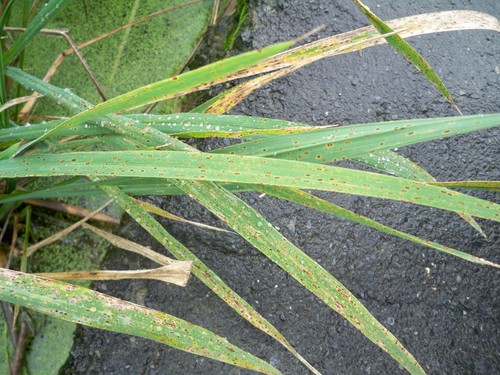
Verbatim
e1“all treatments involving fungicides significantly reduced the incidence of rice brown spot in-vitro condition and increased crop yield when compared to the control group”
t1“Bipolaris oryzae”
Claim · model-written summary
Fungicide treatments increased rice crop yield compared with the control group.
- Taxon
- riceOryza sativae1
- Treatment
- fungicidese1
- Outcome
- crop yielde1
- Direction
- increasede1
- Comparator
- control groupe1
Organisms pictured · Representative pictures of the matched species, not figures from the paper.
Verbatim
e1“all treatments involving fungicides significantly reduced the incidence of rice brown spot in-vitro condition and increased crop yield when compared to the control group”
Claim · model-written summary
Difenoconazole 25% EC at 200ppm was highly effective in controlling growth of the fungal mycelium.
- Taxon
- RiceOryza sativat0
- Treatment
- Difenoconazole 25% EC at a concentration of 200ppme1
- Interactor
- Bipolaris oryzaeBipolaris oryzaet1pathogen
- Outcome
- growth of the fungal myceliume1
- Direction
- decreaseinferrede1
Not reportedComparator
Organisms pictured · Representative pictures of the matched species, not figures from the paper.
Verbatim
t0“Brown Spot Disease in Rice”
t1“Bipolaris oryzae”
e1“Difenoconazole 25% EC at a concentration of 200ppm proved to be highly effective in controlling the growth of the fungal mycelium”
Claim · model-written summary
The T4 treatment, with Trichoderma viride seed and foliar applications plus propiconazole, gave the highest reduction in brown spot incidence, 13.6 per cent.
- Taxon
- RiceOryza sativat0
- Treatment
- T4, which includes seed treatment with the bio-control agent Trichoderma viride (10g/kg seeds)e2
- Interactor
- Bipolaris oryzaeBipolaris oryzaet1pathogen
- Second interactor
- Trichoderma viride
 Trichoderma viridee2biocontrol_agent
- Outcome
- incidence of brown spot diseasee2
- Direction
- reductione2
- Value
- 13.6 per cente2
Not reportedComparator
Organisms pictured · Representative pictures of the matched species, not figures from the paper.

Verbatim
e2“the treatment involving T4, which includes seed treatment with the bio-control agent Trichoderma viride (10g/kg seeds), the application of Trichoderma viride (10g/l) at 15-20 days after transplanting, and the application of propiconazole (1g/l) at the booting exhibited the highest level of reduction in the incidence of brown spot disease, amounting to 13.6 per cent”
t1“Bipolaris oryzae”
t0“Brown Spot Disease in Rice”
Claim · model-written summary
The integrated management approach is very effective for controlling brown spot disease in rice.
- Taxon
- riceOryza sativae3
- Outcome
- control the brown spot diseasee3
Organisms pictured · Representative pictures of the matched species, not figures from the paper.
Verbatim
e3“The integrated management approach are very effective to control the brown spot disease in rice”
The same questions in other papers
difenoconazole · Bipolaris oryzae · Oryza sativa (rice)Results agree
1 paper in the same direction as this paper
- positive
Trichoderma viride · Bipolaris oryzae · Oryza sativa (rice)Results agree
5 papers in the same direction as this paper
- positive
- positive
- positive
2 papers more in this group
See all 6 papers →fungicide · yield · Oryza sativa (rice)Results differ
27 papers in the same direction as this paper · 7 in the opposite direction
- no effect
- no effect
- no effect
31 papers more in this group
See all 35 papers →fungicide · Bipolaris oryzae · Oryza sativa (rice)Positive and negative results
1 paper in the same direction as this paper · 1 in the opposite direction
- negative
- positive
biocontrol · Bipolaris oryzae · Oryza sativa (rice)Positive and negative results
2 papers in the same direction as this paper · 1 in the opposite direction
- no effect
- positive
- positive
seed treatment · Bipolaris oryzae · Oryza sativa (rice)Results agree
4 papers in the same direction as this paper
- positive
- positive
- positive
1 paper more in this group
See all 5 papers →Claims are grouped by organism, treatment and what was measured or targeted. A paper counts as positive when any of its claims in the group is positive.