Abstract
47th Congress 2d Session. HOUSE OF REPRESENTATIVES. Ex. Doc. No. 105. EN ALASKA AND THE N. W. ARCTIC sOCEAN m NOTES AND MEMORAKDAVvMEDIOAi; jAND ANTHROPOLOGICAL ' BOTANICAL;rORKITHOLOGICAL. WASHINGTON: -GOVERNMENT. PEINTING OFFICE. "BOTANICAL .NOTES ON ALASKA. JOHN" MUIR. 45 I r BOTANICAL NOTES. •,'.':/• . By John Mtjie. /,.... INTRODUCTORY. The plants named in the following notes were collected at many localities on the coasts of Alaska and Siberia, and on Saint Lawrence, Wrangel, and Herald Islands, between about latitude .54.° and 71°, longitude 101° aud 178°, in the course of short excursions, some of them less than an hour in length. ,';. .- v. .. -';;;.; _ ''\./i.-:;. .-•;,-:,' I,..,-;,'--:;...-..'„-:-- '-- 'Inasmuch as the flora of the arctic and subarctic regions is nearly the same everywhere, the discovery of many species new to science was not to be expected. The collection, however, will no doubt be valuable for comparison with the plants of other regions. .''.... In general the physiognomy of the vegetation of the polar regions reseinbtes that of the alpine valleys of the temperate zones; so much so that the botanist on the coast of "Artie Siberia or America might readily fancy himself on the Sierra Nevada at a height of 10,000 to 12,000 feet above the sea.: .-" ". v/: ".'•_ ,;-J, '; - X- V.-.v .-:;'.:' A . . --. ---, There is no line of perpetual snow on any portion of the arctic regions known to explorers. The snow disappears every summer not only from the low sandy shores and boggy tundras but also from the tops of the mountains and all the upper slopes and valleys with the exception of small patches of drifts and avalanche-heaps hardly noticeable in general views. But though- nowhere excessively deep or permanent,' the snow-mantle is universal during winter, and the plants are solidly frozen and buried for nearly three-fourths of the year. In this condition they enjoy a sleep and rest about as profound as death, from which they awake in the months of June and July in vigorous health, and speedily reach a far higher development of leaf and flower and fruit than is generally supposed. On the Slier banks and hills about Kotzebue Sound, Cape Thompson, and Cape Lisbourne many species show but little climatic repression, and during the long summer days grow tall enough to wave in the wind, and unfold flowers in as rich profusion and as highly;' colored as may be found in regions lying a thousand miles farther south. ,. -1 •'., ,..{,;•: X;-(-;-'-'' : ';:' :: '-S-)'::V\ - 'y.\ •'• iO-jW-J : j$p r ' To the botanist approaching any portion of the Aleutian chain of islands from the-southward during tbe-winter or spring months,'the view is severely desolate and forbidding. The suow comes, down to the water's edge iu solid white, interrupted only by dark outstanding bluffs with faces too, steep for snow to lie on, and by the backs* of refunded rocks and long rugged reefs beaten and oyerswept; by heavy breakers rolling in from the Pacific, while throughout nearly every month of the year the higher mountains are wrapped in gloomy dripping storm-clouds. .:;.;/ .Nevertheless vegetation here1 is remarkably close and luxuriant, and crowded with showy bloom, covering almost every foot of the ground up to a height of about a thousand feet above the sea—the harsh trachytic rocks, and even the cindery bases of the craters, as well as the moraines and rough soil beds outspread on the low portions of the short narrow valleys. On the 20th of May we found the showy Gemn glaciate already in flower, also an arctostaphylos and draba, on a slope facing the south, near the harbor of Ounalaska. The willows, too, were then beginning to put forth their catkins, while a multitude of green points were springing up in sheltered spots wherever the suow had vanished. ; At a height of 400 and 500 feet, however, winter was still unbroken, with scarce a memory of the rich bloom of summer. 47 m. 48 CRUISE OP STEAMER CORWIN IN THE ARCTIC OCEAN. During a few short excursions along the shores of Ounalaska Harbor and on two of the adjacent mountains, towards the end of May and beginning of Octobenwe saw about fifty species of flowering plants—empetrum,vaccinium, bryanthus, pyrola, arctostaphylos, ledum, cassiope, lupinus, zeranium,. , epilobium, silene, draba, and saxifraga being the most telling and characteristic of the genera represented. Empetrum nigrum, a bryanthus, and three species of vaceiniuin make a grand display when in flower and show their massed colors at a considerablesdistance.-'vo'V'f:'-.:-':"-' ' Almost the entire surface of the valleys and hills and lower slopes of.the mountain is covered • with, a dense spongy plush of lichens and.mosses similar to that which cover,the tundras of the Arctic regions, making a rich .green mantle on which|thev sho wx flowering plants are strikingly ': relieved) though these grow far more luxuriantly on the banks of the streams where the drainage s less interrupted.•_, Here also the fernsrofwhichlsawthree species, are taller and more abundant, some of them arching; their broad delicate fronds over oue's shoulders, while in similar situations .; : the tallest of the five grasses that were seen reaches'a height of nearly six feet, aud forma a growth ; .close enough for the farmer's scythe. - . :. ;, Not a single tree has yet been seen on any of the islands of the chain west of Kodiak, excepting ,;.-. a'-'fewspruces brought*from Sitka and planted at Ounalaskaby the Russians about fifty years ago.V: They are still alive iu a dwarfed condition, having made scarce any appreciable growth since they were planted; .These facts are the more remarkable, since in Southeastern Alaska lying both to ;;the north'and. south of here, and on the many islands of the Aexander Archipelago, as well as ou the mainland, forests of beautiful conifers flourish exuberantly and attain noble dimensions; while the climatic conditions generally do not appear to differ greatly from those that obtain on these treeless islands. 'V "';/ * ,v" '" Wherever cattle have been introduced they have prospered and grown fat on the abundance of rich nutritious pasturage to be fouucl almost everywhere in the deep withdrawing valleys aud I on the green slopes of the hills and mountains,-but the wetness of the summer months will always prevent the making of hay in any considerable quantities. The agricultural possibilities of these islands seem also to be very limited. The hardier of the cereals—rye, barleyr and- oats—make a good vigorous growth, and head out, but seldom or never |k'' mature, on account of insufficient sunshine and overabundance of moisture in the form of long- continUed drizzling fogs and rains. Green crops, however, as potatoes, turnips, cabbages, beets, ;'-'.,- and most other common garden vegetables, thrive wherever the ground is thoroughly drained and has a southerly exposure. - ".. : ' : . .:[.-.. ,;.•-;-,,. V:-;u,.,' - ) '-y SAINTLAWBEjCESLAND.// $Xj$k0i -;'.-': . ' : . • • '"'. Saint Lawrence Island, as far as our observations extended, is mostly a dreary mass of granite and lava of various forms and colors, roughened with volcanic cones, covered with snow, and rigidly bound in ocean ice for half the year. Inasmuch as it lies broadside wise to the direction pursued by the greatice-sheet that recently filled Bering Sea, and its rocks offered unequal resistance to the denuding action of the ice, the island is traversed by numerous ridgesAand low gap-like valleys air trending in the same general direction, some of the lowest of these transverse valleys having been degraded nearly to the level of the sea, showing that had the glaciatiou to which the island has been subjected been slightly greater we should have found several islands here instead of one. '"' '; *. "At the time of our first visit, May 28, winter still had full possession, but eleven days later we found the dwarf willows, drabas, crizerons, saxifrages pushing up their budsund leaves, on spots bare of snow, with wonderful rapidity. This was the beginning of spring at the northwest end of the island. On July 4 the flora seemed to have reached its highest development. The bottoms of the glacial valleys were in many places covered with tall grasses and-carices evenly planted and forming meadows of considerable size, while the drier portions and the"sloping grounds about them were enlivened with gay highly-colored flowers from an inch to nearly two feet in height— Aconitum Napellus, L. var. delpfiini/olkcm ser. Polemonium cceruleum, L. Palaver nudicaule,. Draba alpina, and Silene acaulis inJarge closely flowered tufts, Andromeda, Ledum Liunaea, Cavssiope, and several species of Vaccinium and Saxifraga. CRUISE OF STEAMER CORWIN IN THE ARCTIC OCEAN. 49 SAINT MICHAEL'S. : The region about Saint Michael's is a magnificent tundra, crowded with Arctic lichens and :mosses, which here develop under most favorable conditions. In the spongy plush formed by the lower plants, in which one sinks almost knee-deep at every step, there is a sparse growth of grasses, carices, and rushes, tall enough to wave in the wind, while einpetrum, the dwarf birch, and tbe various heathworts flourish here in all their beauty of bright leaves and flowers. Tbe moss mantle for the most part rests on a stratum of ice that never melts to any great extent, and' the ice on a bed rock of black vesicular lava. Ridges of the lava rise here and there above tbe general level in rough masses, affording ground for plants that like a drier soil. Numerous hollows and watercourses also occur on tbe general tuudra, whose well-drained banks are decked with gay flowers in lavish abundance, and meadow patches of grasses shoulder high, suggestive of regions much farther south. The following plants and a few doubtful species not yet determined were collected here: Linniea borealis, Gronov. Cassiopetctragone,Dea\'.. Andromeda,polifolia} Xi.j.ir-'.-);,: •;, -.'-. Loixelcuria procunibcus, Desv, VaeciniumVitis
Abstract from the paper’s OpenAlex record, shown for indexing and research. Copyright remains with the authors or the publisher. Read at the source ↗
The text the model read, with the source record’s inline markup (italics, sub- and superscripts) rendered and its character entities decoded; quote offsets refer to the raw text.
Claims 9
Claim · model-written summary
Polar vegetation resembled alpine valley vegetation of temperate zones.
Verbatim
e0“the physiognomy of the vegetation of the polar regions reseinbtes that of the alpine valleys of the temperate zones”
Claim · model-written summary
Plants on the named Alaskan banks and hills showed little climatic repression and abundant flowers.
Verbatim
e0“On the Slier banks and hills about Kotzebue Sound, Cape Thompson, and Cape Lisbourne many species show but little climatic repression, and during the long summer days grow tall enough to wave in the wind, and unfold flowers in as rich profusion”
Claim · model-written summary
Vegetation on the Aleutian islands was close, luxuriant and showily flowering up to about a thousand feet.
Verbatim
e0“vegetation here1 is remarkably close and luxuriant, and crowded with showy bloom, covering almost every foot of the ground up to a height of about a thousand feet above the sea”
Claim · model-written summary
The survey saw about fifty flowering plant species near Ounalaska Harbor and two adjacent mountains.
- Taxon
- flowering plantsMagnoliopsidae0
- Outcome
- species of flowering plantse0
- Value
- about fifty speciese0
- Setting
- Ounalaska Harbore0
Verbatim
e0“along the shores of Ounalaska Harbor and on two of the adjacent mountains, towards the end of May and beginning of Octobenwe saw about fifty species of flowering plants”
Claim · model-written summary
Ferns were taller and more abundant on stream banks.
- Taxon
- fernsPolypodiopsidae0
- Outcome
- taller and more abundante0
- Direction
- taller and more abundante0
Verbatim
e0“the fernsrofwhichlsawthree species, are taller and more abundant”
Claim · model-written summary
Planted spruces west of Kodiak survived but remained dwarfed with little growth.
 Picea
Organisms pictured · Representative pictures of the matched species, not figures from the paper.

Verbatim
e0“a'-'fewspruces brought*from Sitka and planted at Ounalaskaby the Russians about fifty years ago.V: They are still alive iu a dwarfed condition, having made scarce any appreciable growth since they were planted”
Claim · model-written summary
Hardy cereals grew and headed out on the islands but seldom matured.
- Taxon
- rye, barleyr and- oatse0
- Outcome
- good vigorous growth, and head out, but seldom or never |k'' maturee0
Not reportedDirection
Verbatim
e0“rye, barleyr and- oats—make a good vigorous growth, and head out, but seldom or never |k'' mature”
Claim · model-written summary
Garden vegetables thrived where ground was drained and south facing.
- Taxon
- potatoes, turnips, cabbages, beets
 Brassica oleracea var. capitata
 Solanum tuberosum
 Brassica rapa subsp. rapa
 Beta vulgarise0
- Outcome
- thrivee0
- Qualifier
- ground is thoroughly drained and has a southerly exposuree0
Not reportedDirection
Organisms pictured · Representative pictures of the matched species, not figures from the paper.


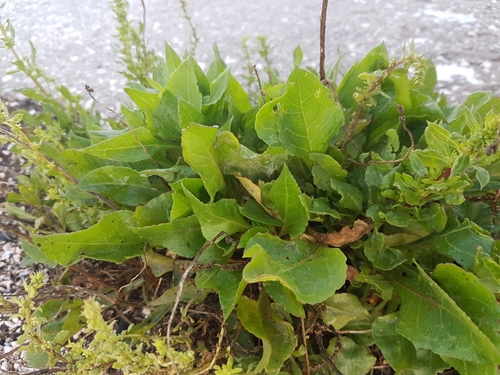
Verbatim
e0“potatoes, turnips, cabbages, beets, ;'-'.,- and most other common garden vegetables, thrive wherever the ground is thoroughly drained and has a southerly exposure”
Claim · model-written summary
Dwarf willows, drabas, erigerons and saxifrages rapidly produced buds and leaves after snow cleared on Saint Lawrence Island.
Not reportedDirection
Verbatim
e0“we found the dwarf willows, drabas, crizerons, saxifrages pushing up their budsund leaves, on spots bare of snow, with wonderful rapidity”