Abstract
To facilitate infection, pathogens deploy a plethora of effectors to suppress basal host immunity induced by exogenous microbe-associated or endogenous damage-associated molecular patterns (DAMPs). In this study, we have characterized family 17 glycosyl hydrolases of the tomato pathogen Cladosporium fulvum (CfGH17) and studied their role in infection. Heterologous expression of CfGH17-1 to 5 by potato virus X in different tomato cultivars showed that CfGH17-1 and CfGH17-5 enzymes induce cell death in Cf-0, Cf-1 and Cf-5 but not in Cf-Ecp3 tomato cultivars or tobacco. Moreover, CfGH17-1 orthologues from other phytopathogens, including Dothistroma septosporum and Mycosphaerella fijiensis, also trigger cell death in tomato. CfGH17-1 and CfGH17-5 are predicted to be β-1,3-glucanases and their enzymatic activity is required for the induction of cell death. CfGH17-1 hydrolyses laminarin, a linear 1,3-β-glucan with 1,6-β linkages. CfGH17-1 expression is down-regulated during the biotrophic phase of infection and up-regulated during the necrotrophic phase. Deletion of CfGH17-1 in C. fulvum did not reduce virulence on tomato, while constitutive expression of CfGH17-1 decreased virulence, suggesting that abundant presence of CfGH17-1 during biotrophic growth may release a DAMP that activates plant defence responses. Under natural conditions CfGH17-1 is suggested to play a role during saprophytic growth when the fungus thrives on dead host tissue, which is in line with its high levels of expression at late stages of infection when host tissues have become necrotic. We suggest that CfGH17-1 releases a DAMP from the host cell wall that is recognized by a yet unknown host plant receptor.
Abstract from the paper’s OpenAlex record; open copy licensed cc-by-nc-nd. Read at the source ↗
The text the model read, with the source record’s inline markup (italics, sub- and superscripts) rendered and its character entities decoded; quote offsets refer to the raw text.
Claims 12
Claim · model-written summary
CfGH17-1 induced cell death in Cf-0, Cf-1 and Cf-5 tomato cultivars.
- Taxon
- tomato
 Solanum lycopersicume0
- Material
- Cf-0, Cf-1 and Cf-5e0
- Treatment
- CfGH17-1e0
- Interactor
- Cladosporium fulvum
 Fulvia fulvat0pathogen
- Gene
- CfGH17-1e0
- Outcome
- cell deathe0
Not reportedComparatorDirection
Organisms pictured · Representative pictures of the matched species, not figures from the paper.


Verbatim
e0“CfGH17-1 and CfGH17-5 enzymes induce cell death in Cf-0, Cf-1 and Cf-5 but not in Cf-Ecp3 tomato cultivars or tobacco”
t0“tomato pathogen Cladosporium fulvum (CfGH17)”
Claim · model-written summary
CfGH17-5 induced cell death in Cf-0, Cf-1 and Cf-5 tomato cultivars.
- Taxon
- tomatoSolanum lycopersicume0
- Material
- Cf-0, Cf-1 and Cf-5e0
- Treatment
- CfGH17-5e0
- Gene
- CfGH17-5e0
- Outcome
- cell deathe0
Not reportedComparatorDirection
Organisms pictured · Representative pictures of the matched species, not figures from the paper.
Verbatim
e0“CfGH17-1 and CfGH17-5 enzymes induce cell death in Cf-0, Cf-1 and Cf-5 but not in Cf-Ecp3 tomato cultivars or tobacco”
Claim · model-written summary
The enzymes did not induce cell death in Cf-Ecp3 tomato.
- Taxon
- tomatoSolanum lycopersicume0
- Material
- Cf-Ecp3e0
- Outcome
- not in Cf-Ecp3 tomato cultivarse0
Organisms pictured · Representative pictures of the matched species, not figures from the paper.
Verbatim
e0“but not in Cf-Ecp3 tomato cultivars or tobacco”
Claim · model-written summary
The enzymes did not induce cell death in tobacco.
- Taxon
- tobacco
 Nicotiana tabacume0
- Outcome
- not in Cf-Ecp3 tomato cultivars or tobaccoe0
Organisms pictured · Representative pictures of the matched species, not figures from the paper.

Verbatim
e0“but not in Cf-Ecp3 tomato cultivars or tobacco”
Claim · model-written summary
CfGH17-1 orthologues from Dothistroma septosporum triggered cell death in tomato.
- Taxon
- tomatoSolanum lycopersicume0
- Treatment
- CfGH17-1 orthologuese0
- Interactor
- Dothistroma septosporum
 Dothistroma septosporume0pathogen
- Outcome
- cell deathe0
Not reportedComparatorDirection
Organisms pictured · Representative pictures of the matched species, not figures from the paper.

Verbatim
e0“CfGH17-1 orthologues from other phytopathogens, including Dothistroma septosporum and Mycosphaerella fijiensis, also trigger cell death in tomato”
Claim · model-written summary
CfGH17-1 orthologues from Mycosphaerella fijiensis triggered cell death in tomato.
- Taxon
- tomatoSolanum lycopersicume0
- Treatment
- CfGH17-1 orthologuese0
- Interactor
- Mycosphaerella fijiensis
 Pseudocercospora fijiensise0pathogen
- Outcome
- cell deathe0
Not reportedComparatorDirection
Organisms pictured · Representative pictures of the matched species, not figures from the paper.
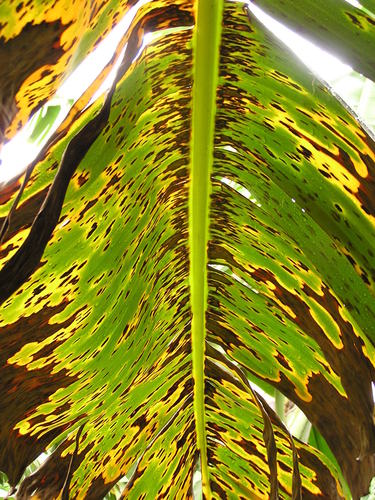
Verbatim
e0“CfGH17-1 orthologues from other phytopathogens, including Dothistroma septosporum and Mycosphaerella fijiensis, also trigger cell death in tomato”
Claim · model-written summary
Enzymatic activity of CfGH17-1 and CfGH17-5 was required for cell death induction.
- Taxon
- tomatoSolanum lycopersicumt0
- Gene
- CfGH17-1 and CfGH17-5e0
- Outcome
- induction of cell deathe0
- Qualifier
- enzymatic activitye0
Organisms pictured · Representative pictures of the matched species, not figures from the paper.
Verbatim
e0“CfGH17-1 and CfGH17-5 are predicted to be β-1,3-glucanases and their enzymatic activity is required for the induction of cell death”
t0“tomato”
Claim · model-written summary
CfGH17-1 hydrolysed laminarin.
- Taxon
- tomatoSolanum lycopersicumt0
- Gene
- CfGH17-1e0
- Outcome
- hydrolyses laminarine0
Organisms pictured · Representative pictures of the matched species, not figures from the paper.
Verbatim
e0“CfGH17-1 hydrolyses laminarin, a linear 1,3-β-glucan with 1,6-β linkages”
t0“tomato”
Claim · model-written summary
CfGH17-1 expression was lower in the biotrophic phase and higher in the necrotrophic phase.
- Taxon
- tomatoSolanum lycopersicumt0
- Gene
- CfGH17-1e0
- Outcome
- CfGH17-1 expressione0
- Direction
- down-regulatede0
- Qualifier
- biotrophic phase of infectione0
Organisms pictured · Representative pictures of the matched species, not figures from the paper.
Verbatim
e0“CfGH17-1 expression is down-regulated during the biotrophic phase of infection and up-regulated during the necrotrophic phase”
t0“tomato”
Claim · model-written summary
Deleting CfGH17-1 did not reduce virulence on tomato.
- Taxon
- tomatoSolanum lycopersicume0
- Treatment
- Deletion of CfGH17-1e0
- Interactor
- C. fulvumFulvia fulvae0pathogen
- Gene
- CfGH17-1e0
- Outcome
- virulence on tomatoe0
- Direction
- did not reducee0
Not reportedComparator
Organisms pictured · Representative pictures of the matched species, not figures from the paper.
Verbatim
e0“Deletion of CfGH17-1 in C. fulvum did not reduce virulence on tomato”
Claim · model-written summary
Constitutive CfGH17-1 expression decreased virulence.
- Taxon
- tomatoSolanum lycopersicumt0
- Treatment
- constitutive expression of CfGH17-1e0
- Gene
- CfGH17-1e0
- Outcome
- virulencee0
- Direction
- decreasede0
Not reportedComparator
Organisms pictured · Representative pictures of the matched species, not figures from the paper.
Verbatim
e0“constitutive expression of CfGH17-1 decreased virulence”
t0“tomato”
Claim · model-written summary
Authors suggest CfGH17-1 releases a host cell-wall DAMP recognized by an unknown host receptor.
- Taxon
- tomatoSolanum lycopersicumt0
- Gene
- CfGH17-1e0
- Outcome
- releases a DAMP from the host cell walle0
- Qualifier
- recognized by a yet unknown host plant receptore0
Organisms pictured · Representative pictures of the matched species, not figures from the paper.
Verbatim
e0“We suggest that CfGH17-1 releases a DAMP from the host cell wall that is recognized by a yet unknown host plant receptor”
t0“tomato”
The same questions in other papers
loss of function · Fulvia fulva · Solanum lycopersicum (tomato)Positive and negative results
9 papers in the same direction as this paper · 3 in the opposite direction
- positive
- positive
- positive
9 papers more in this group
See all 13 papers →overexpression · disease · Solanum lycopersicum (tomato)Positive and negative results
10 papers in the same direction as this paper · 3 in the opposite direction
- no effect
- no effect
- no effect
10 papers more in this group
See all 14 papers →Claims are grouped by organism, treatment and what was measured or targeted. A paper counts as positive when any of its claims in the group is positive.