Abstract
Studies were undertaken across five field locations in Western Australia to determine the relative changes in disease severity and subsequent field pea yield from up to four foliar pathogens associated with a field pea foliar disease complex (viz. genera Didymella, Phoma, Peronospora, and Septoria) across four different pea varieties sown at three different times and at three different densities. Delaying sowing of field pea significantly (P < 0.05) reduced the severity of Ascochyta blight (all five locations) and Septoria blight (one location), increased the severity of downy mildew (four locations), but had no effect on seed yield. In relation to Ascochyta blight severity at 80 days after sowing, at all locations the early time of sowing had significantly (P < 0.05) more severe Ascochyta blight than the mid and late times of sowing. Increasing actual plant density from 20 to 25 plants m −2 to 58 to 78 plants m −2 significantly (P < 0.05) increased the severity of the Ascochyta blight (four locations) and downy mildew (one location), and it increased seed yield at four locations irrespective of sowing date and three locations irrespective of variety. Compared with varieties Dundale, Wirrega, and Pennant, variety Alma showed significantly (P < 0.05) less severe Ascochyta blight, downy mildew, and Septoria blight (one location each). Grain yield was highest for the early time of sowing at three locations. Varieties Alma, Dundale, and Wirrega significantly (P < 0.05) outyielded Pennant at four locations. The percentage of isolations of individual Ascochyta blight pathogens at 80 days after the first time of sowing varied greatly, with genus Didymella ranging from 25 to 93% and genus Phoma ranging from 6 to 23% across the five field locations. This fluctuating nature of individual pathogen types and proportions within the Ascochyta blight complex, along with variation in the occurrence of pathogens Peronospora and Septoria, highlights the challenges to understand and manage the complexities of co-occurring different foliar pathogens of field pea. While the search for more effective host resistance continues, there is a need for and opportunities from further exploring and exploiting cultural management approaches focusing on crop sequence diversification, intercropping, manipulating time of sowing and stand density, and application of improved seed sanitation and residue/inoculum management practices. We discuss the constraints and opportunities toward overcoming the challenges associated with managing foliar disease complexes in field pea.
Abstract from the paper’s OpenAlex record; open copy licensed other-oa. Read at the source ↗
The text the model read, with the source record’s inline markup (italics, sub- and superscripts) rendered and its character entities decoded; quote offsets refer to the raw text.
Claims 15
Claim · model-written summary
Delayed sowing reduced Ascochyta blight severity at all five locations.
- Taxon
- field peae0
- Treatment
- Delaying sowinge0
- Outcome
- severity of Ascochyta blighte0
- Direction
- reducede0
- Setting
- all five locationse0
Not reportedComparator
Verbatim
e0“Delaying sowing of field pea significantly (P < 0.05) reduced the severity of Ascochyta blight (all five locations)”
Claim · model-written summary
Delayed sowing reduced Septoria blight severity at one location.
- Taxon
- field peae0
- Treatment
- Delaying sowinge0
- Outcome
- Septoria blighte0
- Direction
- reducede0
- Setting
- one locatione0
Not reportedComparator
Verbatim
e0“Delaying sowing of field pea significantly (P < 0.05) reduced the severity of Ascochyta blight (all five locations) and Septoria blight (one location)”
Claim · model-written summary
Delayed sowing increased downy mildew severity at four locations.
- Taxon
- field peae0
- Treatment
- Delaying sowinge0
- Outcome
- severity of downy mildewe0
- Direction
- increasede0
- Setting
- four locationse0
Not reportedComparator
Verbatim
e0“Delaying sowing of field pea significantly (P < 0.05) reduced the severity of Ascochyta blight (all five locations) and Septoria blight (one location), increased the severity of downy mildew (four locations)”
Claim · model-written summary
Delayed sowing had no effect on seed yield.
Not reportedComparator
Verbatim
e0“Delaying sowing of field pea significantly (P < 0.05) reduced the severity of Ascochyta blight (all five locations) and Septoria blight (one location), increased the severity of downy mildew (four locations), but had no effect on seed yield”
Claim · model-written summary
Higher plant density increased Ascochyta blight severity at four locations.
- Taxon
- Field Peat0
- Treatment
- Increasing actual plant density from 20 to 25 plants m −2 to 58 to 78 plants m −2e0
- Outcome
- severity of the Ascochyta blighte0
- Direction
- increasede0
- Setting
- four locationse0
Not reportedComparator
Verbatim
e0“Increasing actual plant density from 20 to 25 plants m −2 to 58 to 78 plants m −2 significantly (P < 0.05) increased the severity of the Ascochyta blight (four locations)”
t0“Field Pea”
Claim · model-written summary
Higher plant density increased downy mildew severity at one location.
- Taxon
- Field Peat0
- Treatment
- Increasing actual plant density from 20 to 25 plants m −2 to 58 to 78 plants m −2e0
- Outcome
- downy mildewe0
- Direction
- increasede0
- Setting
- one locatione0
Not reportedComparator
Verbatim
e0“Increasing actual plant density from 20 to 25 plants m −2 to 58 to 78 plants m −2 significantly (P < 0.05) increased the severity of the Ascochyta blight (four locations) and downy mildew (one location)”
t0“Field Pea”
Claim · model-written summary
Higher plant density increased seed yield at four locations regardless of sowing date and three regardless of variety.
- Taxon
- Field Peat0
- Treatment
- Increasing actual plant density from 20 to 25 plants m −2 to 58 to 78 plants m −2e0
- Outcome
- seed yielde0
- Direction
- increasede0
- Qualifier
- at four locations irrespective of sowing date and three locations irrespective of varietye0
Not reportedComparator
Verbatim
e0“Increasing actual plant density from 20 to 25 plants m −2 to 58 to 78 plants m −2 significantly (P < 0.05) increased the severity of the Ascochyta blight (four locations) and downy mildew (one location), and it increased seed yield at four locations irrespective of sowing date and three locations irrespective of variety”
t0“Field Pea”
Claim · model-written summary
Alma had less severe Ascochyta blight than Dundale, Wirrega, and Pennant.
Verbatim
e0“Compared with varieties Dundale, Wirrega, and Pennant, variety Alma showed significantly (P < 0.05) less severe Ascochyta blight, downy mildew, and Septoria blight (one location each)”
t0“Field Pea”
Claim · model-written summary
Alma had less severe downy mildew than Dundale, Wirrega, and Pennant.
Verbatim
e0“Compared with varieties Dundale, Wirrega, and Pennant, variety Alma showed significantly (P < 0.05) less severe Ascochyta blight, downy mildew, and Septoria blight (one location each)”
t0“Field Pea”
Claim · model-written summary
Alma had less severe Septoria blight than Dundale, Wirrega, and Pennant.
Verbatim
e0“Compared with varieties Dundale, Wirrega, and Pennant, variety Alma showed significantly (P < 0.05) less severe Ascochyta blight, downy mildew, and Septoria blight (one location each)”
t0“Field Pea”
Claim · model-written summary
Early sowing yielded the most grain at three locations.
Verbatim
e0“Grain yield was highest for the early time of sowing at three locations”
t0“Field Pea”
Claim · model-written summary
Alma, Dundale, and Wirrega outyielded Pennant at four locations.
Verbatim
e0“Varieties Alma, Dundale, and Wirrega significantly (P < 0.05) outyielded Pennant at four locations”
t0“Field Pea”
Claim · model-written summary
Didymella isolations ranged from 25 to 93% across locations.
 Didymella
Organisms pictured · Representative pictures of the matched species, not figures from the paper.

Verbatim
e0“genus Didymella ranging from 25 to 93% and genus Phoma ranging from 6 to 23% across the five field locations”
t0“Field Pea”
Claim · model-written summary
Phoma isolations ranged from 6 to 23% across locations.
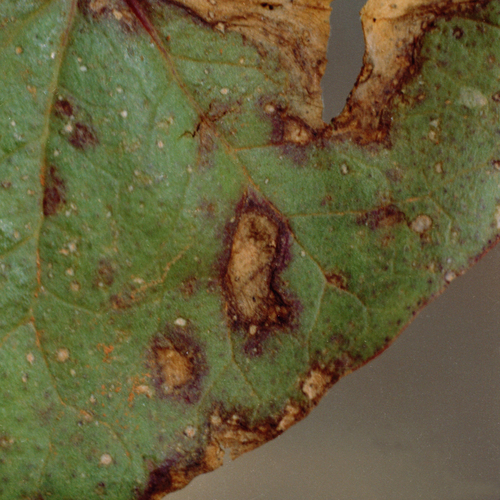
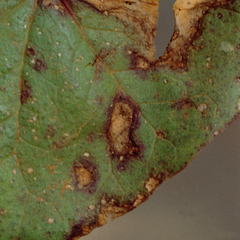 Phoma
Organisms pictured · Representative pictures of the matched species, not figures from the paper.
Verbatim
e0“genus Didymella ranging from 25 to 93% and genus Phoma ranging from 6 to 23% across the five field locations”
t0“Field Pea”
Claim · model-written summary
Authors recommend further exploring cultural management of field pea disease complexes.
Verbatim
e0“there is a need for and opportunities from further exploring and exploiting cultural management approaches focusing on crop sequence diversification, intercropping, manipulating time of sowing and stand density, and application of improved seed sanitation and residue/inoculum management practices”
t0“Field Pea”
The same questions in other papers
density · disease · Lathyrus oleraceus (pea)Positive and negative results
4 in the opposite direction
- positive
- positive
- positive
1 paper more in this group
See all 5 papers →density · yield · Lathyrus oleraceus (pea)Positive and negative results
30 papers in the same direction as this paper · 8 in the opposite direction
- no effect
- no effect
- no effect
35 papers more in this group
See all 39 papers →Claims are grouped by organism, treatment and what was measured or targeted. A paper counts as positive when any of its claims in the group is positive.