Abstract
Spodoptera frugiperda and Rhopalosiphum maidis, as main pests, seriously harm the safety of maize. At present, chemical pesticides are mainly used to control these pests. However, due to residue and resistance problems, more green, environmentally benign, simple preventive control technology is needed. In this study, we reported the reason for the antifeedant activity of azadirachtin on S. frugiperda and proposed that S. frugiperda treated with azadirachtin would turn from pest into natural enemy. S. frugiperda showed an obvious antifeeding phenomenon to maize leaf treated with various azadirachtin concentrations (0.5~20 mg/L). It was found that maize leaf treated with 1 mg/L of azadirachtin has a stimulating effect on the antenna and sensillum basiconicum of S. frugiperda, and azadirachtin can affect the feeding behavior of S. frugiperda. Additionally, after treating maize leaves or maize leaves + R. maidis with 1 mg/L of azadirachtin, the predatory behavior of S. frugiperda changed from a preference for eating maize leaves to R. maidis. Moreover, the molting of R. maidis can promote the change of this predatory behavior. Our results, for the first time, propose that the combined control technology of azadirachtin insecticide and biological control could turn S. frugiperda from pest into natural enemy, which can effectively eliminate R. maidis and protect maize. This combined control technology provides a new way for pest management and has good ecological, environmental, and economic benefits.
Abstract from the paper’s OpenAlex record; open copy licensed cc-by. Read at the source ↗
The text the model read, with the source record’s inline markup (italics, sub- and superscripts) rendered and its character entities decoded; quote offsets refer to the raw text.
Claims 5
Claim · model-written summary
Azadirachtin-treated maize leaves elicited antifeeding in S. frugiperda.
- Treatment
- azadirachtin concentrations (0.5~20 mg/L)e0
- Interactor
- S. frugiperda
 Spodoptera frugiperdae0pest
- Outcome
- antifeeding phenomenone0
 Zea mays
Not reportedComparatorDirection
Organisms pictured · Representative pictures of the matched species, not figures from the paper.


Verbatim
e0“S. frugiperda showed an obvious antifeeding phenomenon to maize leaf treated with various azadirachtin concentrations (0.5~20 mg/L)”
Claim · model-written summary
A 1 mg/L azadirachtin treatment stimulated S. frugiperda antennae and sensilla.
- Treatment
- 1 mg/L of azadirachtine0
- Interactor
- S. frugiperdaSpodoptera frugiperdae0pest
- Outcome
- antenna and sensillum basiconicum of S. frugiperdae0
- Direction
- stimulatinge0
Not reportedComparator
Organisms pictured · Representative pictures of the matched species, not figures from the paper.
Verbatim
e0“maize leaf treated with 1 mg/L of azadirachtin has a stimulating effect on the antenna and sensillum basiconicum of S. frugiperda”
Claim · model-written summary
Treatment shifted S. frugiperda preference from maize leaves to R. maidis.
- Treatment
- 1 mg/L of azadirachtine0
- Interactor
- S. frugiperdaSpodoptera frugiperdae0pest
- Second interactor
- R. maidis
 Rhopalosiphum maidise0pest
- Outcome
- predatory behavior of S. frugiperdae0
- Direction
- changede0
- Comparator
- maize leavese0
Organisms pictured · Representative pictures of the matched species, not figures from the paper.
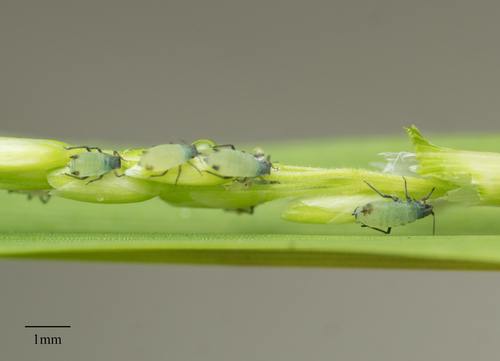
Verbatim
e0“after treating maize leaves or maize leaves + R. maidis with 1 mg/L of azadirachtin, the predatory behavior of S. frugiperda changed from a preference for eating maize leaves to R. maidis”
Claim · model-written summary
R. maidis molting promoted the shift in predatory behavior.
- Interactor
- R. maidisRhopalosiphum maidise0pest
- Outcome
- predatory behaviore0
Not reportedDirection
Organisms pictured · Representative pictures of the matched species, not figures from the paper.
Verbatim
e0“the molting of R. maidis can promote the change of this predatory behavior”
e1“maize leaves or maize leaves + R. maidis”
Claim · model-written summary
The authors propose combined azadirachtin and biological control for maize pest management.
- Interactor
- R. maidisRhopalosiphum maidise0pest
- Second interactor
- S. frugiperdaSpodoptera frugiperdae0pest
- Outcome
- combined control technology of azadirachtin insecticide and biological controle0
Organisms pictured · Representative pictures of the matched species, not figures from the paper.
Verbatim
e0“combined control technology of azadirachtin insecticide and biological control could turn S. frugiperda from pest into natural enemy, which can effectively eliminate R. maidis and protect maize”
The same questions in other papers
azadirachtin · Spodoptera frugiperda · Zea mays (maize)Results agree
6 papers in the same direction as this paper
- positive
- positive
- positive
3 papers more in this group
See all 7 papers →Claims are grouped by organism, treatment and what was measured or targeted. A paper counts as positive when any of its claims in the group is positive.