Abstract
A field investigation was carried out to study different insect pests occurring on snake gourd (Trichosanthes cucumerina var. anguina) during kharif 2018–19 at the University of Agricultural Sciences, GKVK, Bengaluru. The study revealed the occurrence of 17 species of insect pests belonging to four economically important orders such as Lepidoptera (three species), Coleoptera (five species), Diptera (two species) and Hemiptera (seven species) which are of both major and minor importance. The major defoliator insects such as semilooper, Anadevidia peponis (Fab.) population showed significant positive correlation with morning relative humidity (RH) (r=0.69*), while, leaf miner, Liriomyza trifolii (Burgess) and population of pumpkin caterpillar, Diaphania indica (Saunders) and plume moth, Sphenarches caffer (Zeller) were significantly positively correlated with afternoon RH (r=0.60* and 0.59*, respectively), pumpkin beetle, Aulacophora spp. population showed significant positive correlation with total rainfall (r=0.69*), leaf hopper species had significant negative correlation with total rainfall (r=-0.60*), whereas, mirid bug, Nesidiocoris tenuis (Reuter) population exhibited significant negative correlation with sunshine hours (r=-0.65*).
Abstract from the paper’s OpenAlex record, shown for indexing and research. Copyright remains with the authors or the publisher. Read at the source ↗
The text the model read, with the source record’s inline markup (italics, sub- and superscripts) rendered and its character entities decoded; quote offsets refer to the raw text.
Claims 8
Claim · model-written summary
Snake gourd hosted 17 insect pest species: three Lepidoptera, five Coleoptera, two Diptera and seven Hemiptera.
- Taxon
- snake gourd
 Trichosanthes cucumerinat0
- Interactor
- insect pestse0pest
- Outcome
- occurrence of 17 species of insect pestse0
- Value
- 17 speciese0
- Qualifier
- Lepidoptera (three species), Coleoptera (five species), Diptera (two species) and Hemiptera (seven species)e0
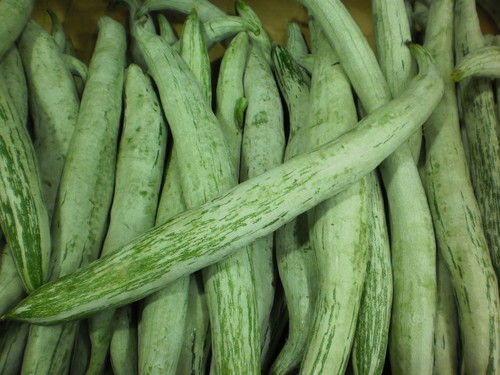
Organisms pictured · Representative pictures of the matched species, not figures from the paper.
Verbatim
e0“The study revealed the occurrence of 17 species of insect pests belonging to four economically important orders such as Lepidoptera (three species), Coleoptera (five species), Diptera (two species) and Hemiptera (seven species) which are of both major and minor importance.”
t0“snake gourd”
Claim · model-written summary
Anadevidia peponis population correlated positively with morning relative humidity (r=0.69*).
- Taxon
- Anadevidia peponis
 Anadevidia peponise0
- Treatment
- morning relative humiditye0
- Interactor
- snake gourdTrichosanthes cucumerinat0host
- Outcome
- populatione0
- Direction
- positivee0
- Value
- r=0.69*e0
Organisms pictured · Representative pictures of the matched species, not figures from the paper.

Verbatim
e0“The major defoliator insects such as semilooper, Anadevidia peponis (Fab.) population showed significant positive correlation with morning relative humidity (RH) (r=0.69*)”
t0“snake gourd”
Claim · model-written summary
Liriomyza trifolii population correlated significantly positively with afternoon relative humidity.
- Taxon
- Liriomyza trifolii
 Liriomyza trifoliie0
- Treatment
- afternoon RHe0
- Interactor
- snake gourdTrichosanthes cucumerinat0host
- Outcome
- populatione0
- Direction
- positivelye0
- Qualifier
- r=0.60* and 0.59*, respectivelye0
Organisms pictured · Representative pictures of the matched species, not figures from the paper.

Schema note from the model: Three insect species are followed by only two coefficients, so coefficient assignment is unresolved.
Verbatim
e0“leaf miner, Liriomyza trifolii (Burgess) and population of pumpkin caterpillar, Diaphania indica (Saunders) and plume moth, Sphenarches caffer (Zeller) were significantly positively correlated with afternoon RH (r=0.60* and 0.59*, respectively)”
t0“snake gourd”
Claim · model-written summary
Diaphania indica population correlated significantly positively with afternoon relative humidity.
- Taxon
- Diaphania indica
 Diaphania indicae0
- Treatment
- afternoon RHe0
- Interactor
- snake gourdTrichosanthes cucumerinat0host
- Outcome
- populatione0
- Direction
- positivelye0
- Qualifier
- r=0.60* and 0.59*, respectivelye0
Organisms pictured · Representative pictures of the matched species, not figures from the paper.

Schema note from the model: Three insect species are followed by only two coefficients, so coefficient assignment is unresolved.
Verbatim
e0“leaf miner, Liriomyza trifolii (Burgess) and population of pumpkin caterpillar, Diaphania indica (Saunders) and plume moth, Sphenarches caffer (Zeller) were significantly positively correlated with afternoon RH (r=0.60* and 0.59*, respectively)”
t0“snake gourd”
Claim · model-written summary
Sphenarches caffer population correlated significantly positively with afternoon relative humidity.
- Taxon
- Sphenarches caffer
 Sphenarches caffere0
- Treatment
- afternoon RHe0
- Interactor
- snake gourdTrichosanthes cucumerinat0host
- Outcome
- populatione0
- Direction
- positivelye0
- Qualifier
- r=0.60* and 0.59*, respectivelye0
Organisms pictured · Representative pictures of the matched species, not figures from the paper.

Schema note from the model: Three insect species are followed by only two coefficients, so coefficient assignment is unresolved.
Verbatim
e0“leaf miner, Liriomyza trifolii (Burgess) and population of pumpkin caterpillar, Diaphania indica (Saunders) and plume moth, Sphenarches caffer (Zeller) were significantly positively correlated with afternoon RH (r=0.60* and 0.59*, respectively)”
t0“snake gourd”
Claim · model-written summary
Aulacophora spp. population correlated positively with total rainfall (r=0.69*).
- Taxon
- Aulacophora spp.
 Aulacophorae0
- Treatment
- total rainfalle0
- Interactor
- snake gourdTrichosanthes cucumerinat0host
- Outcome
- populatione0
- Direction
- positivee0
- Value
- r=0.69*e0
Organisms pictured · Representative pictures of the matched species, not figures from the paper.

Verbatim
e0“pumpkin beetle, Aulacophora spp. population showed significant positive correlation with total rainfall (r=0.69*)”
t0“snake gourd”
Claim · model-written summary
Leaf hopper species correlated negatively with total rainfall (r=-0.60*).
- Taxon
- leaf hopper speciese0
- Treatment
- total rainfalle0
- Interactor
- snake gourdTrichosanthes cucumerinat0host
- Outcome
- negative correlatione0
- Direction
- negativee0
- Value
- r=-0.60*e0
Organisms pictured · Representative pictures of the matched species, not figures from the paper.
Verbatim
e0“leaf hopper species had significant negative correlation with total rainfall (r=-0.60*)”
t0“snake gourd”
Claim · model-written summary
Nesidiocoris tenuis population correlated negatively with sunshine hours (r=-0.65*).
- Taxon
- Nesidiocoris tenuis
 Nesidiocoris tenuise0
- Treatment
- sunshine hourse0
- Interactor
- snake gourdTrichosanthes cucumerinat0host
- Outcome
- populatione0
- Direction
- negativee0
- Value
- r=-0.65*e0
Organisms pictured · Representative pictures of the matched species, not figures from the paper.

Verbatim
e0“mirid bug, Nesidiocoris tenuis (Reuter) population exhibited significant negative correlation with sunshine hours (r=-0.65*)”
t0“snake gourd”