Abstract
"Large areas of the Southern Monte in the Patagonia have been severely degraded by overgrazing and oil extraction activities. Rehabilitation and restoration by planting native species are suitable alternatives to reverse this problem. Planting Fabaceae species is particularly recommended to reinitiate the ecological succession because of their ability to improve the soil physical and chemical properties as well as their nitrogen-fixing capability. In addition, this family includes several species that are used as fodder, timber, and for decorative and industrial uses. Thus, these species can be included in restoration projects that integrate social and ecological goals. To explore the suitability of these species for the restoration and rehabilitation of degraded areas, it is necessary to assess what pre-germination treatments are appropriate to obtain a fast and uniform germination in nursery gardens. The goal of this study was to determine the effect of chemical scarification treatments (5 or 45 minutes) and wet-cold treatments (7 or 30 days) on the germination of the following species: Parkinsonia praecox, Prosopidastrum striatum, and Senna aphylla. The three studied species showed the highest germination percentages with chemical scarification during 45 minutes, while the wet-cold treatments did not differ from the control. In conclusion, the acid scarification treatment is suitable for the large-scale propagation of these species because a substantial quantity of seeds can be treated in a short time and with homogeneous results."
Abstract from the paper’s OpenAlex record, shown for indexing and research. Copyright remains with the authors or the publisher. Read at the source ↗
The text the model read, with the source record’s inline markup (italics, sub- and superscripts) rendered and its character entities decoded; quote offsets refer to the raw text.
Claims 5
Claim · model-written summary
Parkinsonia praecox had its highest germination percentage after 45 minutes of chemical scarification.
- Taxon
- Parkinsonia praecox
 Parkinsonia praecoxt0
- Treatment
- chemical scarification during 45 minutese0
- Outcome
- germination percentagese0
- Direction
- higheste0
Not reportedComparator
Organisms pictured · Representative pictures of the matched species, not figures from the paper.

Verbatim
e0“The three studied species showed the highest germination percentages with chemical scarification during 45 minutes, while the wet-cold treatments did not differ from the control.”
t0“Parkinsonia praecox”
Claim · model-written summary
Prosopidastrum striatum had its highest germination percentage after 45 minutes of chemical scarification.
- Taxon
- Prosopidastrum striatum
 Prosopidastrum striatumt0
- Treatment
- chemical scarification during 45 minutese0
- Outcome
- germination percentagese0
- Direction
- higheste0
Not reportedComparator
Organisms pictured · Representative pictures of the matched species, not figures from the paper.
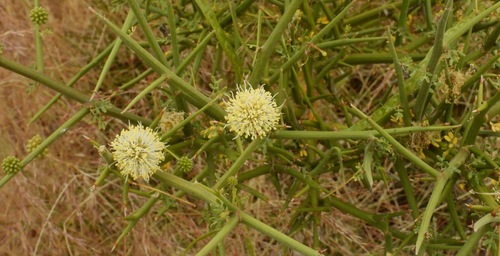
Verbatim
e0“The three studied species showed the highest germination percentages with chemical scarification during 45 minutes, while the wet-cold treatments did not differ from the control.”
t0“Prosopidastrum striatum”
Claim · model-written summary
Senna aphylla had its highest germination percentage after 45 minutes of chemical scarification.
- Taxon
- Senna aphylla
 Senna aphyllat0
- Treatment
- chemical scarification during 45 minutese0
- Outcome
- germination percentagese0
- Direction
- higheste0
Not reportedComparator
Organisms pictured · Representative pictures of the matched species, not figures from the paper.

Verbatim
e0“The three studied species showed the highest germination percentages with chemical scarification during 45 minutes, while the wet-cold treatments did not differ from the control.”
t0“Senna aphylla”
Claim · model-written summary
Wet-cold treatments did not differ from control for germination of the three species.
Verbatim
e0“The three studied species showed the highest germination percentages with chemical scarification during 45 minutes, while the wet-cold treatments did not differ from the control.”
t0“Fabaceae”
Claim · model-written summary
The authors recommend acid scarification for large-scale propagation of these species.
- Treatment
- acid scarification treatmente0
- Outcome
- acid scarification treatment is suitable for the large-scale propagatione0
Not reportedDirection
Verbatim
e0“In conclusion, the acid scarification treatment is suitable for the large-scale propagation of these species because a substantial quantity of seeds can be treated in a short time and with homogeneous results.”
t0“Fabaceae”