Abstract
Background: Rigidoporus microporus causes white root disease, which is one of the most harmful diseases in rubber trees in Thailand. The objectives of this study were to determine the efficacy of T. asperellum NST-009 and its antifungal metabolite in inhibiting R. microporus mycelial development and efficacy of T. asperellum NST-009 in controlling white root disease of rubber trees in an open-field house experiment. Methods: Four native strains of T. asperellum from Nakhon Si Thammarat Province and a commercial strain of Thailand were used in this study. This study was conducted at Agricultural Microbial Production and Service Center, Walailak University, Nakhon Si Thammarat, Thailand, during the period 2017-2020. Result: T. asperellum NST-009 significantly inhibited R. microporus mycelial growth by 77.07% in vitro and its antifungal metabolite from the culture filtrate of T. asperellum NST-009 inhibited mycelial growth by 92.31%. T. asperellum NST-009 reduced the disease severity index by 76.38% in the open-field house experiment compared to the inoculated control. Furthermore, T. asperellum NST-009 was found to survive in rhizosphere soil at 4.50 × 10⁵ CFU/g soil and colonized the roots at 100.00%.
Abstract from the paper’s OpenAlex record, shown for indexing and research. Copyright remains with the authors or the publisher. Read at the source ↗
The text the model read, with the source record’s inline markup (italics, sub- and superscripts) rendered and its character entities decoded; quote offsets refer to the raw text.
Claims 5
Claim · model-written summary
T. asperellum NST-009 significantly inhibited R. microporus mycelial growth by 77.07% in vitro.
- Taxon
- R. microporus
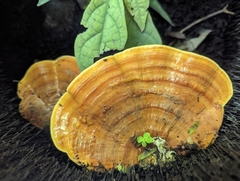 Rigidoporus microporuse0
- Treatment
- T. asperellum NST-009e0
- Interactor
- R. microporusRigidoporus microporuse0pathogen
- Second interactor
- T. asperellum NST-009
 Trichoderma asperellume0biocontrol_agent
- Outcome
- mycelial growthe0
- Direction
- inhibitede0
- Value
- 77.07%e0
- Setting
- in vitroe0
Not reportedComparator
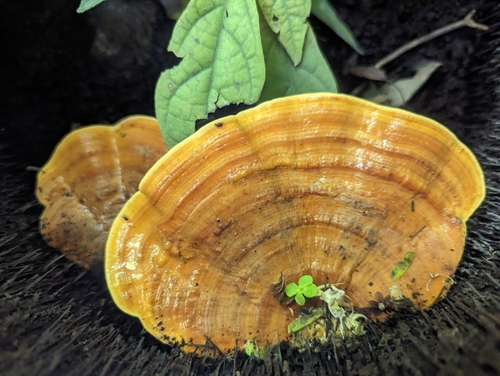
Organisms pictured · Representative pictures of the matched species, not figures from the paper.

Verbatim
e0“T. asperellum NST-009 significantly inhibited R. microporus mycelial growth by 77.07% in vitro”
e1“Rigidoporus microporus causes white root disease”
Claim · model-written summary
The antifungal metabolite from the culture filtrate of T. asperellum NST-009 inhibited R. microporus mycelial growth by 92.31%.
- Taxon
- R. microporusRigidoporus microporuse0
- Treatment
- antifungal metabolite from the culture filtrate of T. asperellum NST-009e1
- Interactor
- R. microporusRigidoporus microporuse0pathogen
- Second interactor
- T. asperellum NST-009Trichoderma asperellume1biocontrol_agent
- Outcome
- mycelial growthe1
- Direction
- inhibitede1
- Value
- 92.31%e1
Not reportedComparator
Organisms pictured · Representative pictures of the matched species, not figures from the paper.
Verbatim
e0“T. asperellum NST-009 significantly inhibited R. microporus mycelial growth by 77.07% in vitro”
e1“its antifungal metabolite from the culture filtrate of T. asperellum NST-009 inhibited mycelial growth by 92.31%”
Claim · model-written summary
T. asperellum NST-009 reduced the disease severity index of white root disease in rubber trees by 76.38% in an open-field house experiment compared with the inoculated control.
- Taxon
- Hevea brasiliensis
 Hevea brasiliensist0
- Treatment
- T. asperellum NST-009e0
- Interactor
- Rigidoporus microporusRigidoporus microporuse1pathogen
- Second interactor
- T. asperellum NST-009Trichoderma asperellume0biocontrol_agent
- Outcome
- disease severity indexe0
- Direction
- reducede0
- Value
- 76.38%e0
- Comparator
- inoculated controle0
- Setting
- open-field house experimente0
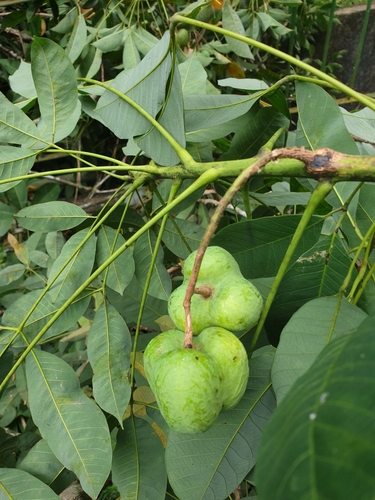
Organisms pictured · Representative pictures of the matched species, not figures from the paper.
Verbatim
e0“T. asperellum NST-009 reduced the disease severity index by 76.38% in the open-field house experiment compared to the inoculated control”
e1“Rigidoporus microporus causes white root disease”
t0“Hevea brasiliensis”
Claim · model-written summary
T. asperellum NST-009 survived in rhizosphere soil of rubber trees at 4.50 × 10⁵ CFU/g soil.
- Taxon
- Hevea brasiliensisHevea brasiliensist0
- Interactor
- T. asperellum NST-009Trichoderma asperellume0biocontrol_agent
- Outcome
- survive in rhizosphere soile0
- Value
- 4.50 × 10⁵ CFU/g soile0
Not reportedDirection
Organisms pictured · Representative pictures of the matched species, not figures from the paper.
Verbatim
e0“T. asperellum NST-009 was found to survive in rhizosphere soil at 4.50 × 10⁵ CFU/g soil and colonized the roots at 100.00%”
t0“Hevea brasiliensis”
Claim · model-written summary
T. asperellum NST-009 colonized the roots of rubber trees at 100.00%.
- Taxon
- Hevea brasiliensisHevea brasiliensist0
- Organ / stage
- rootse0
- Interactor
- T. asperellum NST-009Trichoderma asperellume0biocontrol_agent
- Outcome
- colonized the rootse0
- Value
- 100.00%e0
Not reportedDirection
Organisms pictured · Representative pictures of the matched species, not figures from the paper.
Verbatim
e0“T. asperellum NST-009 was found to survive in rhizosphere soil at 4.50 × 10⁵ CFU/g soil and colonized the roots at 100.00%”
t0“Hevea brasiliensis”
The same questions in other papers
Trichoderma asperellum · Rigidoporus microporus · Hevea brasiliensis (rubber tree)Results agree
1 paper in the same direction as this paper
- positive
Claims are grouped by organism, treatment and what was measured or targeted. A paper counts as positive when any of its claims in the group is positive.