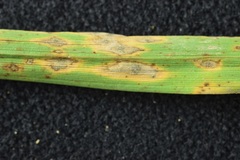
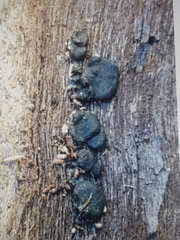
Trichoderma asperellum 1,570 claims

species · family Hypocreaceae · fungus · NCBI Taxonomy ↗

Also written in claims: T.asperellum · T. asperellum NST-009 · T. asperellum 576 · T. asperellum BHUT8 · T. asperellum BV10 · T. asperellum M45a

183 spellings

Trichoderma asperellum
Trichoderma asperellumTashkoskip · CC BY-SA 4.0 · Wikimedia Commons ↗
Intervention effectobservedoriginal resultpositivemeasured

Claim · model-written summary

T. asperellum reduced the aflatoxin level produced by A. flavus alone from 5120 ± 560 µg/kg to 63.1 ± 3.1 µg/kg.

Taxon
Zea maysZea mayst0
Treatment
T. asperellume0
Interactor
A. flavusAspergillus flavuse0pathogen
Second interactor
T. asperellumTrichoderma asperellume0biocontrol_agent
Outcome
AFT productione0
Direction
reducinge0
Value
63.1 ± 3.1 µg/kge0
Qualifier
5120 ± 560 µg/kge0
Comparator
A. flavus alonee0

Verbatim

t0

“Zea mays”

✓ located verbatim in the source · title, characters 47–55
e0

“T. harzianum and T. asperellum were the most effective at lowering AFT production of the aflatoxigenic strains, reducing the 5120 ± 560 µg/kg AFT level produced by A. flavus alone to 50.1 ± 1.10 and 63.1 ± 3.1 µg/kg, respectively”

✓ located verbatim in the source · abstract, characters 1514–1743

Title

Trichoderma harzianum Suppresses Aflatoxins in Zea mays: A Biological Strategy for Pakistan’s Agriculture Industry

Aisha Khalid; Shazia Iram; Irum Asif; et al. Stresses 2026. doi:10.3390/stresses6020034

Other claims from this paper (4)
Intervention effectobservedcited backgroundpositivesignificant (as stated)measured

Claim · model-written summary

Earlier studies showed that dipping rice roots in Trichoderma asperellum or applying it as a foliar spray significantly reduced rice blast.

Treatment
dipping rice roots in a formulation of Trichoderma asperellume0
Interactor
Magnaporthe oryzaePyricularia oryzaee0pathogen
Second interactor
Trichoderma asperellumTrichoderma asperellume0biocontrol_agent
Outcome
rice blaste0
Direction
reductione0

Not reportedComparator

Verbatim

e0

“dipping rice roots in a formulation of Trichoderma asperellum at the transplanting stage or applying the strain as a foliar spray post transplanting led to a statistically significant reduction in rice blast (caused by Magnaporthe oryzae )”

✓ located verbatim in the source · abstract, characters 38–277

Title

Effects of applying Trichoderma asperellum to rice ( Oryza sativa ) on phytobiome and plant responses

Greg Deakin; Georgina Fagg; Tom Passey; et al. Annals of Applied Biology 2026. doi:10.1111/aab.70119

Other claims from this paper (11)
Intervention effectobservedcited backgroundpositivemeasured

Claim · model-written summary

Earlier studies showed that dipping rice roots in Trichoderma asperellum or foliar spraying it increased rice grain yield in Tanzania.

Treatment
dipping rice roots in a formulation of Trichoderma asperellume0
Interactor
Trichoderma asperellumTrichoderma asperellume0biocontrol_agent
Outcome
grain yielde0
Direction
increasede0
Setting
Tanzaniae0

Not reportedComparator

Verbatim

e0

“dipping rice roots in a formulation of Trichoderma asperellum at the transplanting stage or applying the strain as a foliar spray post transplanting led to a statistically significant reduction in rice blast (caused by Magnaporthe oryzae ) and increased grain yield in Tanzania”

✓ located verbatim in the source · abstract, characters 38–315

Title

Effects of applying Trichoderma asperellum to rice ( Oryza sativa ) on phytobiome and plant responses

Greg Deakin; Georgina Fagg; Tom Passey; et al. Annals of Applied Biology 2026. doi:10.1111/aab.70119

Other claims from this paper (11)
Intervention effectobservedoriginal resultno effectmeasured

Claim · model-written summary

Root dipping and foliar application of T. asperellum spore suspension had only a limited impact on the leaf epiphytes and root/rhizosphere microbiome after 1 and 4 weeks.

Treatment
root dipping and foliar application with T. asperellum spore suspensione0
Interactor
T. asperellumTrichoderma asperellume0biocontrol_agent
Outcome
leaf epiphytes and root/rhizosphere microbiomee0
Direction
limited impacte0

Not reportedComparator

Verbatim

t0

“rice ( Oryza sativa )”

✓ located verbatim in the source · title, characters 46–67
e0

“Both root dipping and foliar application with T. asperellum spore suspension only had a limited impact on the leaf epiphytes and root/rhizosphere microbiome after 1 and 4 weeks of treatment, respectively”

✓ located verbatim in the source · abstract, characters 525–728

Title

Effects of applying Trichoderma asperellum to rice ( Oryza sativa ) on phytobiome and plant responses

Greg Deakin; Georgina Fagg; Tom Passey; et al. Annals of Applied Biology 2026. doi:10.1111/aab.70119

Other claims from this paper (11)
Mechanismhypothesisoriginal resultmeasured

Claim · model-written summary

Blast reduction by foliar T. asperellum is unlikely to be due to direct antagonism against M. oryzae and more likely occurs via induced plant defence responses.

Treatment
foliar application of T. asperellume0
Interactor
M. oryzaePyricularia oryzaee0pathogen
Second interactor
T. asperellumTrichoderma asperellume0biocontrol_agent
Outcome
reduction of blaste0
Qualifier
induced plant defence responsese0

Verbatim

t0

“rice ( Oryza sativa )”

✓ located verbatim in the source · title, characters 46–67
e0

“reduction of blast because of foliar application of T. asperellum is unlikely because of direct antagonism against M. oryzae , but more likely via induced plant defence responses”

✓ located verbatim in the source · abstract, characters 1825–2003

Title

Effects of applying Trichoderma asperellum to rice ( Oryza sativa ) on phytobiome and plant responses

Greg Deakin; Georgina Fagg; Tom Passey; et al. Annals of Applied Biology 2026. doi:10.1111/aab.70119

Other claims from this paper (11)
Observationobservedoriginal resultno effectmeasured

Claim · model-written summary

P. putida PCL1760 and T. asperellum T302 showed no antagonistic interactions in vitro.

Interactor
P. putida PCL1760Pseudomonas putidae7biocontrol_agent
Second interactor
T. asperellum T302Trichoderma asperellume7biocontrol_agent
Outcome
antagonistic interactions between the strainse1

Verbatim

e0

“tomato Fusarium root rot”

✓ located verbatim in the source · abstract, characters 532–556
e1

“No antagonistic interactions between the strains were observed in vitro”

✓ located verbatim in the source · abstract, characters 558–629
e7

“These findings demonstrate the compatibility of P. putida PCL1760 and T. asperellum T302 and highlight the potential of their combined application for the management of tomato root rot diseases”

✓ located verbatim in the source · abstract, characters 1448–1641

Title

Compatibility of biocontrol agents Pseudomonas putida PCL1760 and Trichoderma asperellum T302

Shamil' Validov Agrobiotechnologies and digital farming 2026. doi:10.12737/2782-490x-2026-5-1-64-71

Other claims from this paper (7)
Intervention effectobservedoriginal resultpositivemeasured

Claim · model-written summary

Co-inoculation with T. asperellum T302 increased P. putida PCL1760 population density on the apical tomato root region 8.2-fold compared with PCL1760 alone.

Organ / stage
apical root regione2
Treatment
co-inoculation with T. asperellum strain T302e2
Interactor
P. putida strain PCL1760Pseudomonas putidae2biocontrol_agent
Second interactor
T. asperellum strain T302Trichoderma asperellume2biocontrol_agent
Outcome
population density of P. putida strain PCL1760e2
Direction
increasede2
Value
8.2-folde2
Qualifier
1.4 × 10⁶ to 11.5 × 10⁶ cells cm⁻¹e2
Comparator
inoculation with PCL1760 alonee2

Verbatim

e0

“tomato Fusarium root rot”

✓ located verbatim in the source · abstract, characters 532–556
e2

“co-inoculation with T. asperellum strain T302 increased the population density of P. putida strain PCL1760 on the apical root region from 1.4 × 10⁶ to 11.5 × 10⁶ cells cm⁻¹, representing an 8.2-fold increase compared to inoculation with PCL1760 alone”

✓ located verbatim in the source · abstract, characters 658–908

Title

Compatibility of biocontrol agents Pseudomonas putida PCL1760 and Trichoderma asperellum T302

Shamil' Validov Agrobiotechnologies and digital farming 2026. doi:10.12737/2782-490x-2026-5-1-64-71

Other claims from this paper (7)
Intervention effectobservedoriginal resultno effectnot significant (as stated)measured

Claim · model-written summary

The presence of PCL1760 did not significantly affect colonization of tomato roots by T. asperellum T302.

Treatment
presence of strain PCL1760e3
Interactor
T. asperellum T302Trichoderma asperellume3biocontrol_agent
Second interactor
strain PCL1760e3biocontrol_agent
Outcome
colonization of tomato roots by T. asperellum T302e3
Direction
no_changeinferrede3

Not reportedComparator

Verbatim

e0

“tomato Fusarium root rot”

✓ located verbatim in the source · abstract, characters 532–556
e3

“The presence of strain PCL1760 did not significantly affect colonization of tomato roots by T. asperellum T302”

✓ located verbatim in the source · abstract, characters 910–1020

Title

Compatibility of biocontrol agents Pseudomonas putida PCL1760 and Trichoderma asperellum T302

Shamil' Validov Agrobiotechnologies and digital farming 2026. doi:10.12737/2782-490x-2026-5-1-64-71

Other claims from this paper (7)
Observationauthor interpretationoriginal resultpositivemeasured

Claim · model-written summary

P. putida PCL1760 and T. asperellum T302 are compatible.

Interactor
P. putida PCL1760Pseudomonas putidae7biocontrol_agent
Second interactor
T. asperellum T302Trichoderma asperellume7biocontrol_agent
Outcome
compatibility of P. putida PCL1760 and T. asperellum T302e7

Verbatim

e0

“tomato Fusarium root rot”

✓ located verbatim in the source · abstract, characters 532–556
e7

“These findings demonstrate the compatibility of P. putida PCL1760 and T. asperellum T302 and highlight the potential of their combined application for the management of tomato root rot diseases”

✓ located verbatim in the source · abstract, characters 1448–1641

Title

Compatibility of biocontrol agents Pseudomonas putida PCL1760 and Trichoderma asperellum T302

Shamil' Validov Agrobiotechnologies and digital farming 2026. doi:10.12737/2782-490x-2026-5-1-64-71

Other claims from this paper (7)
Intervention effectobservedoriginal resultpositivemeasured

Claim · model-written summary

T. lixii, T. asperellum and T. harzianum inhibited up to 58% of Foc radial growth in vitro.

Taxon
Musa AAA cv. Gros Michele0
Material
Gros Michele0
Treatment
T. lixii, T. asperellum, and T. harzianume1
Interactor
Fusarium oxysporum f. sp. cubenseFusarium oxysporum f. sp. cubensee5pathogen
Second interactor
T. lixii, T. asperellum, and T. harzianumTrichoderma harzianumTrichoderma asperellumTrichoderma lixiie1biocontrol_agent
Outcome
radial growthe1
Direction
inhibitede1
Value
58%e1

Not reportedComparator

Verbatim

e0

“Musa AAA cv. Gros Michel”

✓ located verbatim in the source · abstract, characters 503–527
e1

“In vitro, T. lixii, T. asperellum, and T. harzianum inhibited up to 58% of Foc radial growth”

✓ located verbatim in the source · abstract, characters 686–778
e5

“Fusarium oxysporum f. sp. cubense (Foc)”

✓ located verbatim in the source · abstract, characters 84–123

Title

Antagonistic and growth-enhancing effect of native Trichoderma spp. on ‘Gros Michel’ banana under Foc R1 infection

Terrero Yepez, Pedro; Mayorga Morejon, Rafaela; Rodulfo Acuña, Paola; et al. Dialnet (Universidad de la Rioja) 2026

Other claims from this paper (4)