Abstract
Oak wilt caused by Bretziella fagacearum is an important disease of Quercus spp.; however, its diagnosis may be confused with damage resulting from other diseases, insects, or abiotic factors. Laboratory diagnosis is important in such situations and when disease control action is desired. PCR tests can provide accurate lab diagnosis within 2 days. Two variations of a simple DNA extraction protocol using sodium hydroxide (NaOH) were compared with that of the proprietary protocol of a commercially available kit (CK) for nested PCR to detect the pathogen in oak sapwood. High frequencies of pathogen detection (98 to 100% of 48 branch segments assayed) were found for northern pin oak using the two NaOH-based and the CK methods. Detection rates were similar but lower for bur oak (ranged from 58 to 79%) and white oak (ranged from 54 to 71%) regardless of DNA extraction method. Using our alternative DNA extraction protocols may reduce total time and cost of B. fagacearum detection in PCR-based diagnosis and other downstream applications.
Abstract from the paper’s OpenAlex record; open copy licensed public-domain. Read at the source ↗
The text the model read, with the source record’s inline markup (italics, sub- and superscripts) rendered and its character entities decoded; quote offsets refer to the raw text.
Claims 4
Claim · model-written summary
Pathogen detection in northern pin oak was 98 to 100% with the NaOH-based and kit methods.
- Taxon
- northern pin oak
 Quercus ellipsoidalise1
- Treatment
- the two NaOH-based and the CK methodse1
- Interactor
- Bretziella fagacearum
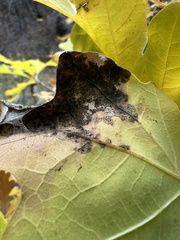 Bretziella fagacearumt0pathogen
- Outcome
- pathogen detectione1
- Value
- 98 to 100%e1
Organisms pictured · Representative pictures of the matched species, not figures from the paper.

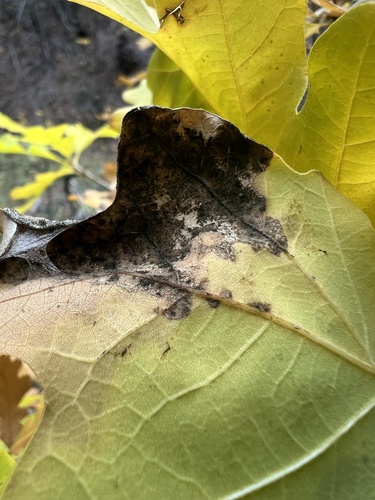
Verbatim
e1“High frequencies of pathogen detection (98 to 100% of 48 branch segments assayed) were found for northern pin oak using the two NaOH-based and the CK methods”
t0“Nested PCR Detection of Bretziella fagacearum in the Sapwood of Oak Species”
Claim · model-written summary
Detection rates in bur oak were lower, at 58 to 79%, than in northern pin oak.
- Taxon
- bur oak
 Quercus macrocarpae2
- Interactor
- Bretziella fagacearumBretziella fagacearumt0pathogen
- Outcome
- Detection ratese2
- Direction
- lowere2
- Value
- 58 to 79%e2
Organisms pictured · Representative pictures of the matched species, not figures from the paper.

Verbatim
e2“Detection rates were similar but lower for bur oak (ranged from 58 to 79%) and white oak (ranged from 54 to 71%) regardless of DNA extraction method”
t0“Nested PCR Detection of Bretziella fagacearum in the Sapwood of Oak Species”
Claim · model-written summary
Detection rates in white oak were lower, at 54 to 71%.
- Taxon
- white oak
 Quercus albae2
- Interactor
- Bretziella fagacearumBretziella fagacearumt0pathogen
- Outcome
- Detection ratese2
- Direction
- lowere2
- Value
- 54 to 71%e2
Organisms pictured · Representative pictures of the matched species, not figures from the paper.

Verbatim
e2“Detection rates were similar but lower for bur oak (ranged from 58 to 79%) and white oak (ranged from 54 to 71%) regardless of DNA extraction method”
t0“Nested PCR Detection of Bretziella fagacearum in the Sapwood of Oak Species”
Claim · model-written summary
Alternative NaOH DNA extraction protocols may reduce the time and cost of B. fagacearum detection compared with a commercial kit.
- Outcome
- total time and cost of B. fagacearum detectione3
- Comparator
- proprietary protocol of a commercially available kit (CK)e4
 Quercus
Organisms pictured · Representative pictures of the matched species, not figures from the paper.

Verbatim
e3“Using our alternative DNA extraction protocols may reduce total time and cost of B. fagacearum detection in PCR-based diagnosis and other downstream applications”
e4“Two variations of a simple DNA extraction protocol using sodium hydroxide (NaOH) were compared with that of the proprietary protocol of a commercially available kit (CK) for nested PCR to detect the pathogen in oak sapwood”
t0“Oak Species”