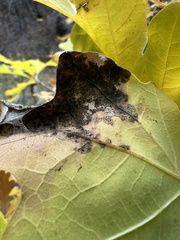
Quercus macrocarpa 285 claims

species · family Fagaceae · green plant · NCBI Taxonomy ↗

Common name: bur oak — Also written in claims: bur oak · bur oaks · Q . macrocarpa · burr oak

25 spellings

Quercus macrocarpa
Quercus macrocarpaPublic domain · Wikimedia Commons ↗
Associationobservedoriginal resultmeasured

Claim · model-written summary

Q. macrocarpa genetic structure was associated with latitude.

Taxon
Q. macrocarpaQuercus macrocarpae0
Outcome
genetic structuree0
Setting
latitudee0

Not reportedDirection

Verbatim

e0

“Additionally, we recovered a genetic structure within Q. macrocarpa associated with latitude.”

✓ located verbatim in the source · abstract, characters 1225–1318

Title

Introgression, Phylogeography, and Genomic Species Cohesion in the Eastern North American White Oak Syngameon

Gabe Ribicoff; Mira Garner; Kasey Pham; et al. Molecular Ecology 2025. doi:10.1111/mec.17822

Other claims from this paper (4)
Intervention effectobservedoriginal resultnegativesignificant (as stated)measured

Claim · model-written summary

Southern seed sources of burr oak performed significantly worse than local sources at two trials in eastern Ontario.

Treatment
southern seed sourcese1
Outcome
growth and survivale2
Direction
worsee1
Comparator
local sourcese1
Setting
eastern Ontarioe1

Verbatim

e1

“southern seed sources of burr oak performed significantly worse than local sources at 2 trials in eastern Ontario”

✓ located verbatim in the source · abstract, characters 794–907
e2

“report on the growth and survival of oak species”

✓ located verbatim in the source · abstract, characters 155–203

Title

Assisted migration outcomes for oak species and seed sources in southern Ontario, Canada

John H. Pedlar; Daniel W. McKenney; Kristen Sandvall; et al. Frontiers in Forests and Global Change 2024. doi:10.3389/ffgc.2024.1445029

Other claims from this paper (2)
Observationobservedoriginal resultpositivemeasured

Claim · model-written summary

Quercus macrocarpa received among the highest indicators and was considered most promising for landscaping.

Taxon
Quercus macrocarpaQuercus macrocarpae0
Outcome
highest indicators for the complex of characteristicse0
Direction
higheste0
Setting
urban landscapinge0

Verbatim

e0

“Quercus macrocarpa and Quercus imbricaria received the highest indicators for the complex of characteristics among the analyzed species, and, therefore, we can say that they are the most promising for use in urban landscaping”

✓ located verbatim in the source · abstract, characters 1214–1439

Title

INTRODUCTION AND PROSPECTS OF APPLICATION OF SOME SPECIES OF NORTH AMERICAN WOODY PLANTS IN THE URBAN FLORA OF VORONEZH

Aleksey Tseplyaev; Valentina Popova; O. Ryazantseva Materials of the International Youth Scientific and Practical Conference "FORESTRY-BIOLOGICAL FOUNDATIONS OF SUSTAINABILITY OF NATURAL AND ARTIFICIAL PHYTOCOENOSES" 2024. doi:10.58168/fbfsnap2024_147-154

Other claims from this paper (3)
Associationobservedoriginal resultmeasured

Claim · model-written summary

Leaf size of bur oak was highly responsive to latitude.

Treatment
latitudee1
Outcome
Leaf sizee1

Not reportedDirection

Verbatim

e1

“Leaf size was highly responsive to latitude”

✓ located verbatim in the source · abstract, characters 1025–1068
e2

“bur oak (Quercus macrocarpa: Fagaceae)”

✓ located verbatim in the source · abstract, characters 304–342

Title

Leaf shape and size variation in bur oaks: an empirical study and simulation of sampling strategies

Sara C. Desmond; Mira Garner; Seamus Flannery; et al. American Journal of Botany 2021. doi:10.1002/ajb2.1705

Other claims from this paper (4)
Associationobservedoriginal resultmeasured

Claim · model-written summary

Site contributed more than tree to total variation in bur oak leaf shape and size.

Treatment
Sitee3
Outcome
total variation in leaf shape and sizee3
Comparator
treee3

Not reportedDirection

Verbatim

e3

“Site contributed more than tree to total variation in leaf shape and size”

✓ located verbatim in the source · abstract, characters 1070–1143
e2

“bur oak (Quercus macrocarpa: Fagaceae)”

✓ located verbatim in the source · abstract, characters 304–342

Title

Leaf shape and size variation in bur oaks: an empirical study and simulation of sampling strategies

Sara C. Desmond; Mira Garner; Seamus Flannery; et al. American Journal of Botany 2021. doi:10.1002/ajb2.1705

Other claims from this paper (4)
Associationauthor interpretationoriginal resultpositivesimulated

Claim · model-written summary

Simulated power to detect among-site variance in bur oak leaf shape and size increases with more leaves per tree (10-11 leaves from each of 5 trees).

Treatment
more leaves per tree (10-11 leaves from each of 5 trees)e5
Outcome
power to detect among-site variance in leaf shape and sizee5
Direction
increasese5

Verbatim

e5

“power to detect among-site variance in leaf shape and size increases with either more leaves per tree (10-11 leaves from each of 5 trees) or more trees per site (5 leaves from each of 10+ trees)”

✓ located verbatim in the source · abstract, characters 1170–1364
e2

“bur oak (Quercus macrocarpa: Fagaceae)”

✓ located verbatim in the source · abstract, characters 304–342

Title

Leaf shape and size variation in bur oaks: an empirical study and simulation of sampling strategies

Sara C. Desmond; Mira Garner; Seamus Flannery; et al. American Journal of Botany 2021. doi:10.1002/ajb2.1705

Other claims from this paper (4)
Associationauthor interpretationoriginal resultpositivesimulated

Claim · model-written summary

Simulated power to detect among-site variance in bur oak leaf shape and size increases with more trees per site (5 leaves from each of 10+ trees).

Treatment
more trees per site (5 leaves from each of 10+ trees)e5
Outcome
power to detect among-site variance in leaf shape and sizee5
Direction
increasese5

Verbatim

e5

“power to detect among-site variance in leaf shape and size increases with either more leaves per tree (10-11 leaves from each of 5 trees) or more trees per site (5 leaves from each of 10+ trees)”

✓ located verbatim in the source · abstract, characters 1170–1364
e2

“bur oak (Quercus macrocarpa: Fagaceae)”

✓ located verbatim in the source · abstract, characters 304–342

Title

Leaf shape and size variation in bur oaks: an empirical study and simulation of sampling strategies

Sara C. Desmond; Mira Garner; Seamus Flannery; et al. American Journal of Botany 2021. doi:10.1002/ajb2.1705

Other claims from this paper (4)
Recommendationauthor interpretationoriginal resultpositivebasis n/a

Claim · model-written summary

Simulating sampling and controlling for variance in sampling is useful for bur oak leaf morphology studies.

Outcome
utility of simulating sampling and controlling for variance in sampling for leaf morphologye6

Verbatim

e6

“Our study demonstrates the utility of simulating sampling and controlling for variance in sampling for leaf morphology”

✓ located verbatim in the source · abstract, characters 1379–1497
e2

“bur oak (Quercus macrocarpa: Fagaceae)”

✓ located verbatim in the source · abstract, characters 304–342

Title

Leaf shape and size variation in bur oaks: an empirical study and simulation of sampling strategies

Sara C. Desmond; Mira Garner; Seamus Flannery; et al. American Journal of Botany 2021. doi:10.1002/ajb2.1705

Other claims from this paper (4)
Observationobservedoriginal resultmeasured

Claim · model-written summary

Detection rates in bur oak were lower, at 58 to 79%, than in northern pin oak.

Interactor
Bretziella fagacearumBretziella fagacearumt0pathogen
Outcome
Detection ratese2
Direction
lowere2
Value
58 to 79%e2

Verbatim

e2

“Detection rates were similar but lower for bur oak (ranged from 58 to 79%) and white oak (ranged from 54 to 71%) regardless of DNA extraction method”

✓ located verbatim in the source · abstract, characters 733–881
t0

“Nested PCR Detection of Bretziella fagacearum in the Sapwood of Oak Species”

✓ located verbatim in the source · title, characters 51–126

Title

Use of Sodium Hydroxide DNA Extraction Methods for Nested PCR Detection of Bretziella fagacearum in the Sapwood of Oak Species in Minnesota

Melanie J. Moore; Jennifer Juzwik; Olga Saiapina; et al. Plant Health Progress 2021. doi:10.1094/php-03-21-0057-rs

Other claims from this paper (3)
Observationobservedoriginal resultmeasured

Claim · model-written summary

The oldest sampled trees were Q. macrocarpa and C. laevigata, dating to the 1920s and 1930s.

Taxon
Q. macrocarpa and C. laevigataCeltis laevigataQuercus macrocarpae0
Outcome
oldest treese0
Value
1920s and 1930se0
Setting
parke0

Verbatim

e0

“The oldest trees at the park were Q. macrocarpa and C. laevigata with individuals dating back to the 1920s and 1930s”

✓ located verbatim in the source · abstract, characters 304–420
t1

“The oldest trees at the park were Q. macrocarpa and C. laevigata with individuals dating back to the 1920s and 1930s”

✓ located verbatim in the source · abstract, characters 304–420

Title

Growth Patterns and Ages of Trees from Martin Park Nature Center, Oklahoma County, Oklahoma

Chad King Oklahoma Native Plant Record 2021. doi:10.22488/okstate.22.100001

Other claims from this paper (3)