Abstract
The objective of this study was to examine the development of corn leaf aphid,Rhopalosiphum maidis Fitch (Aphididae: Hemiptera) on maize Zea mays Linnaeus at elevated and ambient concentrations of CO2 (550 and 380ppm ± 25 ppm, respectively) at six temperatures (20, 25, 27, 30, 33 and 35°C) and to estimate thermal constants and lower temperature thresholds for the forecasting models based on heat accumulation units which could be developed for use in forecasting. The duration of different growth stages of R.maidis were reduced with an increase of temperature from 20°C to 35°C under both ambient and elevated CO2 conditions. The lower development threshold for first nymphal instar,second nymphal instar, third nymphal instar, fourth nymphal instar, adult duration and total development period required 10.1, 5.04, 13.42, 26.96, 10.9, 23.22 and 20.20°C under eCO2 whereas it was 13.32, 9.41, 19.13, 30.48, 16.38, 22.88 and 20.89°C under aCO2 conditions,respectively. The mean lower temperature threshold for nymph was slightly higher (16.38°C) at aCO2 compared to that of eCO2 (10.90°C) whereas for adult the mean lower temperature threshold was slightly higher (23.22°C) at eCO2 compared to that of aCO2 (22.88°C). The thermal requirement of R. maidis from first nymphal instar to adult (total development period) was found to be 100.00 degree days (DD) under eCO2 conditions as against 111.11degree days under aCO2 conditions. These estimated temperature thresholds and thermal constant can predict the pest scenarios and population dynamics of R. maidis.
Abstract from the paper’s OpenAlex record; open copy licensed cc-by. Read at the source ↗
The text the model read, with the source record’s inline markup (italics, sub- and superscripts) rendered and its character entities decoded; quote offsets refer to the raw text.
Claims 5
Claim · model-written summary
Growth stage durations of R. maidis on maize were reduced as temperature rose from 20°C to 35°C under both ambient and elevated CO2.
- Treatment
- an increase of temperature from 20°C to 35°Ce1
- Interactor
- R.maidis
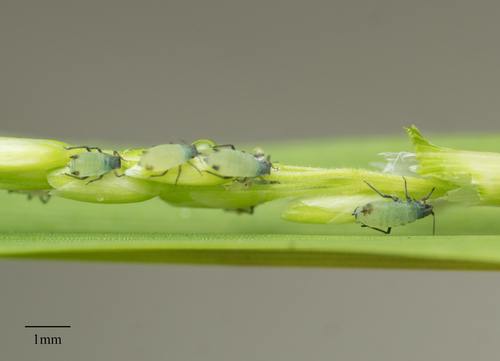
 Rhopalosiphum maidise1pest
- Outcome
- duration of different growth stagese1
- Direction
- reducede1
 Zea mays
Not reportedComparator
Organisms pictured · Representative pictures of the matched species, not figures from the paper.

Verbatim
t0“maize, Zea mays (Linn.)”
e1“The duration of different growth stages of R.maidis were reduced with an increase of temperature from 20°C to 35°C under both ambient and elevated CO2 conditions”
Claim · model-written summary
The mean lower temperature threshold for R. maidis nymphs was slightly higher at ambient CO2 (16.38°C) than at elevated CO2 (10.90°C).
- Treatment
- aCO2e3
- Outcome
- mean lower temperature threshold for nymphe3
- Direction
- slightly highere3
- Value
- 16.38°Ce3
- Comparator
- eCO2e3
Organisms pictured · Representative pictures of the matched species, not figures from the paper.
Verbatim
t0“maize, Zea mays (Linn.)”
e3“The mean lower temperature threshold for nymph was slightly higher (16.38°C) at aCO2 compared to that of eCO2 (10.90°C)”
Claim · model-written summary
The mean lower temperature threshold for R. maidis adults was slightly higher at elevated CO2 (23.22°C) than at ambient CO2 (22.88°C).
- Treatment
- eCO2e4
- Outcome
- mean lower temperature thresholde4
- Direction
- slightly highere4
- Value
- 23.22°Ce4
- Comparator
- aCO2e4
Organisms pictured · Representative pictures of the matched species, not figures from the paper.
Verbatim
t0“maize, Zea mays (Linn.)”
e4“for adult the mean lower temperature threshold was slightly higher (23.22°C) at eCO2 compared to that of aCO2 (22.88°C)”
Claim · model-written summary
The total thermal requirement of R. maidis was lower under elevated CO2 (100.00 degree days) than under ambient CO2 (111.11 degree days).
- Treatment
- eCO2 conditionse5
- Interactor
- R. maidisRhopalosiphum maidise5pest
- Outcome
- thermal requiremente5
- Direction
- lowerinferrede5
- Value
- 100.00 degree days (DD)e5
- Comparator
- aCO2 conditionse5
Organisms pictured · Representative pictures of the matched species, not figures from the paper.
Verbatim
t0“maize, Zea mays (Linn.)”
e5“The thermal requirement of R. maidis from first nymphal instar to adult (total development period) was found to be 100.00 degree days (DD) under eCO2 conditions as against 111.11degree days under aCO2 conditions”
Claim · model-written summary
The estimated temperature thresholds and thermal constant can predict pest scenarios and population dynamics of R. maidis (author interpretation).
- Taxon
- R. maidisRhopalosiphum maidise6
- Outcome
- pest scenarios and population dynamicse6
Not reportedComparator
Organisms pictured · Representative pictures of the matched species, not figures from the paper.
Verbatim
e6“These estimated temperature thresholds and thermal constant can predict the pest scenarios and population dynamics of R. maidis”