Abstract
Barley (Hordeum vulgare L.) is an important crop belonging to gramineae family and has been serving as the major portion of diet of humans and feed for animals.Among fungal diseases of barley, Bipolaris sorokiniana(Sacc.) Shoemaker (syn. Helminthosporium sativum, teleomorph: Cochliobolus sativus) is an economically very important fungal pathogen causing spot blotch disease. The fungus causes germination failure, seed mortality and spot blotch development in both wheat and barley. In the present study, field trials using barley cultivars PL426 and DWRUB52 were conducted to study the effect of chemical compounds i.e. salicylic acid (0.01, 0.02 & 0.03%) and calcium chloride (0.1, 0.2 & 0.3%) in induction of resistance against foliar blight of barley. The results revealed that in cultivar PL 426, maximum disease control (45.24%), maximum per cent increase in yield (60.00%)and protein content (15.00%) were recorded when the plants were sprayed with salicylic acid @ 0.03% followed by calcium chloride @ 0.3%. Similarly, in cultivar DWRUB 52, maximum disease control (48.29%), maximum increase in yield (15.60 q/ac) were recorded when the plants were sprayed with salicylic acid @ 0.03% followed by calcium chloride @ 0.3% while the per cent increase in protein content was observed to be similar in both these treatments in cultivar DWRUB 52. In present investigations, the chemical compounds (salicylic acid and calcium chloride) could induce resistance against spot blotch as reflected by disease control, increase in yield, increase in protein content and increase in phenolic content. Salicylic acid @ 0.03% was most effective in inducing resistance. However, calcium chloride proved more effective in increasing phenolic content in both the cultivars.
Abstract from the paper’s OpenAlex record; open copy licensed cc-by. Read at the source ↗
The text the model read, with the source record’s inline markup (italics, sub- and superscripts) rendered and its character entities decoded; quote offsets refer to the raw text.
Claims 9
Claim · model-written summary
Salicylic acid at 0.03% achieved maximum disease control of 45.24% in PL 426.
- Taxon
- barley
 Hordeum vulgaret0
- Material
- PL 426e0
- Treatment
- salicylic acid @ 0.03%e0
- Interactor
- Bipolaris sorokiniana
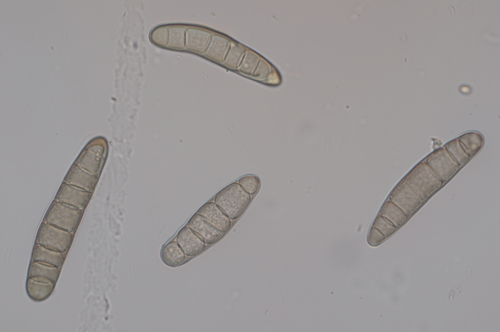
 Bipolaris sorokinianae1pathogen
- Outcome
- disease controle0
- Direction
- maximume0
- Value
- 45.24%e0
Not reportedComparator
Organisms pictured · Representative pictures of the matched species, not figures from the paper.

Verbatim
e0“in cultivar PL 426, maximum disease control (45.24%), maximum per cent increase in yield (60.00%)and protein content (15.00%) were recorded when the plants were sprayed with salicylic acid @ 0.03% followed by calcium chloride @ 0.3%”
e1“Bipolaris sorokiniana(Sacc.) Shoemaker”
t0“barley”
Claim · model-written summary
Salicylic acid at 0.03% yielded a maximum 60.00% yield increase in PL 426.
- Taxon
- barleyHordeum vulgaret0
- Material
- PL 426e0
- Treatment
- salicylic acid @ 0.03%e0
- Interactor
- Bipolaris sorokinianaBipolaris sorokinianae1pathogen
- Outcome
- per cent increase in yielde0
- Direction
- increasee0
- Value
- 60.00%e0
Not reportedComparator
Organisms pictured · Representative pictures of the matched species, not figures from the paper.
Verbatim
e0“in cultivar PL 426, maximum disease control (45.24%), maximum per cent increase in yield (60.00%)and protein content (15.00%) were recorded when the plants were sprayed with salicylic acid @ 0.03% followed by calcium chloride @ 0.3%”
e1“Bipolaris sorokiniana(Sacc.) Shoemaker”
t0“barley”
Claim · model-written summary
Salicylic acid at 0.03% gave 15.00% protein content in PL 426.
- Taxon
- barleyHordeum vulgaret0
- Material
- PL 426e0
- Treatment
- salicylic acid @ 0.03%e0
- Outcome
- protein contente0
- Direction
- maximume0
- Value
- 15.00%e0
Not reportedComparator
Organisms pictured · Representative pictures of the matched species, not figures from the paper.
Verbatim
e0“in cultivar PL 426, maximum disease control (45.24%), maximum per cent increase in yield (60.00%)and protein content (15.00%) were recorded when the plants were sprayed with salicylic acid @ 0.03% followed by calcium chloride @ 0.3%”
t0“barley”
Claim · model-written summary
Salicylic acid at 0.03% achieved maximum disease control of 48.29% in DWRUB 52.
- Taxon
- barleyHordeum vulgaret0
- Material
- DWRUB 52e0
- Treatment
- salicylic acid @ 0.03%e0
- Interactor
- Bipolaris sorokinianaBipolaris sorokinianae1pathogen
- Outcome
- disease controle0
- Direction
- maximume0
- Value
- 48.29%e0
Not reportedComparator
Organisms pictured · Representative pictures of the matched species, not figures from the paper.
Verbatim
e0“in cultivar DWRUB 52, maximum disease control (48.29%), maximum increase in yield (15.60 q/ac) were recorded when the plants were sprayed with salicylic acid @ 0.03% followed by calcium chloride @ 0.3%”
e1“Bipolaris sorokiniana(Sacc.) Shoemaker”
t0“barley”
Claim · model-written summary
Salicylic acid at 0.03% gave a maximum yield increase of 15.60 q/ac in DWRUB 52.
- Taxon
- barleyHordeum vulgaret0
- Material
- DWRUB 52e0
- Treatment
- salicylic acid @ 0.03%e0
- Outcome
- increase in yielde0
- Direction
- increasee0
- Value
- 15.60 q/ace0
Not reportedComparator
Organisms pictured · Representative pictures of the matched species, not figures from the paper.
Verbatim
e0“in cultivar DWRUB 52, maximum disease control (48.29%), maximum increase in yield (15.60 q/ac) were recorded when the plants were sprayed with salicylic acid @ 0.03% followed by calcium chloride @ 0.3%”
t0“barley”
Claim · model-written summary
Protein content increases in DWRUB 52 were similar under both treatments.
- Taxon
- barleyHordeum vulgaret0
- Material
- DWRUB 52e0
- Outcome
- per cent increase in protein contente0
- Direction
- similare0
Organisms pictured · Representative pictures of the matched species, not figures from the paper.
Verbatim
e0“the per cent increase in protein content was observed to be similar in both these treatments in cultivar DWRUB 52”
t0“barley”
Claim · model-written summary
The chemical treatments increased phenolic content.
- Taxon
- barleyHordeum vulgaret0
- Treatment
- salicylic acid and calcium chloridee1
- Outcome
- phenolic contente0
- Direction
- increasee0
Not reportedComparator
Organisms pictured · Representative pictures of the matched species, not figures from the paper.
Verbatim
e0“increase in phenolic content”
e1“salicylic acid and calcium chloride”
t0“barley”
Claim · model-written summary
Salicylic acid at 0.03% was most effective in inducing resistance.
- Taxon
- barleyHordeum vulgaret0
- Treatment
- Salicylic acid @ 0.03%e0
- Outcome
- inducing resistancee0
- Direction
- most effectivee0
Organisms pictured · Representative pictures of the matched species, not figures from the paper.
Verbatim
e0“Salicylic acid @ 0.03% was most effective in inducing resistance”
t0“barley”
Claim · model-written summary
Calcium chloride was more effective at increasing phenolic content in both cultivars.
- Taxon
- barleyHordeum vulgaret0
- Treatment
- calcium chloridee0
- Outcome
- phenolic contente0
- Direction
- increasinge0
- Qualifier
- both the cultivarse0
Not reportedComparator
Organisms pictured · Representative pictures of the matched species, not figures from the paper.
Verbatim
e0“calcium chloride proved more effective in increasing phenolic content in both the cultivars”
t0“barley”
The same questions in other papers
salicylic acid · yield · Hordeum vulgare (barley)Positive and negative results
13 papers in the same direction as this paper · 1 in the opposite direction
- negative
- positive
- positive
11 papers more in this group
See all 15 papers →salicylic acid · quality: protein · Hordeum vulgare (barley)Results agree
1 paper in the same direction as this paper
- positive
salicylic acid · quality: phytochemicals · Hordeum vulgare (barley)Results agree
1 paper in the same direction as this paper
- positive
Claims are grouped by organism, treatment and what was measured or targeted. A paper counts as positive when any of its claims in the group is positive.