Abstract
The production of winter squash used vertical trellising was popular in the greenhouse for easy to manage growth and fruiting. This study investigated the photosynthetic characteristics of six winter squash cultivars to explore the differences in crop production efficiency between cultivars by vertical trellising cultivation. Plant growth, photosynthetic characteristics and fruit quality of winter squash cultivars ‘Black lamp’, ‘Tastemaker’, ‘East elite’, ‘Julius’, ‘Sugar’ and ‘Lyric’ were surveyed. The photosynthetic rate (Pn) was measured on the 70th day after planting. We selected the three leaves above the fruit in which to compare the Pn between cultivars, and surveyed all leaves on ‘Black lamp’ and ‘East elite’ in order to make a comparison between nodes. The Pn values of ‘Black lamp’, ‘East elite’, ‘Lyric’ and ‘Tastemaker’ were significantly higher, at 14.02, 13.06, 12.33 and 12.19 μmol CO2/m2∙s, respectively. The Pn of the leaves on 5–8th nodes decreased significantly, and the Pn of the 1st–5th nodes up to the fruit also decreased. With regards to reproductive traits, the first pistillate flowers of ‘East elite’ and ‘Black lamp’ bloomed on the 30th day after planting, while the other cultivars bloomed on the 35–37th day after planting. The six cultivars were classified according to the size of the fruit on the 48th day after pollination: ‘Lyric’ and ‘Tastemaker’ were classified into the largest group, at 1203 and 1106 cm3, respectively; the second group contained ‘East elite’ and ‘Julius’, at 870 and 687 cm3; while ‘Sugar’ and ‘Black lamp’ were in the smallest group, at 353 and 217 cm3, respectively. The soluble sugar and total soluble solid (TSS) contents of ‘East elite’ were significantly elevated, their values being 630.6 g/kg and 13.3%, respectively. The starch content of ‘Lyric’ was the highest at 193.7 g/kg. "Black Light" was a fruit-number type, and the increase in fruit number could increase the yield/plant; "East elite" was a fruit-weight type, and the yield per plant was related to the weight of a single fruit. The influence of the unit leaf of “Black Lamp” on the fruit fresh weight was the lowest performance in the reproductive growth. In order to increase productivity of small fruit such as ‘Black lamp’ western pumpkin, the balance between the vegetative growth and the reproductive growth was necessary to be improved.
Abstract from the paper’s OpenAlex record; open copy licensed cc-by. Read at the source ↗
The text the model read, with the source record’s inline markup (italics, sub- and superscripts) rendered and its character entities decoded; quote offsets refer to the raw text.
Claims 20
Claim · model-written summary
Pn of Black lamp was significantly higher, at 14.02 μmol CO2/m2∙s.
- Taxon
- winter squash
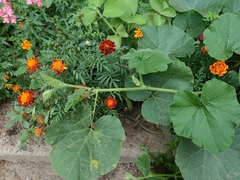 Cucurbita maximae0
- Material
- Black lampe1
- Outcome
- Pn valuese1
- Value
- 14.02e1
- Setting
- greenhousee0
Organisms pictured · Representative pictures of the matched species, not figures from the paper.

Verbatim
e0“The production of winter squash used vertical trellising was popular in the greenhouse for easy to manage growth and fruiting”
e1“The Pn values of ‘Black lamp’, ‘East elite’, ‘Lyric’ and ‘Tastemaker’ were significantly higher, at 14.02, 13.06, 12.33 and 12.19”
Claim · model-written summary
Pn of East elite was significantly higher, at 13.06 μmol CO2/m2∙s.
- Taxon
- winter squashCucurbita maximae0
- Material
- East elitee1
- Outcome
- Pn valuese1
- Value
- 13.06e1
- Setting
- greenhousee0
Organisms pictured · Representative pictures of the matched species, not figures from the paper.
Verbatim
e0“The production of winter squash used vertical trellising was popular in the greenhouse for easy to manage growth and fruiting”
e1“The Pn values of ‘Black lamp’, ‘East elite’, ‘Lyric’ and ‘Tastemaker’ were significantly higher, at 14.02, 13.06, 12.33 and 12.19”
Claim · model-written summary
Pn of Lyric was significantly higher, at 12.33 μmol CO2/m2∙s.
- Taxon
- winter squashCucurbita maximae0
- Material
- Lyrice1
- Outcome
- Pn valuese1
- Value
- 12.33e1
- Setting
- greenhousee0
Organisms pictured · Representative pictures of the matched species, not figures from the paper.
Verbatim
e0“The production of winter squash used vertical trellising was popular in the greenhouse for easy to manage growth and fruiting”
e1“The Pn values of ‘Black lamp’, ‘East elite’, ‘Lyric’ and ‘Tastemaker’ were significantly higher, at 14.02, 13.06, 12.33 and 12.19”
Claim · model-written summary
Pn of Tastemaker was significantly higher, at 12.19 μmol CO2/m2∙s.
- Taxon
- winter squashCucurbita maximae0
- Material
- Tastemakere1
- Outcome
- Pn valuese1
- Value
- 12.19e1
- Setting
- greenhousee0
Organisms pictured · Representative pictures of the matched species, not figures from the paper.
Verbatim
e0“The production of winter squash used vertical trellising was popular in the greenhouse for easy to manage growth and fruiting”
e1“The Pn values of ‘Black lamp’, ‘East elite’, ‘Lyric’ and ‘Tastemaker’ were significantly higher, at 14.02, 13.06, 12.33 and 12.19”
Claim · model-written summary
Pn decreased significantly in leaves on 5–8th nodes, and also decreased for leaves on the 1st–5th nodes up to the fruit.
- Taxon
- winter squashCucurbita maximae0
- Organ / stage
- leaves on 5–8th nodese1
- Outcome
- Pne1
- Direction
- decreasede1
- Setting
- greenhousee0
Organisms pictured · Representative pictures of the matched species, not figures from the paper.
Verbatim
e0“The production of winter squash used vertical trellising was popular in the greenhouse for easy to manage growth and fruiting”
e1“The Pn of the leaves on 5–8th nodes decreased significantly, and the Pn of the 1st–5th nodes up to the fruit also decreased”
Claim · model-written summary
The first pistillate flowers of East elite and Black lamp bloomed on the 30th day after planting.
- Taxon
- winter squashCucurbita maximae0
- Material
- East elitee1
- Organ / stage
- first pistillate flowerse1
- Outcome
- bloomede1
- Value
- 30th day after plantinge1
- Qualifier
- Black lampe1
- Setting
- greenhousee0
Organisms pictured · Representative pictures of the matched species, not figures from the paper.
Verbatim
e0“The production of winter squash used vertical trellising was popular in the greenhouse for easy to manage growth and fruiting”
e1“the first pistillate flowers of ‘East elite’ and ‘Black lamp’ bloomed on the 30th day after planting, while the other cultivars bloomed on the 35–37th day after planting”
Claim · model-written summary
The other winter squash cultivars bloomed on the 35–37th day after planting.
- Taxon
- winter squashCucurbita maximae0
- Material
- other cultivarse1
- Outcome
- bloomede1
- Value
- 35–37th day after plantinge1
- Setting
- greenhousee0
Organisms pictured · Representative pictures of the matched species, not figures from the paper.
Verbatim
e0“The production of winter squash used vertical trellising was popular in the greenhouse for easy to manage growth and fruiting”
e1“the first pistillate flowers of ‘East elite’ and ‘Black lamp’ bloomed on the 30th day after planting, while the other cultivars bloomed on the 35–37th day after planting”
Claim · model-written summary
Lyric had the largest fruit, at 1203 cm3 on the 48th day after pollination.
- Taxon
- winter squashCucurbita maximae0
- Material
- Lyrice1
- Outcome
- size of the fruite1
- Value
- 1203e1
- Qualifier
- largest groupe1
- Setting
- greenhousee0
Organisms pictured · Representative pictures of the matched species, not figures from the paper.
Verbatim
e0“The production of winter squash used vertical trellising was popular in the greenhouse for easy to manage growth and fruiting”
e1“The six cultivars were classified according to the size of the fruit on the 48th day after pollination: ‘Lyric’ and ‘Tastemaker’ were classified into the largest group, at 1203 and 1106 cm3, respectively; the second group contained ‘East elite’ and ‘Julius’, at 870 and 687 cm3; while ‘Sugar’ and ‘Black lamp’ were in the smallest group, at 353 and 217 cm3, respectively”
Claim · model-written summary
Tastemaker had a large fruit, at 1106 cm3 on the 48th day after pollination.
- Taxon
- winter squashCucurbita maximae0
- Material
- Tastemakere1
- Outcome
- size of the fruite1
- Value
- 1106e1
- Qualifier
- largest groupe1
- Setting
- greenhousee0
Organisms pictured · Representative pictures of the matched species, not figures from the paper.
Verbatim
e0“The production of winter squash used vertical trellising was popular in the greenhouse for easy to manage growth and fruiting”
e1“The six cultivars were classified according to the size of the fruit on the 48th day after pollination: ‘Lyric’ and ‘Tastemaker’ were classified into the largest group, at 1203 and 1106 cm3, respectively; the second group contained ‘East elite’ and ‘Julius’, at 870 and 687 cm3; while ‘Sugar’ and ‘Black lamp’ were in the smallest group, at 353 and 217 cm3, respectively”
Claim · model-written summary
East elite had a fruit of 870 cm3 on the 48th day after pollination, in the second group.
- Taxon
- winter squashCucurbita maximae0
- Material
- East elitee1
- Outcome
- size of the fruite1
- Value
- 870e1
- Qualifier
- second groupe1
- Setting
- greenhousee0
Organisms pictured · Representative pictures of the matched species, not figures from the paper.
Verbatim
e0“The production of winter squash used vertical trellising was popular in the greenhouse for easy to manage growth and fruiting”
e1“The six cultivars were classified according to the size of the fruit on the 48th day after pollination: ‘Lyric’ and ‘Tastemaker’ were classified into the largest group, at 1203 and 1106 cm3, respectively; the second group contained ‘East elite’ and ‘Julius’, at 870 and 687 cm3; while ‘Sugar’ and ‘Black lamp’ were in the smallest group, at 353 and 217 cm3, respectively”
Claim · model-written summary
Julius had a fruit of 687 cm3 on the 48th day after pollination, in the second group.
- Taxon
- winter squashCucurbita maximae0
- Material
- Juliuse1
- Outcome
- size of the fruite1
- Value
- 687e1
- Qualifier
- second groupe1
- Setting
- greenhousee0
Organisms pictured · Representative pictures of the matched species, not figures from the paper.
Verbatim
e0“The production of winter squash used vertical trellising was popular in the greenhouse for easy to manage growth and fruiting”
e1“The six cultivars were classified according to the size of the fruit on the 48th day after pollination: ‘Lyric’ and ‘Tastemaker’ were classified into the largest group, at 1203 and 1106 cm3, respectively; the second group contained ‘East elite’ and ‘Julius’, at 870 and 687 cm3; while ‘Sugar’ and ‘Black lamp’ were in the smallest group, at 353 and 217 cm3, respectively”
Claim · model-written summary
Sugar had a fruit of 353 cm3 on the 48th day after pollination, in the smallest group.
- Taxon
- winter squashCucurbita maximae0
- Material
- Sugare1
- Outcome
- size of the fruite1
- Value
- 353e1
- Qualifier
- smallest groupe1
- Setting
- greenhousee0
Organisms pictured · Representative pictures of the matched species, not figures from the paper.
Verbatim
e0“The production of winter squash used vertical trellising was popular in the greenhouse for easy to manage growth and fruiting”
e1“The six cultivars were classified according to the size of the fruit on the 48th day after pollination: ‘Lyric’ and ‘Tastemaker’ were classified into the largest group, at 1203 and 1106 cm3, respectively; the second group contained ‘East elite’ and ‘Julius’, at 870 and 687 cm3; while ‘Sugar’ and ‘Black lamp’ were in the smallest group, at 353 and 217 cm3, respectively”
Claim · model-written summary
Black lamp had a fruit of 217 cm3 on the 48th day after pollination, in the smallest group.
- Taxon
- winter squashCucurbita maximae0
- Material
- Black lampe1
- Outcome
- size of the fruite1
- Value
- 217e1
- Qualifier
- smallest groupe1
- Setting
- greenhousee0
Organisms pictured · Representative pictures of the matched species, not figures from the paper.
Verbatim
e0“The production of winter squash used vertical trellising was popular in the greenhouse for easy to manage growth and fruiting”
e1“The six cultivars were classified according to the size of the fruit on the 48th day after pollination: ‘Lyric’ and ‘Tastemaker’ were classified into the largest group, at 1203 and 1106 cm3, respectively; the second group contained ‘East elite’ and ‘Julius’, at 870 and 687 cm3; while ‘Sugar’ and ‘Black lamp’ were in the smallest group, at 353 and 217 cm3, respectively”
Claim · model-written summary
Soluble sugar content of East elite was significantly elevated, at 630.6 g/kg.
- Taxon
- winter squashCucurbita maximae0
- Material
- East elitee1
- Outcome
- soluble sugare1
- Value
- 630.6 g/kge1
- Setting
- greenhousee0
Organisms pictured · Representative pictures of the matched species, not figures from the paper.
Verbatim
e0“The production of winter squash used vertical trellising was popular in the greenhouse for easy to manage growth and fruiting”
e1“The soluble sugar and total soluble solid (TSS) contents of ‘East elite’ were significantly elevated, their values being 630.6 g/kg and 13.3%, respectively”
Claim · model-written summary
Total soluble solid content of East elite was significantly elevated, at 13.3%.
- Taxon
- winter squashCucurbita maximae0
- Material
- East elitee1
- Outcome
- total soluble solid (TSS) contentse1
- Value
- 13.3%e1
- Setting
- greenhousee0
Organisms pictured · Representative pictures of the matched species, not figures from the paper.
Verbatim
e0“The production of winter squash used vertical trellising was popular in the greenhouse for easy to manage growth and fruiting”
e1“The soluble sugar and total soluble solid (TSS) contents of ‘East elite’ were significantly elevated, their values being 630.6 g/kg and 13.3%, respectively”
Claim · model-written summary
Lyric had the highest starch content, at 193.7 g/kg.
- Taxon
- winter squashCucurbita maximae0
- Material
- Lyrice1
- Outcome
- starch contente1
- Value
- 193.7 g/kge1
- Setting
- greenhousee0
Organisms pictured · Representative pictures of the matched species, not figures from the paper.
Verbatim
e0“The production of winter squash used vertical trellising was popular in the greenhouse for easy to manage growth and fruiting”
e1“The starch content of ‘Lyric’ was the highest at 193.7 g/kg”
Claim · model-written summary
Black Light is a fruit-number type in which more fruit could increase yield per plant.
- Taxon
- winter squashCucurbita maximae0
- Material
- Black Lighte1
- Outcome
- yield/plante1
- Direction
- increasee1
- Setting
- greenhousee0
Organisms pictured · Representative pictures of the matched species, not figures from the paper.
Verbatim
e0“The production of winter squash used vertical trellising was popular in the greenhouse for easy to manage growth and fruiting”
e1“"Black Light" was a fruit-number type, and the increase in fruit number could increase the yield/plant”
Claim · model-written summary
East elite is a fruit-weight type, and its yield per plant was related to single fruit weight.
- Taxon
- winter squashCucurbita maximae0
- Material
- East elitee1
- Outcome
- yield per plante1
- Qualifier
- related to the weight of a single fruite1
- Setting
- greenhousee0
Not reportedDirection
Organisms pictured · Representative pictures of the matched species, not figures from the paper.
Verbatim
e0“The production of winter squash used vertical trellising was popular in the greenhouse for easy to manage growth and fruiting”
e1“"East elite" was a fruit-weight type, and the yield per plant was related to the weight of a single fruit”
Claim · model-written summary
The influence of the Black Lamp unit leaf on fruit fresh weight was the lowest in reproductive growth.
- Taxon
- winter squashCucurbita maximae0
- Material
- Black Lampe1
- Outcome
- fruit fresh weighte1
- Qualifier
- the lowest performance in the reproductive growthe1
- Setting
- greenhousee0
Organisms pictured · Representative pictures of the matched species, not figures from the paper.
Verbatim
e0“The production of winter squash used vertical trellising was popular in the greenhouse for easy to manage growth and fruiting”
e1“The influence of the unit leaf of “Black Lamp” on the fruit fresh weight was the lowest performance in the reproductive growth”
Claim · model-written summary
The authors recommend improving the balance between vegetative and reproductive growth to increase productivity of small-fruited western pumpkin.
Verbatim
e0“In order to increase productivity of small fruit such as ‘Black lamp’ western pumpkin, the balance between the vegetative growth and the reproductive growth was necessary to be improved”