Abstract
One hundred and twenty isolates of Bipolaris sorokiniana of wheat were isolated, identified and characterized based on morphological, cultural, pathogenic and ITS (Internal Transcribed Spacer) based molecular parameters. Collected isolates differed in respect of radial mycelial growth rate, color of the colony, surface texture of the colony, shape of the colony, conidia production ability and shape and color of conidia. ITS1 and ITS4 based PCR products yielded a species-specific band of 600 bp (base pairs) on agarose gel for the confirmation of B. sorokiniana. The mycelial growth rate of the isolates ranged from 1.39 to 4.46 mm/day. The septation of conidia ranged from 1.4 to 8.6. On the basis of conidia morphology, the isolates were grouped into five different groups, whereas the isolates were grouped into 12 cultural groups based on cultural characteristics. Cultural group 8 [CG (Cultural Group)-8] was the most virulent [38.5% LAD (Leaf area diseased)] and [CG (cultural Group)-4] was the less virulent [2% LAD (Leaf area diseased)] group among 12 groups when inoculated at tillering stage of wheat cv. Kachan.
Abstract from the paper’s OpenAlex record; open copy licensed cc-by. Read at the source ↗
The text the model read, with the source record’s inline markup (italics, sub- and superscripts) rendered and its character entities decoded; quote offsets refer to the raw text.
Claims 8
Claim · model-written summary
Bipolaris sorokiniana isolates varied in mycelial growth and colony and conidial traits.
- Taxon
- Bipolaris sorokiniana
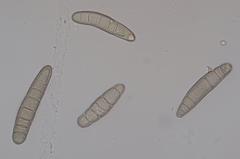 Bipolaris sorokinianae1
- Interactor
- wheat
 Triticum aestivume1host
- Outcome
- radial mycelial growth rate, color of the colony, surface texture of the colonye0
Organisms pictured · Representative pictures of the matched species, not figures from the paper.
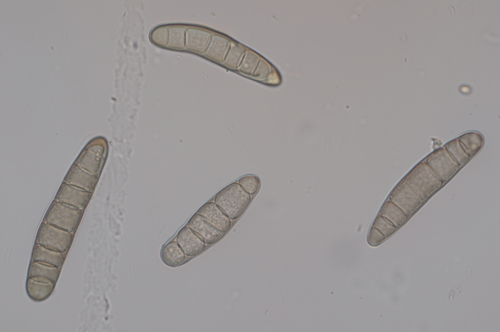

Verbatim
e0“Collected isolates differed in respect of radial mycelial growth rate, color of the colony, surface texture of the colony, shape of the colony, conidia production ability and shape and color of conidia.”
e1“One hundred and twenty isolates of Bipolaris sorokiniana of wheat were isolated”
Claim · model-written summary
ITS1/ITS4 PCR produced a 600 bp species-specific band for B. sorokiniana.
- Taxon
- B. sorokinianaBipolaris sorokinianae0
- Outcome
- species-specific bande0
- Value
- 600 bpe0
Organisms pictured · Representative pictures of the matched species, not figures from the paper.
Verbatim
e0“ITS1 and ITS4 based PCR products yielded a species-specific band of 600 bp (base pairs) on agarose gel for the confirmation of B. sorokiniana.”
Claim · model-written summary
Isolate mycelial growth rates ranged from 1.39 to 4.46 mm/day.
- Taxon
- Bipolaris sorokinianaBipolaris sorokinianae1
- Outcome
- mycelial growth ratee0
- Value
- 1.39 to 4.46 mm/daye0
Organisms pictured · Representative pictures of the matched species, not figures from the paper.
Verbatim
e0“The mycelial growth rate of the isolates ranged from 1.39 to 4.46 mm/day.”
e1“One hundred and twenty isolates of Bipolaris sorokiniana of wheat were isolated”
Claim · model-written summary
Conidial septation ranged from 1.4 to 8.6.
- Taxon
- Bipolaris sorokinianaBipolaris sorokinianae1
- Outcome
- septation of conidiae0
- Value
- 1.4 to 8.6e0
Organisms pictured · Representative pictures of the matched species, not figures from the paper.
Verbatim
e0“The septation of conidia ranged from 1.4 to 8.6.”
e1“One hundred and twenty isolates of Bipolaris sorokiniana of wheat were isolated”
Claim · model-written summary
Conidial morphology divided the isolates into five groups.
- Taxon
- Bipolaris sorokinianaBipolaris sorokinianae1
- Outcome
- five different groupse0
- Value
- fivee0
Organisms pictured · Representative pictures of the matched species, not figures from the paper.
Verbatim
e0“On the basis of conidia morphology, the isolates were grouped into five different groups”
e1“One hundred and twenty isolates of Bipolaris sorokiniana of wheat were isolated”
Claim · model-written summary
Cultural characteristics divided the isolates into 12 groups.
- Taxon
- Bipolaris sorokinianaBipolaris sorokinianae1
- Outcome
- 12 cultural groupse0
- Value
- 12e0
Organisms pictured · Representative pictures of the matched species, not figures from the paper.
Verbatim
e0“the isolates were grouped into 12 cultural groups based on cultural characteristics.”
e1“One hundred and twenty isolates of Bipolaris sorokiniana of wheat were isolated”
Claim · model-written summary
Cultural group 8 caused the greatest disease on wheat cultivar Kachan at tillering, with 38.5% leaf area diseased.
- Taxon
- wheatTriticum aestivume0
- Material
- Kachane0
- Organ / stage
- tillering stagee0
- Treatment
- Cultural group 8e0
- Outcome
- Leaf area diseasede0
- Direction
- most virulente0
- Value
- 38.5%e0
- Comparator
- CG (cultural Group)-4e0
Not reportedInteractor
Organisms pictured · Representative pictures of the matched species, not figures from the paper.
Verbatim
e0“Cultural group 8 [CG (Cultural Group)-8] was the most virulent [38.5% LAD (Leaf area diseased)] and [CG (cultural Group)-4] was the less virulent [2% LAD (Leaf area diseased)] group among 12 groups when inoculated at tillering stage of wheat cv. Kachan.”
Claim · model-written summary
Cultural group 4 caused the least disease on wheat cultivar Kachan at tillering, with 2% leaf area diseased.
- Taxon
- wheatTriticum aestivume0
- Material
- Kachane0
- Organ / stage
- tillering stagee0
- Treatment
- CG (cultural Group)-4e0
- Outcome
- Leaf area diseasede0
- Direction
- less virulente0
- Value
- 2%e0
- Comparator
- Cultural group 8e0
Organisms pictured · Representative pictures of the matched species, not figures from the paper.
Verbatim
e0“Cultural group 8 [CG (Cultural Group)-8] was the most virulent [38.5% LAD (Leaf area diseased)] and [CG (cultural Group)-4] was the less virulent [2% LAD (Leaf area diseased)] group among 12 groups when inoculated at tillering stage of wheat cv. Kachan.”