Claim · model-written summary
Bipolaris sorokiniana isolates varied in mycelial growth and colony and conidial traits.
- Taxon
- Bipolaris sorokiniana
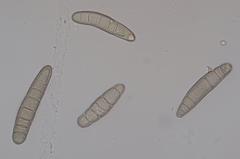 Bipolaris sorokinianae1
- Interactor
- wheat
 Triticum aestivume1host
- Outcome
- radial mycelial growth rate, color of the colony, surface texture of the colonye0
Not reportedMaterialGeneCompoundOrgan / stageSecond interactorSecond interactor roleTreatmentComparatorSettingDirectionValueQualifier
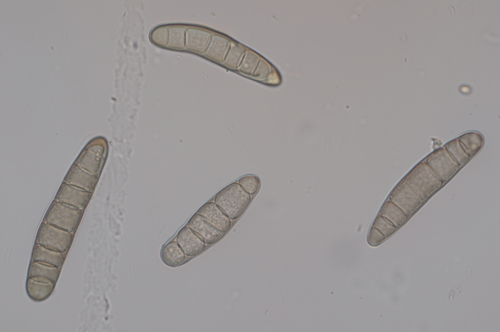
Organisms pictured · Representative pictures of the matched species, not figures from the paper.

Verbatim
e0“Collected isolates differed in respect of radial mycelial growth rate, color of the colony, surface texture of the colony, shape of the colony, conidia production ability and shape and color of conidia.”
e1“One hundred and twenty isolates of Bipolaris sorokiniana of wheat were isolated”
Title
Morphological, Cultural, Molecular and Pathogenic Variation of Bipolaris sorokiniana in Wheat
A. Sharmin; F. M. Aminuzzaman; T. H. Ansari; et al. American Journal of Molecular Biology 2022. doi:10.4236/ajmb.2022.124016
Other claims from this paper (7)
- Method / resource ITS1/ITS4 PCR produced a 600 bp species-specific band for B. sorokiniana.
- Observation Isolate mycelial growth rates ranged from 1.39 to 4.46 mm/day.
- Observation Conidial septation ranged from 1.4 to 8.6.
- Observation Conidial morphology divided the isolates into five groups.
- Observation Cultural characteristics divided the isolates into 12 groups.
- Intervention effect Cultural group 8 caused the greatest disease on wheat cultivar Kachan at tillering, with 38.5% leaf area diseased.
- Intervention effect Cultural group 4 caused the least disease on wheat cultivar Kachan at tillering, with 2% leaf area diseased.