Abstract
The article presents the results of research to clarify the species composition of the harmful entomocomplex of soybean agrocenosis in the Right Bank Forest-Steppe. It was found that the most harmful phytophagous were Etiella zinckenella Tr., Tetranychus urticae Koch. and bedbugs (Miridae). Six periods of development of soybean plants have been identified, which are associated with certain phytophagous complexes, three of which are critical when active protection measures are needed. Depending on the damage to various plant organs, soybean phytophages are conventionally divided into the following groups of pests: nodules, root system, leaves and stems and generative organs. The application of methods and effectiveness of modern chemical and biological drugs and their mixtures against the most dangerous species of arthropods are substantiated. According to the results of our research, we found that spraying soybean crops in the period of the beginning of the formation of beans against acacia fire is the most effective: Dragun, k.e. (1,2 l/ha), Decis f-Lux, 10% m.e. (0,25 l/ha) and a mixture of Dragoon, k.e. with Aktofit, k.e. (0,6 + 1,0 l/ha), the technical efficiency of which was 95,3 and 98,7% (above the standard Zolon, k.e. – 94,5%). At the same time, seed damage decreased by 4,2–5,6 times, and the preserved yield averaged 0,59–0,63 t/ha. Aktofit, k.e., was somewhat inferior in efficiency. (89,4%). When spraying soybean crops against common spider mites, the most effective were Dragun, k.e. (1,2 l/ha), Syntax (0,2 g/l) and a mixture of Syntax, g/l with Aktofit, k.e. Their technical efficiency was 95,2 and 99,7%, respectively (Zolon, k.e. – 87,9%). The saved yield was 0,55 and 0,66 t/ha.
Abstract from the paper’s OpenAlex record, shown for indexing and research. Copyright remains with the authors or the publisher. Read at the source ↗
The text the model read, with the source record’s inline markup (italics, sub- and superscripts) rendered and its character entities decoded; quote offsets refer to the raw text.
Claims 10
Claim · model-written summary
Etiella zinckenella, Tetranychus urticae and bedbugs (Miridae) were the most harmful soybean phytophagous.
- Taxon
- soybean
 Glycine maxe0
- Interactor
- Etiella zinckenella Tr.
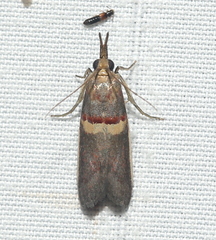 Etiella zinckenellae1pest
- Second interactor
- Tetranychus urticae Koch.
 Tetranychus urticaee1pest
- Outcome
- most harmful phytophagouse1
- Qualifier
- bedbugs (Miridae)e1
Organisms pictured · Representative pictures of the matched species, not figures from the paper.


Verbatim
e0“The article presents the results of research to clarify the species composition of the harmful entomocomplex of soybean agrocenosis in the Right Bank Forest-Steppe”
e1“It was found that the most harmful phytophagous were Etiella zinckenella Tr., Tetranychus urticae Koch. and bedbugs (Miridae)”
Claim · model-written summary
Six developmental periods of soybean plants were identified, each associated with particular phytophagous complexes.
- Taxon
- soybeanGlycine maxe0
- Outcome
- periods of developmente2
- Value
- Six periodse2
Organisms pictured · Representative pictures of the matched species, not figures from the paper.
Verbatim
e0“The article presents the results of research to clarify the species composition of the harmful entomocomplex of soybean agrocenosis in the Right Bank Forest-Steppe”
e2“Six periods of development of soybean plants have been identified, which are associated with certain phytophagous complexes, three of which are critical when active protection measures are needed”
Claim · model-written summary
Three of the soybean developmental periods are critical when active protection measures are needed.
- Taxon
- soybeanGlycine maxe0
- Outcome
- critical when active protection measures are needede2
- Value
- threee2
Organisms pictured · Representative pictures of the matched species, not figures from the paper.
Verbatim
e0“The article presents the results of research to clarify the species composition of the harmful entomocomplex of soybean agrocenosis in the Right Bank Forest-Steppe”
e2“Six periods of development of soybean plants have been identified, which are associated with certain phytophagous complexes, three of which are critical when active protection measures are needed”
Claim · model-written summary
Soybean phytophages are divided into pest groups according to the damaged plant organ.
- Taxon
- soybeanGlycine maxe0
- Organ / stage
- nodules, root system, leaves and stems and generative organse3
- Outcome
- divided into the following groups of pestse3
Organisms pictured · Representative pictures of the matched species, not figures from the paper.
Verbatim
e0“The article presents the results of research to clarify the species composition of the harmful entomocomplex of soybean agrocenosis in the Right Bank Forest-Steppe”
e3“Depending on the damage to various plant organs, soybean phytophages are conventionally divided into the following groups of pests: nodules, root system, leaves and stems and generative organs”
Claim · model-written summary
Spraying soybean at the beginning of bean formation against acacia fire with Dragun, Decis f-Lux or a Dragoon and Aktofit mixture gave 95.3% and 98.7% technical efficiency, above the standard Zolon (94.5%).
- Taxon
- soybeanGlycine maxe4
- Treatment
- Dragun, k.e. (1,2 l/ha), Decis f-Lux, 10% m.e. (0,25 l/ha) and a mixture of Dragoon, k.e. with Aktofit, k.e. (0,6 + 1,0 l/ha)e4
- Interactor
- acacia firee4pest
- Outcome
- technical efficiencye4
- Direction
- abovee4
- Value
- 95,3 and 98,7%e4
- Qualifier
- Zolon, k.e. – 94,5%e4
- Comparator
- standard Zolon, k.e.e4
Organisms pictured · Representative pictures of the matched species, not figures from the paper.
Verbatim
e4“spraying soybean crops in the period of the beginning of the formation of beans against acacia fire is the most effective: Dragun, k.e. (1,2 l/ha), Decis f-Lux, 10% m.e. (0,25 l/ha) and a mixture of Dragoon, k.e. with Aktofit, k.e. (0,6 + 1,0 l/ha), the technical efficiency of which was 95,3 and 98,7% (above the standard Zolon, k.e. – 94,5%)”
Claim · model-written summary
Aktofit was somewhat inferior in efficiency against soybean pests, at 89.4%.
- Taxon
- soybeanGlycine maxe0
- Treatment
- Aktofit, k.e.e5
- Outcome
- efficiencye5
- Direction
- somewhat inferiore5
- Value
- 89,4%e5
Not reportedComparator
Organisms pictured · Representative pictures of the matched species, not figures from the paper.
Verbatim
e0“The article presents the results of research to clarify the species composition of the harmful entomocomplex of soybean agrocenosis in the Right Bank Forest-Steppe”
e5“Aktofit, k.e., was somewhat inferior in efficiency. (89,4%)”
Claim · model-written summary
Spraying soybean at the beginning of bean formation against acacia fire decreased seed damage by 4.2 to 5.6 times.
- Taxon
- soybeanGlycine maxe0
- Treatment
- spraying soybean crops in the period of the beginning of the formation of beans against acacia firee4
- Interactor
- acacia firee4pest
- Outcome
- seed damagee6
- Direction
- decreasede6
- Value
- 4,2–5,6 timese6
Not reportedComparator
Organisms pictured · Representative pictures of the matched species, not figures from the paper.
Verbatim
e0“The article presents the results of research to clarify the species composition of the harmful entomocomplex of soybean agrocenosis in the Right Bank Forest-Steppe”
e4“spraying soybean crops in the period of the beginning of the formation of beans against acacia fire is the most effective”
e6“At the same time, seed damage decreased by 4,2–5,6 times, and the preserved yield averaged 0,59–0,63 t/ha”
Claim · model-written summary
Spraying soybean at the beginning of bean formation against acacia fire raised the preserved yield to 0.59 to 0.63 t/ha.
- Taxon
- soybeanGlycine maxe0
- Treatment
- spraying soybean crops in the period of the beginning of the formation of beans against acacia firee4
- Outcome
- preserved yielde6
- Direction
- increaseinferrede6
- Value
- 0,59–0,63 t/hae6
Not reportedComparator
Organisms pictured · Representative pictures of the matched species, not figures from the paper.
Verbatim
e0“The article presents the results of research to clarify the species composition of the harmful entomocomplex of soybean agrocenosis in the Right Bank Forest-Steppe”
e4“spraying soybean crops in the period of the beginning of the formation of beans against acacia fire is the most effective”
e6“At the same time, seed damage decreased by 4,2–5,6 times, and the preserved yield averaged 0,59–0,63 t/ha”
Claim · model-written summary
Spraying soybean against common spider mites with Dragun, Syntax or a Syntax and Aktofit mixture gave 95.2% and 99.7% technical efficiency, above Zolon (87.9%).
- Taxon
- soybeanGlycine maxe7
- Treatment
- Dragun, k.e. (1,2 l/ha), Syntax (0,2 g/l) and a mixture of Syntax, g/l with Aktofit, k.e.e7
- Interactor
- common spider mitese7pest
- Outcome
- technical efficiencye7
- Direction
- most effectivee7
- Value
- 95,2 and 99,7%e7
- Qualifier
- Zolon, k.e. – 87,9%e7
- Comparator
- Zolon, k.e.e7
Organisms pictured · Representative pictures of the matched species, not figures from the paper.
Verbatim
e7“When spraying soybean crops against common spider mites, the most effective were Dragun, k.e. (1,2 l/ha), Syntax (0,2 g/l) and a mixture of Syntax, g/l with Aktofit, k.e. Their technical efficiency was 95,2 and 99,7%, respectively (Zolon, k.e. – 87,9%)”
Claim · model-written summary
Spraying soybean against common spider mites saved 0.55 and 0.66 t/ha of yield.
- Taxon
- soybeanGlycine maxe7
- Treatment
- spraying soybean crops against common spider mitese7
- Interactor
- common spider mitese7pest
- Outcome
- saved yielde6
- Direction
- increaseinferrede6
- Value
- 0,55 and 0,66 t/hae6
Not reportedComparator
Organisms pictured · Representative pictures of the matched species, not figures from the paper.
Verbatim
e7“When spraying soybean crops against common spider mites, the most effective were Dragun, k.e. (1,2 l/ha), Syntax (0,2 g/l) and a mixture of Syntax, g/l with Aktofit, k.e. Their technical efficiency was 95,2 and 99,7%, respectively (Zolon, k.e. – 87,9%)”
e6“The saved yield was 0,55 and 0,66 t/ha”
The same questions in other papers
fire · pest · Glycine max (soybean)Positive and negative results
1 reporting no difference from an alternative
- no effect
fire · yield · Glycine max (soybean)Positive and negative results
5 papers in the same direction as this paper · 2 in the opposite direction · 1 reporting no difference from an alternative
- negative
- no effect
- no effect
5 papers more in this group
See all 9 papers →application · pest · Glycine max (soybean)Positive and negative results
24 papers in the same direction as this paper · 5 in the opposite direction
- negative
- negative
- negative
26 papers more in this group
See all 30 papers →application · yield · Glycine max (soybean)Positive and negative results
331 papers in the same direction as this paper · 66 in the opposite direction · 6 reporting no difference from an alternative
- negative
- no effect
- no effect
400 papers more in this group
See all 404 papers →Claims are grouped by organism, treatment and what was measured or targeted. A paper counts as positive when any of its claims in the group is positive.