Abstract
Indus delta with its coastal zones is the most significant coastal environment in Pakistan for mangroves and associated ecosystems. Mangrove forests are important components for maintenance of ecosystems in severe environments. The purpose of the study is to assess the mangrove species' tolerance to salinity. Aegiceras corniculatum and Ceriops tagal (C. tagal) propagules were grown in pots with sandy soil and subirrigated with 25, and 50% nitrogen-fortified saltwater for this research. The propagules were procured from the Indus delta. We raised seedlings for six months as an experiment. Aegiceras corniculatum species behaved moderately in the greenhouse, whereas Ceriops tagal's growth maximum at a salinity of 50% seawater and declined as the salinity increased. Furthermore, Ceriops tagal a non-secretor, accumulated more sodium and chloride ions while severely restricting the availability of other ions. This species might therefore be used to repair intertidal ecosystems, which frequently get freshwater. During a six-month the experimental cultivation period, and measurements were taken of the seedlings' length, weight at planting, and number of leaves. Maximum growth was observed in 50% seawater, and as the salinity increased, it became worse. Three times a week, fresh water was provided to wash away the excess salt. It has been discovered that medium and large-sized propagules function better in a greenhouse environment than small-sized ones. In order for plant seeds to successfully reproduce, the environmental conditions in which they disseminate and settle must be suitable for them. For establishment and dissemination inside the greenhouse environment, the propagules of viviparous mangrove species appear optimal.
Abstract from the paper’s OpenAlex record; open copy licensed cc-by. Read at the source ↗
The text the model read, with the source record’s inline markup (italics, sub- and superscripts) rendered and its character entities decoded; quote offsets refer to the raw text.
Claims 7
Claim · model-written summary
Aegiceras corniculatum behaved moderately in the greenhouse under saline treatment.
- Taxon
- Aegiceras corniculatum
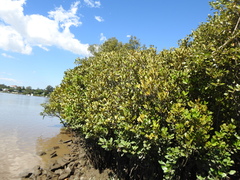 Aegiceras corniculatume1
- Outcome
- behaved moderatelye1
- Setting
- in the greenhousee1
Organisms pictured · Representative pictures of the matched species, not figures from the paper.
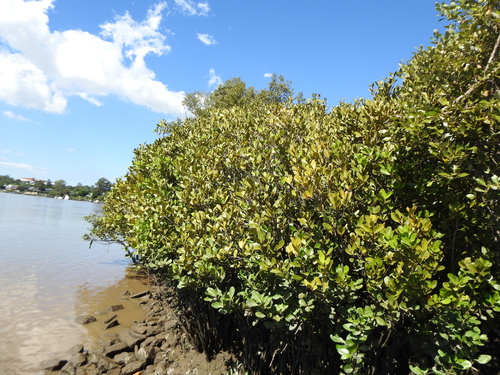
Verbatim
e1“Aegiceras corniculatum species behaved moderately in the greenhouse”
Claim · model-written summary
Ceriops tagal growth was highest at 50% seawater salinity and declined as salinity increased.
- Taxon
- Ceriops tagal
 Ceriops tagale2
- Treatment
- a salinity of 50% seawatere2
- Outcome
- growthe2
- Direction
- maximume2
- Qualifier
- declined as the salinity increasede2
Organisms pictured · Representative pictures of the matched species, not figures from the paper.

Verbatim
e2“Ceriops tagal's growth maximum at a salinity of 50% seawater and declined as the salinity increased”
Claim · model-written summary
Ceriops tagal accumulated more sodium and chloride ions.
- Taxon
- Ceriops tagalCeriops tagale3
- Outcome
- accumulated more sodium and chloride ionse3
Organisms pictured · Representative pictures of the matched species, not figures from the paper.
Verbatim
e3“Ceriops tagal a non-secretor, accumulated more sodium and chloride ions”
Claim · model-written summary
Ceriops tagal severely restricted the availability of other ions.
- Taxon
- Ceriops tagalCeriops tagale3
- Outcome
- severely restricting the availability of other ionse4
Organisms pictured · Representative pictures of the matched species, not figures from the paper.
Verbatim
e3“Ceriops tagal a non-secretor, accumulated more sodium and chloride ions”
e4“severely restricting the availability of other ions”
Claim · model-written summary
Ceriops tagal may be used to repair intertidal ecosystems (author suggestion).
- Taxon
- Ceriops tagalCeriops tagale3
- Outcome
- be used to repair intertidal ecosystemse5
Organisms pictured · Representative pictures of the matched species, not figures from the paper.
Verbatim
e3“Ceriops tagal a non-secretor, accumulated more sodium and chloride ions”
e5“This species might therefore be used to repair intertidal ecosystems”
Claim · model-written summary
Medium and large-sized propagules of viviparous mangroves function better in a greenhouse than small-sized ones.
Verbatim
e6“medium and large-sized propagules function better in a greenhouse environment than small-sized ones”
e7“For establishment and dissemination inside the greenhouse environment, the propagules of viviparous mangrove species appear optimal”
Claim · model-written summary
Propagules of viviparous mangrove species appear optimal for establishment in the greenhouse (author conclusion).
Verbatim
e7“For establishment and dissemination inside the greenhouse environment, the propagules of viviparous mangrove species appear optimal”