Abstract
Introduction The severity of flood disasters is increasing due to climate change, resulting in a significant reduction in the yield and quality of forage crops worldwide. This poses a serious threat to the development of agriculture and livestock. Hemarthria compressa is an important high-quality forage grass in southern China. In recent years, frequent flooding has caused varying degrees of impacts on H. compressa and their ecological environment. Methods In this study, we evaluated differences in flooding tolerance between the root systems of the experimental materials GY (Guang Yi, flood-tolerant) and N1291 (N201801291, flood-sensitive). We measured their morphological indexes after 7 d, 14 d, and 21 d of submergence stress and sequenced their transcriptomes at 8 h and 24 h, with 0 h as the control. Results During submergence stress, the number of adventitious roots and root length of both GY and N1291 tended to increase, but the overall growth of GY was significantly higher than that of N1291. RNA-seq analysis revealed that 6046 and 7493 DEGs were identified in GY-8h and GY-24h, respectively, and 9198 and 4236 DEGs in N1291-8h and N1291-24h, respectively, compared with the control. The GO and KEGG enrichment analysis results indicated the GO terms mainly enriched among the DEGs were oxidation-reduction process, obsolete peroxidase reaction, and other antioxidant-related terms. The KEGG pathways that were most significantly enriched were phenylpropanoid biosynthesis, plant hormone signal transduction etc. The genes of transcription factor families, such as C2H2, bHLH and bZIP, were highly expressed in the H. compressa after submergence, which might be closely related to the submergence adaptive response mechanisms of H. compressa . Discussion This study provides basic data for analyzing the molecular and morphological mechanisms of H. compressa in response to submergence stress, and also provides theoretical support for the subsequent improvement of submergence tolerance traits of H. compressa .
Abstract from the paper’s OpenAlex record; open copy licensed cc-by. Read at the source ↗
The text the model read, with the source record’s inline markup (italics, sub- and superscripts) rendered and its character entities decoded; quote offsets refer to the raw text.
Claims 10
Claim · model-written summary
Adventitious root number and root length increased under submergence in GY.
- Taxon
- Hemarthria compressa
 Hemarthria compressat0
- Material
- GYe0
- Treatment
- submergence stresse0
- Outcome
- number of adventitious roots and root lengthe0
- Direction
- increasee0
Not reportedComparator
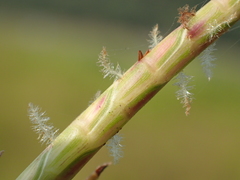
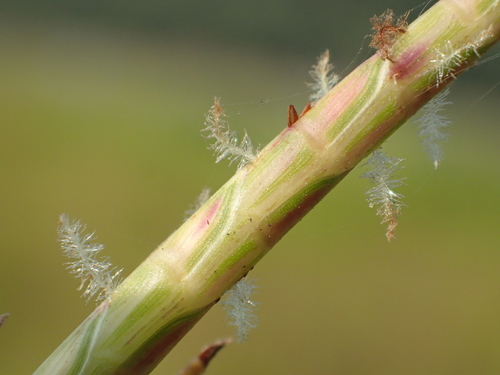
Organisms pictured · Representative pictures of the matched species, not figures from the paper.
Verbatim
e0“During submergence stress, the number of adventitious roots and root length of both GY and N1291 tended to increase”
t0“Hemarthria compressa”
Claim · model-written summary
Adventitious root number and root length increased under submergence in N1291.
- Taxon
- Hemarthria compressaHemarthria compressat0
- Material
- N1291e0
- Treatment
- submergence stresse0
- Outcome
- number of adventitious roots and root lengthe0
- Direction
- increasee0
Not reportedComparator
Organisms pictured · Representative pictures of the matched species, not figures from the paper.
Verbatim
e0“During submergence stress, the number of adventitious roots and root length of both GY and N1291 tended to increase”
t0“Hemarthria compressa”
Claim · model-written summary
Overall growth of GY was significantly higher than N1291 during submergence.
- Taxon
- Hemarthria compressaHemarthria compressat0
- Material
- GYe0
- Outcome
- overall growthe0
- Direction
- highere0
- Comparator
- N1291e0
Organisms pictured · Representative pictures of the matched species, not figures from the paper.
Verbatim
e0“the overall growth of GY was significantly higher than that of N1291.”
t0“Hemarthria compressa”
Claim · model-written summary
GY had 6046 differentially expressed genes after 8 hours of submergence versus control.
- Taxon
- Hemarthria compressaHemarthria compressat0
- Material
- GY-8he0
- Outcome
- DEGse0
- Value
- 6046e0
- Comparator
- controle0
Organisms pictured · Representative pictures of the matched species, not figures from the paper.
Verbatim
e0“6046 and 7493 DEGs were identified in GY-8h and GY-24h, respectively, and 9198 and 4236 DEGs in N1291-8h and N1291-24h, respectively, compared with the control.”
t0“Hemarthria compressa”
Claim · model-written summary
GY had 7493 differentially expressed genes after 24 hours of submergence versus control.
- Taxon
- Hemarthria compressaHemarthria compressat0
- Material
- GY-24he0
- Outcome
- DEGse0
- Value
- 7493e0
- Comparator
- controle0
Organisms pictured · Representative pictures of the matched species, not figures from the paper.
Verbatim
e0“6046 and 7493 DEGs were identified in GY-8h and GY-24h, respectively, and 9198 and 4236 DEGs in N1291-8h and N1291-24h, respectively, compared with the control.”
t0“Hemarthria compressa”
Claim · model-written summary
N1291 had 9198 differentially expressed genes after 8 hours of submergence versus control.
- Taxon
- Hemarthria compressaHemarthria compressat0
- Material
- N1291-8he0
- Outcome
- DEGse0
- Value
- 9198e0
- Comparator
- controle0
Organisms pictured · Representative pictures of the matched species, not figures from the paper.
Verbatim
e0“6046 and 7493 DEGs were identified in GY-8h and GY-24h, respectively, and 9198 and 4236 DEGs in N1291-8h and N1291-24h, respectively, compared with the control.”
t0“Hemarthria compressa”
Claim · model-written summary
N1291 had 4236 differentially expressed genes after 24 hours of submergence versus control.
- Taxon
- Hemarthria compressaHemarthria compressat0
- Material
- N1291-24he0
- Outcome
- DEGse0
- Value
- 4236e0
- Comparator
- controle0
Organisms pictured · Representative pictures of the matched species, not figures from the paper.
Verbatim
e0“6046 and 7493 DEGs were identified in GY-8h and GY-24h, respectively, and 9198 and 4236 DEGs in N1291-8h and N1291-24h, respectively, compared with the control.”
t0“Hemarthria compressa”
Claim · model-written summary
Differentially expressed genes were enriched for redox and antioxidant-related GO terms.
- Taxon
- Hemarthria compressaHemarthria compressat0
- Outcome
- GO terms mainly enriched among the DEGse0
- Qualifier
- oxidation-reduction process, obsolete peroxidase reaction, and other antioxidant-related termse0
Organisms pictured · Representative pictures of the matched species, not figures from the paper.
Verbatim
e0“the GO terms mainly enriched among the DEGs were oxidation-reduction process, obsolete peroxidase reaction, and other antioxidant-related terms.”
t0“Hemarthria compressa”
Claim · model-written summary
Phenylpropanoid biosynthesis and hormone signal transduction were the most significantly enriched KEGG pathways.
- Taxon
- Hemarthria compressaHemarthria compressat0
- Outcome
- KEGG pathwayse0
- Qualifier
- phenylpropanoid biosynthesis, plant hormone signal transductione0
Organisms pictured · Representative pictures of the matched species, not figures from the paper.
Verbatim
e0“The KEGG pathways that were most significantly enriched were phenylpropanoid biosynthesis, plant hormone signal transduction etc.”
t0“Hemarthria compressa”
Claim · model-written summary
C2H2, bHLH and bZIP transcription factor genes were highly expressed after submergence.
- Taxon
- H. compressaHemarthria compressae0
- Treatment
- submergencee0
- Gene
- C2H2, bHLH and bZIPe0
- Outcome
- genes of transcription factor familiese0
- Direction
- highly expressede0
Organisms pictured · Representative pictures of the matched species, not figures from the paper.
Verbatim
e0“The genes of transcription factor families, such as C2H2, bHLH and bZIP, were highly expressed in the H. compressa after submergence”