Abstract
This study determined the antioxidant and antibacterial activities of Thymus schimperi (Ts), Rhamnus prinoides (Rp), and Justicia schimperiana (Js) from Addis Ababa against MDR-Uropathogenic bacteria. Accordingly, Thymus schimperi had the highest total phenolic (TPC), flavonoid (TFC) and proanthocyanidin content. In Ts, the GC-MS analyses predicted 14 bioactive compounds. And among these, hexanedioic acid, bis(2-ethylhexyl) ester, thymol, and o-cymen-5-ol were the most predominant compounds, respectively. Six compounds were also predicted in Rp, where hexanedioic acid, bis(2-ethylhexyl) ester, β-D-glucopyranoside, methyl, and desulphosinigrin were the predominant, respectively. Whereas in the Js extract, five bioactive compounds were predicted, with hexanedioic acid, mono (2-ethylhexyl) ester, debrisoquine, and 8,11,14-heptadecatrienoate, methyl ester being predominant compounds, respectively. The extracts’ TPC showed a strong negative correlation with the DPPH (2,2-diphenyl-1-picrylhydrazyl) assay (r = −0.999; p = 0.023). In addition, the TFC correlated significantly with the ABTS (2,2′-azino-di-(3-ethylbenzthiazoline sulfonic acid)) assay (r = 0.999; p = 0.032). Thymus schimperi showed the highest antibacterial activity against clinical isolates of Escherichia coli and Klebsiella pneumoniae ESBL at 1000 mg/mL, and Ts had the lowest MIC (4 mg/mL) among evaluated extracts against E. coli (ATCC25922). In conclusion, Ts and Rp possess higher predicted bioactive molecules, including antioxidant and antibacterial activities, which are potentially useful in treating urinary tract infections.
Abstract from the paper’s OpenAlex record; open copy licensed cc-by. Read at the source ↗
The text the model read, with the source record’s inline markup (italics, sub- and superscripts) rendered and its character entities decoded; quote offsets refer to the raw text.
Claims 11
Claim · model-written summary
Thymus schimperi had the highest phenolic, flavonoid and proanthocyanidin content.
- Taxon
- Thymus schimperi
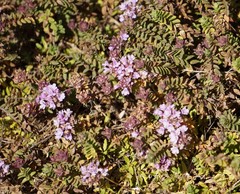 Thymus schimperie0
- Outcome
- total phenolic (TPC), flavonoid (TFC) and proanthocyanidin contente0
- Direction
- higheste0
Organisms pictured · Representative pictures of the matched species, not figures from the paper.
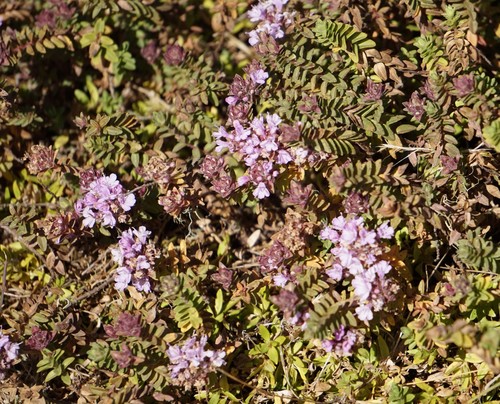
Verbatim
e0“Thymus schimperi had the highest total phenolic (TPC), flavonoid (TFC) and proanthocyanidin content”
Claim · model-written summary
GC-MS predicted 14 bioactive compounds in Thymus schimperi.
- Taxon
- Thymus schimperiThymus schimperit0
- Outcome
- bioactive compoundse0
- Value
- 14e0
Not reportedDirection
Organisms pictured · Representative pictures of the matched species, not figures from the paper.
Verbatim
e0“In Ts, the GC-MS analyses predicted 14 bioactive compounds”
t0“Thymus schimperi (Ts), Rhamnus prinoides (Rp), and Justicia schimperiana (Js) from Addis Ababa”
Claim · model-written summary
Three named compounds predominated in the Thymus schimperi extract.
- Taxon
- Thymus schimperiThymus schimperit0
- Outcome
- hexanedioic acid, bis(2-ethylhexyl) ester, thymol, and o-cymen-5-ole0
Not reportedDirection
Organisms pictured · Representative pictures of the matched species, not figures from the paper.
Verbatim
e0“hexanedioic acid, bis(2-ethylhexyl) ester, thymol, and o-cymen-5-ol were the most predominant compounds”
t0“Thymus schimperi (Ts), Rhamnus prinoides (Rp), and Justicia schimperiana (Js) from Addis Ababa”
Claim · model-written summary
Six compounds were predicted in Rhamnus prinoides.
- Taxon
- Rhamnus prinoides
 Rhamnus prinoidest0
- Outcome
- compoundse0
- Value
- Sixe0
Not reportedDirection
Organisms pictured · Representative pictures of the matched species, not figures from the paper.

Verbatim
e0“Six compounds were also predicted in Rp”
t0“Rhamnus prinoides (Rp)”
Claim · model-written summary
Three named compounds predominated in Rhamnus prinoides.
- Taxon
- Rhamnus prinoidesRhamnus prinoidest0
- Outcome
- hexanedioic acid, bis(2-ethylhexyl) ester, β-D-glucopyranoside, methyl, and desulphosinigrine0
Not reportedDirection
Organisms pictured · Representative pictures of the matched species, not figures from the paper.
Verbatim
e0“hexanedioic acid, bis(2-ethylhexyl) ester, β-D-glucopyranoside, methyl, and desulphosinigrin were the predominant”
t0“Rhamnus prinoides (Rp)”
Claim · model-written summary
Five bioactive compounds were predicted in Justicia schimperiana.
- Taxon
- Justicia schimperiana
 Justicia schimperianat0
- Outcome
- bioactive compoundse0
- Value
- fivee0
Not reportedDirection
Organisms pictured · Representative pictures of the matched species, not figures from the paper.

Verbatim
e0“in the Js extract, five bioactive compounds were predicted”
t0“Justicia schimperiana (Js)”
Claim · model-written summary
The Justicia extract had three named predominant compounds.
- Taxon
- Justicia schimperianaJusticia schimperianat0
- Outcome
- hexanedioic acid, mono (2-ethylhexyl) ester, debrisoquine, and 8,11,14-heptadecatrienoate, methyl estere0
Not reportedDirection
Organisms pictured · Representative pictures of the matched species, not figures from the paper.
Verbatim
e0“hexanedioic acid, mono (2-ethylhexyl) ester, debrisoquine, and 8,11,14-heptadecatrienoate, methyl ester being predominant compounds”
t0“Justicia schimperiana (Js)”
Claim · model-written summary
Total phenolic content correlated negatively with DPPH assay results.
- Taxon
- Thymus schimperiThymus schimperit0
- Compound
- TPCe0
- Outcome
- DPPH (2,2-diphenyl-1-picrylhydrazyl) assaye0
- Direction
- negativee0
- Value
- r = −0.999e0
Organisms pictured · Representative pictures of the matched species, not figures from the paper.
Verbatim
e0“The extracts’ TPC showed a strong negative correlation with the DPPH (2,2-diphenyl-1-picrylhydrazyl) assay (r = −0.999; p = 0.023)”
t0“Thymus schimperi (Ts), Rhamnus prinoides (Rp), and Justicia schimperiana (Js) from Addis Ababa”
Claim · model-written summary
Flavonoid content correlated positively with ABTS assay results.
- Taxon
- Thymus schimperiThymus schimperit0
- Compound
- TFCe0
- Outcome
- ABTS (2,2′-azino-di-(3-ethylbenzthiazoline sulfonic acid)) assaye0
- Value
- r = 0.999e0
Not reportedDirection
Organisms pictured · Representative pictures of the matched species, not figures from the paper.
Verbatim
e0“the TFC correlated significantly with the ABTS (2,2′-azino-di-(3-ethylbenzthiazoline sulfonic acid)) assay (r = 0.999; p = 0.032)”
t0“Thymus schimperi (Ts), Rhamnus prinoides (Rp), and Justicia schimperiana (Js) from Addis Ababa”
Claim · model-written summary
Thymus schimperi showed the highest antibacterial activity against E. coli and K. pneumoniae ESBL at 1000 mg/mL.
- Taxon
- Thymus schimperiThymus schimperie0
- Interactor
- Escherichia coli
 Escherichia colie0other
- Outcome
- antibacterial activitye0
- Direction
- higheste0
- Value
- 1000 mg/mLe0
Organisms pictured · Representative pictures of the matched species, not figures from the paper.

Verbatim
e0“Thymus schimperi showed the highest antibacterial activity against clinical isolates of Escherichia coli and Klebsiella pneumoniae ESBL at 1000 mg/mL”
Claim · model-written summary
Thymus schimperi had the lowest MIC, 4 mg/mL, against E. coli.
- Taxon
- Thymus schimperiThymus schimperit0
- Interactor
- E. coli (ATCC25922)Escherichia colie0other
- Outcome
- MICe0
- Direction
- loweste0
- Value
- 4 mg/mLe0
Organisms pictured · Representative pictures of the matched species, not figures from the paper.
Verbatim
e0“Ts had the lowest MIC (4 mg/mL) among evaluated extracts against E. coli (ATCC25922)”
t0“Thymus schimperi (Ts), Rhamnus prinoides (Rp), and Justicia schimperiana (Js) from Addis Ababa”