Abstract
The “pear degeneration” is increasingly jeopardizing the pear production in Emilia Romagna. Furthermore, starting from the 1980s, the average temperatures gradually increased, with peaks above 35°C more and more frequent with a clear reduction of rain. The summer evapotranspiration values are increasingly higher. This situation may have induced several farms to carry out irrigation surpluses also in unsuitable soils and agronomic and productive situations, with an increasing mortality of pear trees. In this context, the Apo Conerpo and Phytosanitary Service of Modena carried out a survey showing that the agronomic management of orchards plays a fundamental role in the manifestation of the pear degeneration problem, likely related to a loss of the soil structure and a consequent reduction of root functionality. It is evident that ‘Abbé Fetel’ grafted on dwarf rootstocks requires more attention because of a lack of the growth of the root system. This tends to exacerbate potential disaffinity and disaffinity problems, resistance of plants to stress, since a stunted root system is not able to support a well-structured canopy with high productivity. With regard to the phytosanitary state, the surveys on the aerial part of the plant showed a worrying situation linked to the spread of cancers produced by Valsa ceratosperma, a fungus affecting especially the central structure of the plant. Cancers that extend into the first branches and on the stems proceed by limiting the flow toward the roots, which leads to decay of the tree. A general decay of the root systems, in the absence of a dominant biotic factor, was found with the proliferation of primary or secondary different microorganisms.
Abstract from the paper’s OpenAlex record, shown for indexing and research. Copyright remains with the authors or the publisher. Read at the source ↗
The text the model read, with the source record’s inline markup (italics, sub- and superscripts) rendered and its character entities decoded; quote offsets refer to the raw text.
Claims 7
Claim · model-written summary
Pear degeneration increasingly jeopardizes production in Emilia Romagna.
- Taxon
- pear
 Pyrus communise0
- Outcome
- pear productione0
- Direction
- jeopardizinge0
- Setting
- Emilia Romagnae0
Organisms pictured · Representative pictures of the matched species, not figures from the paper.

Verbatim
e0“The “pear degeneration” is increasingly jeopardizing the pear production in Emilia Romagna.”
Claim · model-written summary
Surveys associated orchard management with manifestation of pear degeneration.
- Taxon
- PearPyrus communist0
- Treatment
- agronomic management of orchardse0
- Outcome
- manifestation of the pear degeneration probleme0
Not reportedDirection
Organisms pictured · Representative pictures of the matched species, not figures from the paper.
Verbatim
e0“the agronomic management of orchards plays a fundamental role in the manifestation of the pear degeneration problem”
t0“Pear”
Claim · model-written summary
The authors relate pear degeneration to soil structure loss and reduced root function.
- Taxon
- PearPyrus communist0
- Outcome
- reduction of root functionalitye0
- Qualifier
- loss of the soil structuree0
Organisms pictured · Representative pictures of the matched species, not figures from the paper.
Verbatim
e0“likely related to a loss of the soil structure and a consequent reduction of root functionality”
t0“Pear”
Claim · model-written summary
Abbé Fetel on dwarf rootstocks shows insufficient root growth.
- Taxon
- PearPyrus communist0
- Material
- ‘Abbé Fetel’e0
- Organ / stage
- root systeme0
- Outcome
- lack of the growth of the root systeme0
Organisms pictured · Representative pictures of the matched species, not figures from the paper.
Verbatim
e0“‘Abbé Fetel’ grafted on dwarf rootstocks requires more attention because of a lack of the growth of the root system.”
t0“Pear”
Claim · model-written summary
Valsa ceratosperma cancers spread in aerial pear tissues, especially the central structure.
- Taxon
- PearPyrus communist0
- Organ / stage
- central structure of the plante0
- Interactor
- Valsa ceratosperma
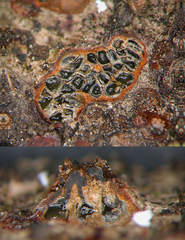 Cytospora ceratospermae0pathogen
- Outcome
- spread of cancerse0
Organisms pictured · Representative pictures of the matched species, not figures from the paper.

Verbatim
e0“the surveys on the aerial part of the plant showed a worrying situation linked to the spread of cancers produced by Valsa ceratosperma, a fungus affecting especially the central structure of the plant.”
t0“Pear”
Claim · model-written summary
Cancers extending into pear branches and stems limit flow to roots and cause tree decay.
- Taxon
- PearPyrus communist0
- Organ / stage
- first branches and on the stemse0
- Outcome
- decay of the treee0
- Qualifier
- limiting the flow toward the rootse0
Organisms pictured · Representative pictures of the matched species, not figures from the paper.
Verbatim
e0“Cancers that extend into the first branches and on the stems proceed by limiting the flow toward the roots, which leads to decay of the tree.”
t0“Pear”
Claim · model-written summary
Pear root systems showed general decay with proliferation of varied microorganisms but no dominant biotic factor.
- Taxon
- PearPyrus communist0
- Interactor
- primary or secondary different microorganismse0other
- Outcome
- general decay of the root systemse0
Organisms pictured · Representative pictures of the matched species, not figures from the paper.
Verbatim
e0“A general decay of the root systems, in the absence of a dominant biotic factor, was found with the proliferation of primary or secondary different microorganisms.”
t0“Pear”