Abstract
Abstract Cereal grains both for human consumption and animal feed are an essential component of global food systems. However, during production they are often targeted by various pest insects, including aphids. A survey was carried out from 2017 to 2021 in six cereal production sites in Tunisia to evaluate aphid diversity and identify natural enemies on Triticum turgidum subsp. durum (durum wheat), Hordeum vulgare (barley), Avena sativa (oat) and Triticum secale (triticale). Six aphid species belonging to four genera were recorded: Diuraphis noxia , Rhopalosiphum maidis , R. padi , Schizaphis graminum , Sitobion avenae and Sitobion fragariae . Among these, S. avenae and R. padi emerged as the most prevalent species across the majority of sites, infesting durum wheat, barley and triticale. Sc. graminum , R. maidis and D. noxia were less frequent, while S. fragariae was exclusively found on oat plants. Common aphid predators observed included Coccinella algerica , Hippodamia variegata and C. undecimpunctata , as well as syrphid flies such as Episyrphus balteatus and Sphaerophoria rueppellii . Lysiphlebus testaceipes was the sole parasitoid species detected, emerging exclusively from R. padi and R. maidis mummies. Furthermore, the study on the efficacy of L. testaceipes against R. maidis indicated that parasitism levels increased with the number of introduced parasitoid pairs. Aphid and natural enemy diversity were also evaluated.
Abstract from the paper’s OpenAlex record; open copy licensed cc-by-nc-nd. Read at the source ↗
The text the model read, with the source record’s inline markup (italics, sub- and superscripts) rendered and its character entities decoded; quote offsets refer to the raw text.
Claims 15
Claim · model-written summary
Six aphid species in four genera were recorded on cereal crops.
- Taxon
- cerealt0
- Interactor
- Diuraphis noxia
 Diuraphis noxiae0pest
- Outcome
- Six aphid speciese0
- Value
- Six aphid speciese0
Organisms pictured · Representative pictures of the matched species, not figures from the paper.

Verbatim
e0“Six aphid species belonging to four genera were recorded: Diuraphis noxia , Rhopalosiphum maidis , R. padi , Schizaphis graminum , Sitobion avenae and Sitobion fragariae .”
t0“Cereal aphid species”
Claim · model-written summary
Sitobion avenae was among the most prevalent aphids across sites, infesting durum wheat, barley and triticale.
- Taxon
- durum wheat
 Triticum turgidum subsp. durume0
- Interactor
- S. avenae
 Sitobion avenaee0pest
- Outcome
- most prevalent speciese0
- Direction
- most prevalente0
Organisms pictured · Representative pictures of the matched species, not figures from the paper.


Verbatim
e0“S. avenae and R. padi emerged as the most prevalent species across the majority of sites, infesting durum wheat, barley and triticale.”
Claim · model-written summary
R. padi was among the most prevalent aphids across sites, infesting durum wheat, barley and triticale.
- Taxon
- barley
 Hordeum vulgaree0
- Interactor
- R. padi
 Rhopalosiphum padie0pest
- Outcome
- most prevalent speciese0
- Direction
- most prevalente0
Organisms pictured · Representative pictures of the matched species, not figures from the paper.


Verbatim
e0“S. avenae and R. padi emerged as the most prevalent species across the majority of sites, infesting durum wheat, barley and triticale.”
Claim · model-written summary
Schizaphis graminum was less frequent.
Verbatim
e0“Sc. graminum , R. maidis and D. noxia were less frequent”
t0“Cereal aphid species”
Claim · model-written summary
R. maidis was less frequent.
- Taxon
- cerealt0
- Interactor
- R. maidis
 Rhopalosiphum maidise0pest
- Outcome
- R. maidise0
- Direction
- less frequente0
Organisms pictured · Representative pictures of the matched species, not figures from the paper.
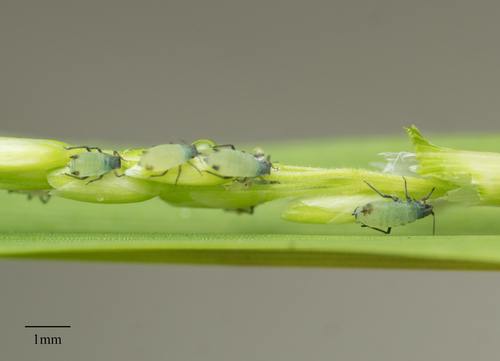
Verbatim
e0“Sc. graminum , R. maidis and D. noxia were less frequent”
t0“Cereal aphid species”
Claim · model-written summary
D. noxia was less frequent.
- Taxon
- cerealt0
- Interactor
- D. noxiaDiuraphis noxiae0pest
- Outcome
- D. noxiae0
- Direction
- less frequente0
Organisms pictured · Representative pictures of the matched species, not figures from the paper.
Verbatim
e0“Sc. graminum , R. maidis and D. noxia were less frequent”
t0“Cereal aphid species”
Claim · model-written summary
S. fragariae was found only on oat plants.
- Taxon
- oat
 Avena sativae0
- Interactor
- S. fragariae
 Sitobion fragariaee0pest
- Outcome
- exclusively found on oat plantse0
Organisms pictured · Representative pictures of the matched species, not figures from the paper.


Verbatim
e0“S. fragariae was exclusively found on oat plants.”
Claim · model-written summary
Coccinella algerica was observed as a common aphid predator.
Verbatim
e0“Common aphid predators observed included Coccinella algerica , Hippodamia variegata and C. undecimpunctata”
t0“Cereal aphid species”
Claim · model-written summary
Hippodamia variegata was observed as a common aphid predator.
- Taxon
- cerealt0
- Interactor
- Hippodamia variegata
 Hippodamia variegatae0biocontrol_agent
- Outcome
- Common aphid predators observede0
Organisms pictured · Representative pictures of the matched species, not figures from the paper.

Verbatim
e0“Common aphid predators observed included Coccinella algerica , Hippodamia variegata and C. undecimpunctata”
t0“Cereal aphid species”
Claim · model-written summary
C. undecimpunctata was observed as a common aphid predator.
- Taxon
- cerealt0
- Interactor
- C. undecimpunctata
Coccinella undecimpunctatae0biocontrol_agent
- Outcome
- Common aphid predators observede0
Organisms pictured · Representative pictures of the matched species, not figures from the paper.
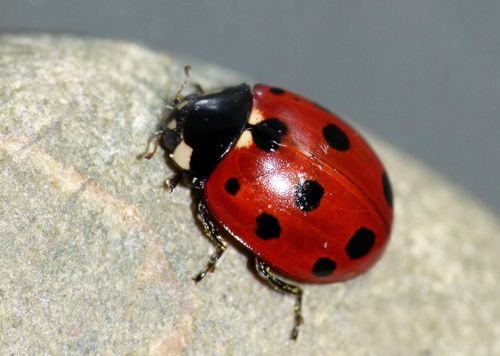
Verbatim
e0“Common aphid predators observed included Coccinella algerica , Hippodamia variegata and C. undecimpunctata”
t0“Cereal aphid species”
Claim · model-written summary
Episyrphus balteatus was observed as a common syrphid aphid predator.
- Taxon
- cerealt0
- Interactor
- Episyrphus balteatus
 Episyrphus balteatuse0biocontrol_agent
- Outcome
- syrphid fliese0
Organisms pictured · Representative pictures of the matched species, not figures from the paper.

Verbatim
e0“as well as syrphid flies such as Episyrphus balteatus and Sphaerophoria rueppellii”
t0“Cereal aphid species”
Claim · model-written summary
Sphaerophoria rueppellii was observed as a common syrphid aphid predator.
- Taxon
- cerealt0
- Interactor
- Sphaerophoria rueppellii
 Sphaerophoria rueppelliie0biocontrol_agent
- Outcome
- syrphid fliese0
Organisms pictured · Representative pictures of the matched species, not figures from the paper.

Verbatim
e0“as well as syrphid flies such as Episyrphus balteatus and Sphaerophoria rueppellii”
t0“Cereal aphid species”
Claim · model-written summary
Lysiphlebus testaceipes was the only parasitoid found from R. padi mummies.
- Taxon
- cerealt0
- Interactor
- R. padiRhopalosiphum padie0pest
- Second interactor
- Lysiphlebus testaceipesLysiphlebus testaceipese0biocontrol_agent
- Outcome
- sole parasitoid species detectede0
Organisms pictured · Representative pictures of the matched species, not figures from the paper.
Verbatim
e0“Lysiphlebus testaceipes was the sole parasitoid species detected, emerging exclusively from R. padi and R. maidis mummies.”
t0“Cereal aphid species”
Claim · model-written summary
Lysiphlebus testaceipes was found from R. maidis mummies.
- Taxon
- cerealt0
- Interactor
- R. maidisRhopalosiphum maidise0pest
- Second interactor
- Lysiphlebus testaceipesLysiphlebus testaceipese0biocontrol_agent
- Outcome
- emerging exclusively from R. padi and R. maidis mummiese0
Organisms pictured · Representative pictures of the matched species, not figures from the paper.
Verbatim
e0“Lysiphlebus testaceipes was the sole parasitoid species detected, emerging exclusively from R. padi and R. maidis mummies.”
t0“Cereal aphid species”
Claim · model-written summary
R. maidis parasitism increased with more introduced L. testaceipes pairs.
- Taxon
- Cerealt0
- Treatment
- number of introduced parasitoid pairse0
- Interactor
- Rhopalosiphum maidisRhopalosiphum maidist0pest
- Second interactor
- Lysiphlebus testaceipesLysiphlebus testaceipest0biocontrol_agent
- Outcome
- parasitism levelse0
- Direction
- increasede0
Organisms pictured · Representative pictures of the matched species, not figures from the paper.
Verbatim
e0“parasitism levels increased with the number of introduced parasitoid pairs.”
t0“Cereal aphid species: their natural enemies and efficiency of Lysiphlebus testaceipes (Cresson, 1880) to control Rhopalosiphum maidis (Fitch, 1856)”