Abstract
Strigolactones serve as germination signals for several root-parasitic plant species within the Orobanchaceae family. Yet, their role in the life cycle of the facultatively parasitic genus Castilleja has remained elusive. Here, we demonstrate that strigolactones initiate the formation of haustorium-like structures in Castilleja . We present the genome of Castilleja foliolosa , which reveals an abundance of KAI2d paralogs that act as strigolactone receptors. Castilleja foliolosa 's KAI2d proteins include high-turnover enzymes, in particular KAI2d15, which features a substrate binding pocket with a methionine cluster at its entrance that is involved in the trade-off between substrate turnover and affinity. Our findings provide insights into strigolactone perception in Castilleja and refine our perspective on their role in facultative parasitism.
Abstract from the paper’s OpenAlex record; open copy licensed cc-by. Read at the source ↗
The text the model read, with the source record’s inline markup (italics, sub- and superscripts) rendered and its character entities decoded; quote offsets refer to the raw text.
Claims 4
Claim · model-written summary
Strigolactones initiate haustorium-like structures in Castilleja.
- Taxon
- Castilleja
 Castillejae0
- Treatment
- strigolactonese0
- Outcome
- formation of haustorium-like structurese0
Not reportedComparatorDirection
Organisms pictured · Representative pictures of the matched species, not figures from the paper.

Verbatim
e0“strigolactones initiate the formation of haustorium-like structures in Castilleja”
Claim · model-written summary
The Castilleja foliolosa genome contains abundant KAI2d paralogs acting as strigolactone receptors.
- Taxon
- Castilleja foliolosa
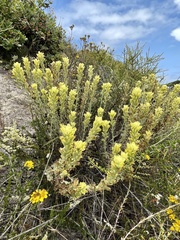 Castilleja foliolosae0
- Gene
- KAI2d paralogse0
- Outcome
- abundance of KAI2d paralogse0
Organisms pictured · Representative pictures of the matched species, not figures from the paper.

Verbatim
e0“the genome of Castilleja foliolosa , which reveals an abundance of KAI2d paralogs that act as strigolactone receptors”
Claim · model-written summary
KAI2d15 is a high-turnover enzyme.
- Taxon
- Castilleja foliolosaCastilleja foliolosae0
- Gene
- KAI2d15e0
- Outcome
- high-turnover enzymese0
Organisms pictured · Representative pictures of the matched species, not figures from the paper.
Verbatim
e0“Castilleja foliolosa 's KAI2d proteins include high-turnover enzymes, in particular KAI2d15”
Claim · model-written summary
A methionine cluster in the KAI2d15 pocket affects the turnover-affinity trade-off.
- Taxon
- CastillejaCastillejat0
- Gene
- KAI2d15e0
- Outcome
- trade-off between substrate turnover and affinitye0
- Qualifier
- methionine cluster at its entrancee0
Organisms pictured · Representative pictures of the matched species, not figures from the paper.
Verbatim
e0“KAI2d15, which features a substrate binding pocket with a methionine cluster at its entrance that is involved in the trade-off between substrate turnover and affinity”
t0“Castilleja”