Abstract
This study aims to evaluate swamp forage, for possible application as an animal feed in South Kalimantan Indonesia. The samples were obtained from the swamp areas through a survey method, by collecting sampling the grass from 2 selected regions (North Hulu Sungai and South Hulu Sungai). The observed parameters are 1). Identify the characteristics of the growth of swamp grass by the shape of leaves, roots and flowers. 2). Measurement of Nutrient Content, NDF and ADF, nutrient content of swamp forage.. The results showed that the characteristics of the South Kalimantan swamp grass had stolon and fiber roots, the leaves were mostly ribbon-shaped and compound flowers, and the highest lignin content was in Ischaemum polystachyum grass. J. Presl of 11.45%, total phenol 9.23, tannins of 3.74 and condensed tannins of 1.43. while for the highest digestibility of Hymenachne amplexicaulis (Rudges) Ness grass, namely dry matter digestibility of 31.25%, organic matter 27.42%, VFA 124.22 mM and NH3 of 3.65.mM.. The findings in this study will provide important information about forage fodder that grows in swampland in Kalimantan. It was concluded that swamp grass has a comparative advantage compared to other grasses.
Abstract from the paper’s OpenAlex record; open copy licensed cc-by-sa. Read at the source ↗
The text the model read, with the source record’s inline markup (italics, sub- and superscripts) rendered and its character entities decoded; quote offsets refer to the raw text.
Claims 9
Claim · model-written summary
South Kalimantan swamp grass had stolons, fibrous roots, ribbon shaped leaves and compound flowers.
Verbatim
e0“South Kalimantan swamp grass had stolon and fiber roots, the leaves were mostly ribbon-shaped and compound flowers”
Claim · model-written summary
Ischaemum polystachyum had the highest lignin content at 11.45%.
- Taxon
- Ischaemum polystachyum
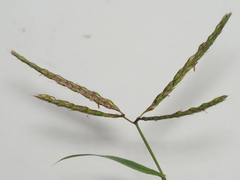 Ischaemum polystachyume0
- Outcome
- lignin contente0
- Direction
- higheste0
- Value
- 11.45%e0
Organisms pictured · Representative pictures of the matched species, not figures from the paper.

Verbatim
e0“the highest lignin content was in Ischaemum polystachyum grass. J. Presl of 11.45%”
Claim · model-written summary
Ischaemum polystachyum had total phenol of 9.23.
- Taxon
- Ischaemum polystachyumIschaemum polystachyume0
- Outcome
- total phenole0
- Value
- 9.23e0
Organisms pictured · Representative pictures of the matched species, not figures from the paper.
Verbatim
e0“Ischaemum polystachyum grass. J. Presl of 11.45%, total phenol 9.23”
Claim · model-written summary
Ischaemum polystachyum had tannins of 3.74.
- Taxon
- Ischaemum polystachyumIschaemum polystachyume0
- Outcome
- tanninse0
- Value
- 3.74e0
Organisms pictured · Representative pictures of the matched species, not figures from the paper.
Verbatim
e0“Ischaemum polystachyum grass. J. Presl of 11.45%, total phenol 9.23, tannins of 3.74”
Claim · model-written summary
Ischaemum polystachyum had condensed tannins of 1.43.
- Taxon
- Ischaemum polystachyumIschaemum polystachyume0
- Outcome
- condensed tanninse0
- Value
- 1.43e0
Organisms pictured · Representative pictures of the matched species, not figures from the paper.
Verbatim
e0“Ischaemum polystachyum grass. J. Presl of 11.45%, total phenol 9.23, tannins of 3.74 and condensed tannins of 1.43”
Claim · model-written summary
Hymenachne amplexicaulis had the highest dry matter digestibility, 31.25%.
- Taxon
- Hymenachne amplexicaulis
 Hymenachne amplexicaulise0
- Outcome
- dry matter digestibilitye0
- Direction
- higheste0
- Value
- 31.25%e0
Organisms pictured · Representative pictures of the matched species, not figures from the paper.

Verbatim
e0“the highest digestibility of Hymenachne amplexicaulis (Rudges) Ness grass, namely dry matter digestibility of 31.25%”
Claim · model-written summary
Hymenachne amplexicaulis organic matter digestibility was 27.42%.
- Taxon
- Hymenachne amplexicaulisHymenachne amplexicaulise0
- Outcome
- organic mattere0
- Value
- 27.42%e0
Organisms pictured · Representative pictures of the matched species, not figures from the paper.
Verbatim
e0“Hymenachne amplexicaulis (Rudges) Ness grass, namely dry matter digestibility of 31.25%, organic matter 27.42%”
Claim · model-written summary
Hymenachne amplexicaulis VFA was 124.22 mM.
- Taxon
- Hymenachne amplexicaulisHymenachne amplexicaulise0
- Outcome
- VFAe0
- Value
- 124.22 mMe0
Organisms pictured · Representative pictures of the matched species, not figures from the paper.
Verbatim
e0“Hymenachne amplexicaulis (Rudges) Ness grass, namely dry matter digestibility of 31.25%, organic matter 27.42%, VFA 124.22 mM”
Claim · model-written summary
Hymenachne amplexicaulis NH3 was 3.65.mM.
- Taxon
- Hymenachne amplexicaulisHymenachne amplexicaulise0
- Outcome
- NH3e0
- Value
- 3.65.mMe0
Organisms pictured · Representative pictures of the matched species, not figures from the paper.
Verbatim
e0“Hymenachne amplexicaulis (Rudges) Ness grass, namely dry matter digestibility of 31.25%, organic matter 27.42%, VFA 124.22 mM and NH3 of 3.65.mM”