Abstract
Investigated influence of synthetic phytohormone epin on the functional parameters of leaves of three species of bushes (Caragana arborescens Lam., Cerasus vulgaris Mill., Lonicera tatarica L.), which are widely used for urban greening. Plants grew at moderate and strong air pollution by emissions of the motor transport (a recreation zone) and the production enterprises (industrial zone). The rate of ion release from leaf tissues of medium-aged generative individuals was a measure of changings in the permeability of cell membranes. In plants exposed to stress factors, this indicator is used for early diagnosis of functional disorders. It was shown that treatment of fourth-order shoots of plants growing in the recreational and industrial zones of the city with a phytohormone slowed down the rate of release of electrolytes into the aqueous solution. The biggest response to epin treatment had Caragana arborescens Lam., the average reaction for Cerasus vulgaris Mill., and the minimum reaction – Lonicera tatarica L. «Epin-Extra» reduced the negative impact of air pollution with gases (sulfur oxides and nitrogen oxides). When analyzing the functional response to air pollution levels, a shift in the permeability of the leaf cell membrane towards an increase was observed. Treatment of plant shoots exposed to varying degrees of air pollution with epin weakened this effect. The overall resistance level of individual cells and tissues of woody plants as a whole increased in response to epibrassinolide exposure. Investigations allow us to recommend to use phytohormone epine to increase the resistance of shrubs to the negative factors of the urban area.
Abstract from the paper’s OpenAlex record; open copy licensed cc-by. Read at the source ↗
The text the model read, with the source record’s inline markup (italics, sub- and superscripts) rendered and its character entities decoded; quote offsets refer to the raw text.
Claims 9
Claim · model-written summary
Epin treatment slowed the rate of electrolyte release from shoots of bushes growing in recreational and industrial zones.
- Taxon
- bushese1
- Treatment
- synthetic phytohormone epine1
- Outcome
- rate of release of electrolytese2
- Direction
- slowed downe2
- Setting
- recreational and industrial zonese2
Not reportedComparator
Verbatim
e1“Investigated influence of synthetic phytohormone epin on the functional parameters of leaves of three species of bushes”
e2“treatment of fourth-order shoots of plants growing in the recreational and industrial zones of the city with a phytohormone slowed down the rate of release of electrolytes into the aqueous solution”
Claim · model-written summary
Caragana arborescens showed the biggest response to epin treatment.
- Taxon
- Caragana arborescens Lam.
 Caragana arborescense3
- Treatment
- epin treatmente3
- Outcome
- responsee3
- Direction
- biggeste3
Not reportedComparator
Organisms pictured · Representative pictures of the matched species, not figures from the paper.

Verbatim
e1“Investigated influence of synthetic phytohormone epin on the functional parameters of leaves of three species of bushes”
e3“The biggest response to epin treatment had Caragana arborescens Lam., the average reaction for Cerasus vulgaris Mill., and the minimum reaction – Lonicera tatarica L.”
Claim · model-written summary
Cerasus vulgaris showed an average response to epin treatment.
- Taxon
- Cerasus vulgaris Mill.
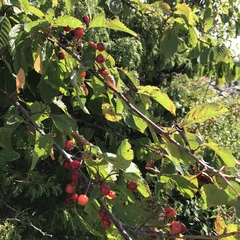 Prunus cerasuse3
- Treatment
- epin treatmente3
- Outcome
- responsee3
- Direction
- averagee3
Not reportedComparator
Organisms pictured · Representative pictures of the matched species, not figures from the paper.

Verbatim
e1“Investigated influence of synthetic phytohormone epin on the functional parameters of leaves of three species of bushes”
e3“The biggest response to epin treatment had Caragana arborescens Lam., the average reaction for Cerasus vulgaris Mill., and the minimum reaction – Lonicera tatarica L.”
Claim · model-written summary
Lonicera tatarica showed the minimum response to epin treatment.
- Taxon
- Lonicera tatarica L.
 Lonicera tataricae3
- Treatment
- epin treatmente3
- Outcome
- responsee3
- Direction
- minimume3
Not reportedComparator
Organisms pictured · Representative pictures of the matched species, not figures from the paper.

Verbatim
e1“Investigated influence of synthetic phytohormone epin on the functional parameters of leaves of three species of bushes”
e3“The biggest response to epin treatment had Caragana arborescens Lam., the average reaction for Cerasus vulgaris Mill., and the minimum reaction – Lonicera tatarica L.”
Claim · model-written summary
«Epin-Extra» reduced the negative impact of gaseous air pollution (sulfur and nitrogen oxides) on bushes.
Not reportedComparator
Verbatim
e1“Investigated influence of synthetic phytohormone epin on the functional parameters of leaves of three species of bushes”
e4“«Epin-Extra» reduced the negative impact of air pollution with gases (sulfur oxides and nitrogen oxides)”
Claim · model-written summary
Under air pollution, leaf cell membrane permeability of bushes shifted towards an increase.
Verbatim
e1“Investigated influence of synthetic phytohormone epin on the functional parameters of leaves of three species of bushes”
e5“When analyzing the functional response to air pollution levels, a shift in the permeability of the leaf cell membrane towards an increase was observed”
Claim · model-written summary
Epin treatment weakened the air-pollution-induced increase in leaf membrane permeability of bushes.
Not reportedComparator
Verbatim
e1“Investigated influence of synthetic phytohormone epin on the functional parameters of leaves of three species of bushes”
e6“Treatment of plant shoots exposed to varying degrees of air pollution with epin weakened this effect”
Claim · model-written summary
Overall resistance of woody plant cells and tissues increased in response to epibrassinolide exposure.
- Taxon
- woody plantse7
- Treatment
- epibrassinolide exposuree7
- Outcome
- overall resistance levele7
- Direction
- increasede7
Not reportedComparator
Verbatim
e7“The overall resistance level of individual cells and tissues of woody plants as a whole increased in response to epibrassinolide exposure”
Claim · model-written summary
Epin is recommended to increase the resistance of urban shrubs to negative urban factors.
Verbatim
e2“Investigations allow us to recommend to use phytohormone epine to increase the resistance of shrubs to the negative factors of the urban area”