Abstract
The genus Vochysia, particularly Vochysia divergens Pohl, has been studied for its diverse biological activities and phytochemical composition. This study investigates the phytotoxic potential of V. divergens extracts as bioherbicides, with emphasis on their effects on photosystem II (PSII) and weed growth. Methanolic and hexane extracts from leaves, flowers, and stems were prepared and evaluated in semi in vivo and in vivo assays against the weeds Senna alata and Sida rhombifolia. Chlorophyll a fluorescence analysis revealed that both methanolic and hexane stem extracts (VMS and VHS) significantly reduced PSII efficiency and performance indices. These effects were associated with inhibition of the electron transport chain, suppression of photochemical reactions, and a reduction in the number of active PSII reaction centers. In vivo assays further confirmed the phytotoxic effects, with the VMS extract at 300 ppm reducing the photosynthetic capacity of S. rhombifolia by 46% and plant growth by 87%. These results highlight the potential of V. divergens stem extracts as eco-friendly bioherbicides eco-friendly bioherbicides and support their use as sustainable alternatives to synthetic herbicides.
Abstract from the paper’s OpenAlex record; open copy licensed cc-by. Read at the source ↗
The text the model read, with the source record’s inline markup (italics, sub- and superscripts) rendered and its character entities decoded; quote offsets refer to the raw text.
Claims 4
Claim · model-written summary
Methanolic and hexane stem extracts of Vochysia divergens significantly reduced PSII efficiency and performance indices of weeds.
- Taxon
- Vochysia divergens
 Vochysia divergenst0
- Treatment
- methanolic and hexane stem extractse1
- Interactor
- weedse0weed
- Outcome
- PSII efficiency and performance indicese1
- Direction
- significantly reducede1
Not reportedComparator
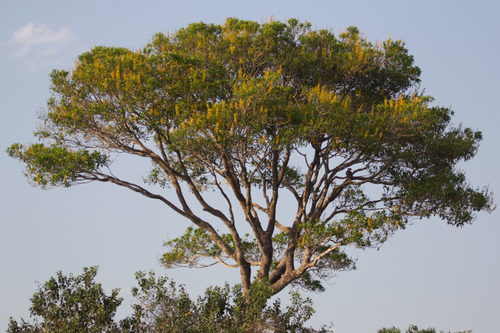
Organisms pictured · Representative pictures of the matched species, not figures from the paper.
Verbatim
t0“Vochysia divergens extracts as a post-emergence bioherbicide”
e0“against the weeds Senna alata and Sida rhombifolia”
e1“Chlorophyll a fluorescence analysis revealed that both methanolic and hexane stem extracts (VMS and VHS) significantly reduced PSII efficiency and performance indices”
Claim · model-written summary
Inhibition of the electron transport chain is associated with the reduced PSII performance caused by the extracts.
- Taxon
- Vochysia divergensVochysia divergenst0
- Treatment
- methanolic and hexane stem extractse1
- Outcome
- PSII efficiency and performance indicese1
- Qualifier
- inhibition of the electron transport chaine2
Organisms pictured · Representative pictures of the matched species, not figures from the paper.
Verbatim
t0“Vochysia divergens extracts as a post-emergence bioherbicide”
e1“Chlorophyll a fluorescence analysis revealed that both methanolic and hexane stem extracts (VMS and VHS) significantly reduced PSII efficiency and performance indices”
e2“These effects were associated with inhibition of the electron transport chain, suppression of photochemical reactions, and a reduction in the number of active PSII reaction centers”
Claim · model-written summary
The VMS extract at 300 ppm reduced the photosynthetic capacity of Sida rhombifolia by 46%.
- Taxon
- Vochysia divergensVochysia divergenst0
- Treatment
- VMS extract at 300 ppme3
- Interactor
- S. rhombifolia
 Sida rhombifoliae3weed
- Outcome
- photosynthetic capacitye3
- Direction
- reducinge3
- Value
- 46%e3
Not reportedComparator
Organisms pictured · Representative pictures of the matched species, not figures from the paper.

Verbatim
t0“Vochysia divergens extracts as a post-emergence bioherbicide”
e3“the VMS extract at 300 ppm reducing the photosynthetic capacity of S. rhombifolia by 46% and plant growth by 87%”
Claim · model-written summary
The VMS extract at 300 ppm reduced growth of Sida rhombifolia by 87%.
- Taxon
- Vochysia divergensVochysia divergenst0
- Treatment
- VMS extract at 300 ppme3
- Interactor
- S. rhombifoliaSida rhombifoliae3weed
- Outcome
- plant growthe3
- Direction
- reducinge3
- Value
- 87%e3
Not reportedComparator
Organisms pictured · Representative pictures of the matched species, not figures from the paper.
Verbatim
t0“Vochysia divergens extracts as a post-emergence bioherbicide”
e3“the VMS extract at 300 ppm reducing the photosynthetic capacity of S. rhombifolia by 46% and plant growth by 87%”