Abstract
Lavender (Lavandula angustifolia) is an economically and ornamentally important species with unexplored flowering mechanisms. Genomic analysis revealed a significant expansion of key flowering gene families in lavender, including those encoding phosphatidylethanolamine-binding protein (PEBP) family (which harbors both FLOWERING LOCUS T (FT) and TERMINAL FLOWER 1 (TFL1) genes, collectively termed LaPEBPs), bZIP transcription factor FD (LaFDs), and GENERAL REGULATOR FACTORs (LaGRFs). This expansion, particularly in TFL1-like and Group 4 GRF genes, was likely caused by polyploidization and segmental duplication events. Expression profiling demonstrated that these genes exhibit distinct tissue-specific patterns during floral development. Heterologous overexpression of LaFT8 in Arabidopsis accelerated flowering in a dose-dependent manner and upregulate the expression of key flowering promoters SUPPRESSOR OF OVEREXPRESSION OF CONSTANS 1 (AtSOC1), LEAFY (AtLFY), and APETALA1 (AtAP1) by approximately 2- to 15-fold. In contrast, flowering was delayed and AtAP1 and AtSOC1 expression was suppressed by LaTFL1-1 overexpression. However, no significant phenotypic changes were observed in Arabidopsis overexpressed LaFT4 or LaTFL1-3. Protein interaction assays confirmed the formation of a flowering activation complex between LaFT8, LaFD3 and LaGRFs (e.g., LaGRF3-3). Antagonistically, LaTFL1-1 was shown to compete by binding LaFD3 with higher affinity, thereby inhibiting LaFT8 function. This competitive inhibition mechanism provides a precise rheostat for fine-tuning floral transition signals, representing a novel regulatory layer beyond the canonical FT-FD activation paradigm. These results illustrate both conserved and species-specific characteristics of the expanded "FT-TFL1-FD/GRF" module in lavender flowering regulation. The findings not only improve the understanding of flowering mechanisms in non-model perennial plants and also provide a foundation for molecular breeding in lavender.
Abstract from the paper’s OpenAlex record; open copy licensed cc-by-nc-nd. Read at the source ↗
The text the model read, with the source record’s inline markup (italics, sub- and superscripts) rendered and its character entities decoded; quote offsets refer to the raw text.
Claims 10
Claim · model-written summary
Genomic analysis revealed an expansion of key flowering gene families in lavender.
- Taxon
- lavender
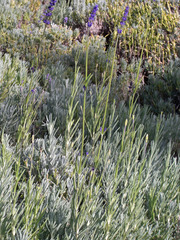 Lavandula angustifoliae0
- Outcome
- expansion of key flowering gene familiese0
Organisms pictured · Representative pictures of the matched species, not figures from the paper.
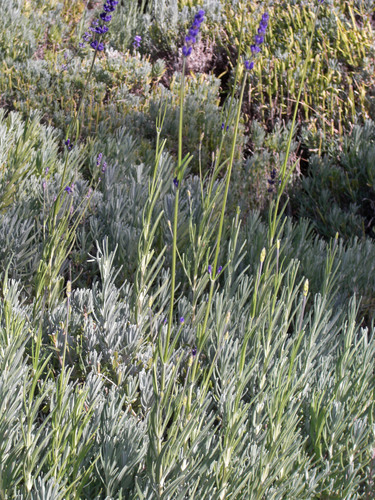
Verbatim
e0“Genomic analysis revealed a significant expansion of key flowering gene families in lavender”
Claim · model-written summary
The expansion, particularly in TFL1-like and Group 4 GRF genes, was likely caused by polyploidization and segmental duplication.
- Taxon
- Lavandula angustifoliaLavandula angustifoliat0
- Outcome
- expansione0
- Qualifier
- likely caused by polyploidization and segmental duplication eventse0
Organisms pictured · Representative pictures of the matched species, not figures from the paper.
Verbatim
e0“This expansion, particularly in TFL1-like and Group 4 GRF genes, was likely caused by polyploidization and segmental duplication events”
t0“Lavandula angustifolia”
Claim · model-written summary
The flowering gene family members showed distinct tissue-specific expression patterns during lavender floral development.
- Taxon
- Lavandula angustifoliaLavandula angustifoliat0
- Organ / stage
- floral developmente0
- Outcome
- distinct tissue-specific patternse0
Organisms pictured · Representative pictures of the matched species, not figures from the paper.
Verbatim
e0“these genes exhibit distinct tissue-specific patterns during floral development”
t0“Lavandula angustifolia”
Claim · model-written summary
Heterologous overexpression of LaFT8 in Arabidopsis accelerated flowering in a dose-dependent manner.
- Taxon
- Arabidopsis
 Arabidopsise0
- Treatment
- Heterologous overexpression of LaFT8e0
- Gene
- LaFT8e0
- Outcome
- floweringe0
- Direction
- acceleratede0
- Qualifier
- dose-dependent mannere0
Not reportedComparator
Organisms pictured · Representative pictures of the matched species, not figures from the paper.

Verbatim
e0“Heterologous overexpression of LaFT8 in Arabidopsis accelerated flowering in a dose-dependent manner”
Claim · model-written summary
LaFT8 overexpression in Arabidopsis upregulated expression of AtSOC1, AtLFY and AtAP1 by approximately 2- to 15-fold.
- Taxon
- ArabidopsisArabidopsise0
- Treatment
- Heterologous overexpression of LaFT8e0
- Gene
- LaFT8e0
- Outcome
- expression of key flowering promoterse0
- Direction
- upregulatee0
- Value
- approximately 2- to 15-folde0
- Qualifier
- SUPPRESSOR OF OVEREXPRESSION OF CONSTANS 1 (AtSOC1), LEAFY (AtLFY), and APETALA1 (AtAP1)e0
Not reportedComparator
Organisms pictured · Representative pictures of the matched species, not figures from the paper.
Verbatim
e0“Heterologous overexpression of LaFT8 in Arabidopsis accelerated flowering in a dose-dependent manner and upregulate the expression of key flowering promoters SUPPRESSOR OF OVEREXPRESSION OF CONSTANS 1 (AtSOC1), LEAFY (AtLFY), and APETALA1 (AtAP1) by approximately 2- to 15-fold”
Claim · model-written summary
LaTFL1-1 overexpression in Arabidopsis delayed flowering.
- Taxon
- ArabidopsisArabidopsise1
- Treatment
- LaTFL1-1 overexpressione0
- Gene
- LaTFL1-1e0
- Outcome
- floweringe0
- Direction
- delayede0
Not reportedComparator
Organisms pictured · Representative pictures of the matched species, not figures from the paper.
Verbatim
e0“flowering was delayed and AtAP1 and AtSOC1 expression was suppressed by LaTFL1-1 overexpression”
e1“overexpression of LaFT8 in Arabidopsis”
Claim · model-written summary
LaTFL1-1 overexpression in Arabidopsis suppressed AtAP1 and AtSOC1 expression.
- Taxon
- ArabidopsisArabidopsise1
- Treatment
- LaTFL1-1 overexpressione0
- Gene
- LaTFL1-1e0
- Outcome
- AtAP1 and AtSOC1 expressione0
- Direction
- suppressede0
Not reportedComparator
Organisms pictured · Representative pictures of the matched species, not figures from the paper.
Verbatim
e0“flowering was delayed and AtAP1 and AtSOC1 expression was suppressed by LaTFL1-1 overexpression”
e1“overexpression of LaFT8 in Arabidopsis”
Claim · model-written summary
No significant phenotypic changes were observed in Arabidopsis overexpressing LaFT4 or LaTFL1-3.
- Taxon
- ArabidopsisArabidopsise0
- Treatment
- overexpressed LaFT4 or LaTFL1-3e0
- Gene
- LaFT4 or LaTFL1-3e0
- Outcome
- phenotypic changese0
- Direction
- no significant phenotypic changese0
Not reportedComparator
Organisms pictured · Representative pictures of the matched species, not figures from the paper.
Verbatim
e0“no significant phenotypic changes were observed in Arabidopsis overexpressed LaFT4 or LaTFL1-3”
Claim · model-written summary
Protein interaction assays confirmed formation of a flowering activation complex between LaFT8, LaFD3 and LaGRFs.
- Taxon
- Lavandula angustifoliaLavandula angustifoliat0
- Gene
- LaFT8, LaFD3 and LaGRFse0
- Outcome
- flowering activation complexe0
Organisms pictured · Representative pictures of the matched species, not figures from the paper.
Verbatim
e0“Protein interaction assays confirmed the formation of a flowering activation complex between LaFT8, LaFD3 and LaGRFs”
t0“Lavandula angustifolia”
Claim · model-written summary
LaTFL1-1 competes by binding LaFD3 with higher affinity, thereby inhibiting LaFT8 function.
- Taxon
- Lavandula angustifoliaLavandula angustifoliat0
- Gene
- LaTFL1-1e0
- Outcome
- inhibiting LaFT8 functione0
Organisms pictured · Representative pictures of the matched species, not figures from the paper.
Verbatim
e0“LaTFL1-1 was shown to compete by binding LaFD3 with higher affinity, thereby inhibiting LaFT8 function”
t0“Lavandula angustifolia”